
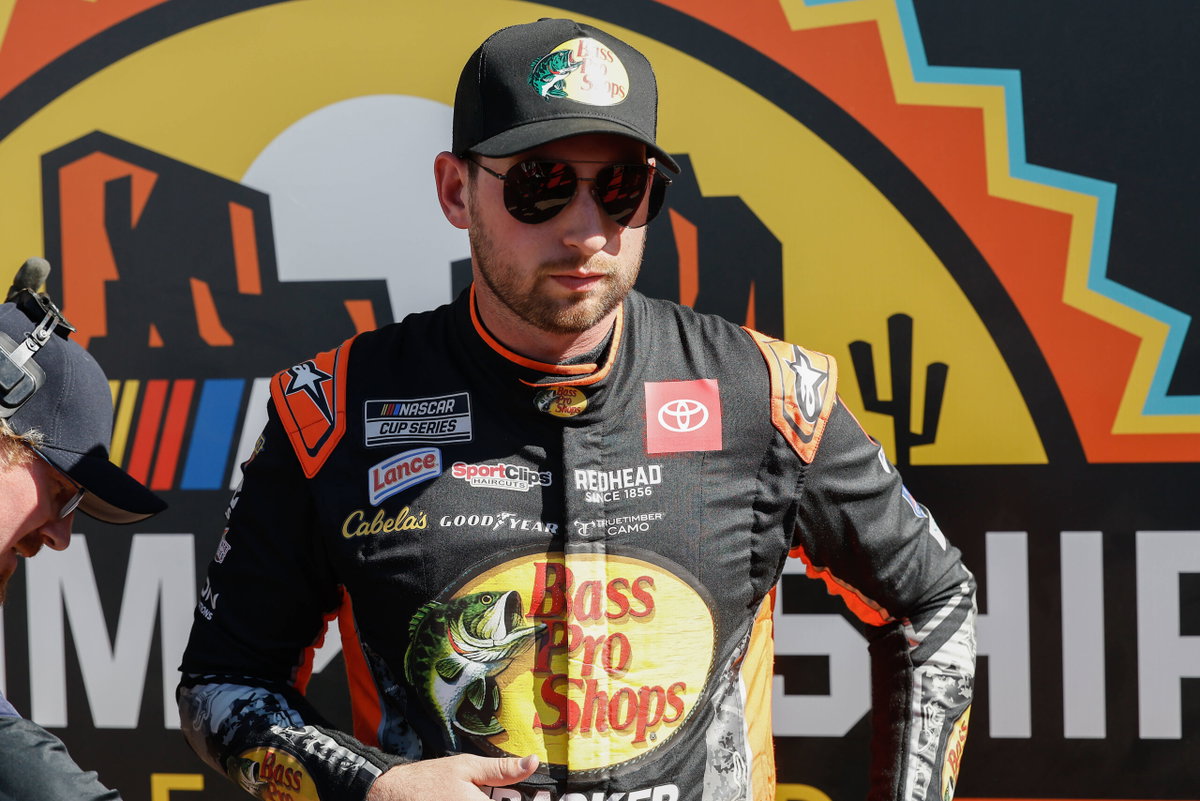
A new team, a new manufacturer and the unenviable task of filling Martin Truex Jr.’s shoes. Chase Briscoe had plenty working against him when he arrived at Joe Gibbs Racing in 2025. Making the Championship 4 in his first season was hardly the result everyone saw coming. His crew chief, however, wasn’t among those who needed convincing. James Small knew what the No. 19 team was capable of, and he has a rather pointed reminder for those who didn’t.
Watch What’s Trending Now!
“Me internally knew we were capable of doing that because we are a really good team,” Small said while reflecting on his first season working with Chase Briscoe on the Dinner with Racers podcast. “I know a lot of people didn’t think that. So, yeah, it wasn’t a surprise to me.”
Small’s confidence in the No. 19 wasn’t without precedent. Before working with Briscoe, he had spent five seasons with Martin Truex Jr., first as the team’s lead engineer and then as crew chief from 2020. The pairing went on to collect eight Cup victories, including four in 2021, when Truex finished runner-up in the championship standings.
They added three more wins in 2023, underlining the consistency of a partnership built over several years. Having been part of the No. 19’s success with Truex, Small understood what it took to keep the team competitive at the front. Briscoe’s arrival presented him with an opportunity to build on that foundation with a new driver.
Chase Briscoe joined Joe Gibbs Racing after four seasons with Stewart-Haas Racing, taking over the No. 19 Toyota following Truex’s retirement. Replacing a 34-time Cup race winner and former champion was never going to be a decision JGR took lightly. But the driver was hardly an unproven name when the opportunity came his way.
Does Sprint Car Racing Put Kyle Larson’s NASCAR Future at Unnecessary Risk?
Before joining the Cup ranks, he had won the 2016 ARCA championship, earned victories in the Truck Series and established himself as a formidable Xfinity Series contender, winning nine races in 2020 alone.
His Cup record was still developing, with just one victory to his name when JGR announced the signing, but there was enough evidence of his potential to attract the team’s attention. Christopher Bell, a longtime friend and former roommate, also backed Briscoe’s case to team owner Joe Gibbs, highlighting the driver he had watched work his way up through the sport.
Gibbs, meanwhile, said the decision came down to character and the belief that the racer could win. It was a calculated investment in a driver whose results across NASCAR’s national series suggested there was more to come.
The move offered Chase Briscoe a place in one of NASCAR’s strongest organizations, but also brought the pressure of replacing an established champion. The adjustment wasn’t immediate. Briscoe, Small and their new engineer needed time to understand one another, while the driver was also getting accustomed to Toyota’s equipment after years in a Ford.
The driver himself recognized how different the environment was from his time at SHR. Reflecting on the change in expectations, he explained: “At SHR, I feel like you really felt like you kind of surprised the world when you won. With JGR, their cars are capable week in and week out.”
But the summer changed the picture. Chase Briscoe secured his first victory with JGR at Pocono, holding off Denny Hamlin to earn a playoff berth. He followed it with a commanding Southern 500 win at Darlington, leading 309 laps, before sealing his first Championship 4 appearance with another victory at Talladega.
The breakthrough was significant, particularly given where the team had started. The No. 19 driver entered the season with two previous Cup victories and finished his first JGR campaign with three wins, 15 top-five finishes, 19 top-10s, and 884 laps led. He ultimately placed third in the championship standings after two flat tires derailed his title hopes at Phoenix.
For Small, though, the results were not an unexpected late-season surge. They were the payoff for progress he had been watching unfold for months. The crew chief pointed to the team’s performance from approximately Race 11 through the season finale as evidence of its underlying strength.
“Obviously, it’s very hard the way the format was and everything to get to there. But I think, you know, the run we had from, you know, I think race 11 through last year to the end of the season, you know, only one car scored more points than us for that whole period,” he explained.
Despite the slower start, the No. 19 had also scored almost the most points during the playoffs. That consistency, rather than one spectacular result, was what convinced Small they belonged in the championship fight. The final defeat still stung, however. When the host remarked that missing out on the title must have been difficult to live with, Small had little hesitation.
“Well, that eats at you.”
“Yeah, it does,” he replied.
The 2025 campaign gave Chase Briscoe and Small something far more valuable than a collection of race wins: familiarity. By the following season, they were no longer figuring out how to work together or trying to establish themselves within the organization. They already knew what the partnership could deliver, and the expectation was to build on it.
His second season at Joe Gibbs Racing was hardly a straightforward title pursuit. He endured a difficult start to 2026, with three finishes of 36th or worse in the opening four races, before gradually finding his rhythm. His first win of the year came at Chicagoland in July, and he carried that momentum into the Chase, where back-to-back victories at Las Vegas and Charlotte put him firmly in the championship fight. Even then, his run was far from smooth.
A crash at Bristol, an incident at Talladega and other costly setbacks disrupted his progress, but Briscoe remained in contention until the Martinsville round. He ultimately finished sixth in the standings, with three wins, 13 top-five finishes and 18 top-10s to his name. Having come within reach of the title in his first JGR season, he had once again shown he could compete at the front — even when the results did not always reflect the speed of his team.
There is another standard the No. 19 driver has to measure himself against within the JGR garage: Denny Hamlin. The veteran remains one of the organization’s leading championship contenders, and Small was quick to acknowledge his performance when the host suggested that Chase Briscoe had almost been the top Gibbs car during their debut season together.
“Denny (Hamlin),” Small interjected.
When the host agreed that Hamlin had performed better, the crew chief was equally direct.
“Denny did better.”
It was a brief exchange, but an interesting glimpse into the competitive standards at JGR. Small wasn’t interested in overstating his own team’s achievements, even after a Championship 4 campaign. For Briscoe, having an experienced teammate such as Denny Hamlin provides both a benchmark and a reminder of the consistency required to compete at the highest level.
At 31, Chase Briscoe has already built a substantial Cup career. He earned Rookie of the Year honors in 2021, claimed his first Cup victory at Phoenix in 2022 and added the Southern 500 to his résumé in 2024. Across six full-time seasons, he has accumulated eight victories, 41 top-five finishes and 67 top-10 finishes.
His arrival at Joe Gibbs Racing has taken those achievements to another level. Yet, Small’s comments suggest the biggest change wasn’t that Chase Briscoe suddenly became a championship-caliber driver. It was that the team finally had the time and understanding to show what it could do together. The doubters may have needed the results to believe. Small didn’t.