
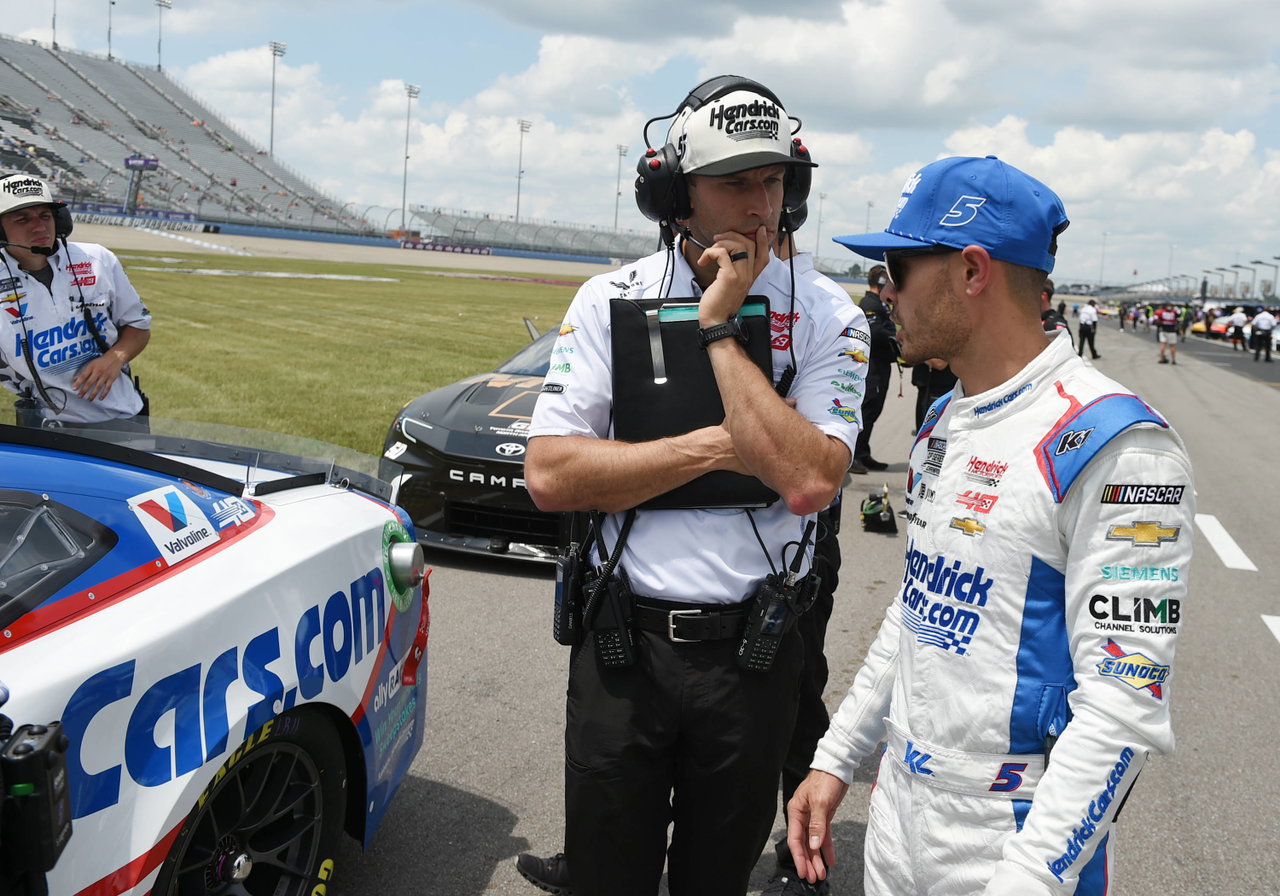
Kyle Larson was one corner away from losing the Talladega race he had spent 23 career starts trying to win. He took the white flag in front, got shoved out of line, and tumbled to 11th. Then, in the final two turns, he fought his way back through the field and beat William Byron by 0.041 seconds. It was the kind of finish that can change a championship. Just a week earlier, Larson had been the driver watching his title hopes take a hit, and his crew chief had a confession to make.
Watch What’s Trending Now!
“I walked in Monday and owned it.”
Cliff Daniels was talking to Matt Weaver about the days after Phoenix Raceway, where a setup decision had left Larson fighting an uncompetitive car before a right-front tire failure sent him into the wall. Daniels did not blame the driver or the crew. He blamed his own judgment.
“I mean, it’s on me for the setup that we had in the car. I thought there was more that could translate from our good setup at Gateway to Phoenix than reality showed for that tire and that track.”
The mistake certainly was reflected in the results.. Larson qualified 22nd, struggled to find speed, and slipped a lap down during Stage 2. He recovered his lap through a caution, but the No. 5 Chevrolet still could not make enough progress. With 31 laps remaining, the right-front tire failed entering Turn 1.
Kyle Larson could not slow the car in time and hit the wall, ending his afternoon in 34th place with three points. The damage reached well beyond one Sunday.
Larson had come to Phoenix with a 49-point Chase lead. He left with only five points over Christopher Bell. Tyler Reddick won the race, while Larson surrendered 46 points to Bell in a single afternoon. Three races remained, and the margin for another mistake had all but vanished.
Daniels had expected more from a setup that had worked at World Wide Technology Raceway, where Larson won in September. Phoenix demanded something different, and the crew chief’s confidence in that transfer proved misplaced.
He had even added a full pound of air pressure compared with the previous year’s Phoenix Championship 4 race, when Larson also suffered a tire failure. It still was not enough to give the car the margin he expected.
Daniels took the blame, but not all the progress with it. What Daniels said next was important.
He did not want the result to erase the work his crew had done throughout a difficult weekend.
“I know that might be difficult to hear or even think that I could identify with, but our team did a good job executing practice, qualifying, and the race with a car that didn’t have the right setup.”
The crew had continued making changes as Kyle Larson struggled. Daniels pointed to the speed of the pit-road adjustments, particularly the front-end work, which the team completed faster than it had at Las Vegas. Those changes could not turn the Phoenix car into a contender, but they showed the crew was responding to the problem rather than letting the race run away from it.
There is a difference between a team failing to execute and a team executing a plan that starts with the wrong decision. Daniels was clear about which one had happened. His setup choice had put Larson in a hole. The crew’s work could limit the damage, but it could not erase the underlying problem.
That distinction mattered even more under NASCAR’s 2026 Chase format. The 16 drivers carry their points through a 10-race championship battle, with no eliminations or resets. A victory brings a major points reward, but it does not guarantee a title. Kyle Larson’s Phoenix result had shown how quickly a comfortable lead could disappear.
Daniels said the team spent Monday working through the disappointment. By the time Talladega preparation took over, the mood had changed.
“Once we got through the disappointment on Monday, we probably spent more time laughing and having fun preparing for Talladega this week than we have in a long time. The spirit of the team was up. Everybody was positive.”
It was not that Phoenix had stopped mattering. The team had to move forward knowing exactly what had gone wrong, without turning one bad call into a reason to question everything else. Talladega offered little time to dwell on it. The superspeedway’s tight packs and frequent contact can ruin a race in seconds, even for a car running near the front.
Talladega gave Kyle Larson the points he needed.
The YellaWood 500 on October 25 brought its own chaos. Several Chase contenders were caught in major accidents, including Christopher Bell, Ryan Blaney, Tyler Reddick, Chase Elliott, Chase Briscoe and Joey Logano. Larson survived the wrecks, scored 16 stage points, and remained in position to benefit from the late-race shake-up.
Even then, the win nearly escaped him. Kyle Larson led at the white flag, lost his place in the pack, and fell to 11th after contact from Austin Hill. He then found a way through the final two turns, crossing the line just ahead of Byron. The victory was Larson’s first at Talladega Superspeedway, his third of 2026, and his 35th in the Cup Series. The championship picture changed with it.
Larson left Talladega 73 points ahead of Denny Hamlin, with Bell another point behind. With two races remaining, Larson could clinch the title at Martinsville Speedway if the results fall his way.
Daniels had used a familiar line to describe what his crew needed to learn from the Phoenix setback: “a smooth sea does not make for a skilled sailor.”
It is easy to say that after a win. The harder part was walking into work on Monday after Phoenix and admitting the decision was yours. Daniels did that before he knew how Talladega would turn out. Kyle Larson’s victory does not make the setup call right, but it shows the No. 5 team did not let it define the rest of its Chase. Now, instead of trying to recover a lost lead, Larson heads to Martinsville with a chance to finish the job.