
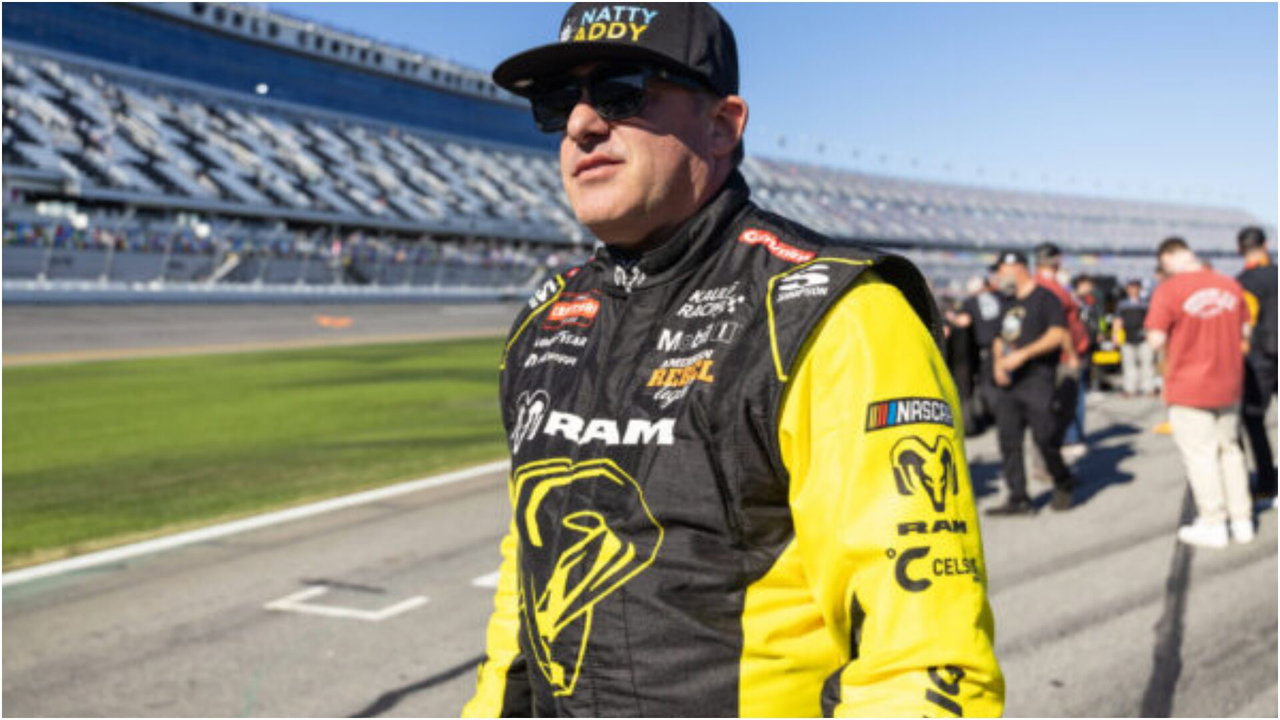
Rico Abreu has built an impressive reputation in dirt racing, collecting major victories and establishing himself as one of the most versatile drivers in the discipline. But when he looks back at his attempt to transition into NASCAR, there is one decision he wishes he could revisit: working more closely with Kyle Busch.
Watch What’s Trending Now!
The current Tony Stewart/Curb-Agajanian Racing driver recently opened up about his relationship with Kyle Busch during an appearance on Black Flag Confessions with SpeedFreaks. Abreu discussed their connection through racing and business, but his biggest admission concerned an opportunity he believes could have changed the direction of his career.
“I honestly wish I would have got the opportunity when I was doing the stock car stuff to kind of go through his development program from the late models to the trucks,” Abreu admitted. “I feel like I would be in a different position as a race car driver in NASCAR to this day if I were to figure that out, that I needed to be with an individual like Kyle.”
It was a revealing admission from someone who has already achieved considerable success outside NASCAR, as Abreu reflected on the value of having a proven driver and team owner guide his transition into stock cars, something he now believes he should have pursued more deliberately.
Abreu’s regret becomes easier to understand when considering what Kyle Busch Motorsports accomplished during its time in NASCAR. Established in 2010, KBM became one of the strongest organizations in the Truck Series, combining competitive equipment with a reputation for identifying and developing young talent.
Drivers such as Erik Jones and Christopher Bell benefited from that environment. Jones won the 2015 Truck Series championship with KBM, while Bell followed with the 2017 title. Both eventually reached the Cup Series, demonstrating how the organization could serve as an important step in a driver’s progression.
Busch’s contribution went beyond providing competitive trucks. He regularly raced in various categories himself, giving him the opportunity to evaluate young talent and understand what drivers needed to improve as they moved between disciplines.
NASCAR previously highlighted his mentoring abilities, noting how he helped guide Jones and Bell to Truck Series championships. Bell even publicly thanked Busch for the four years he spent developing at KBM after winning his 2017 title.
For Abreu, that kind of guidance could have made a significant difference during his own transition. Moving from sprint cars and midgets into heavier stock cars requires more than adapting to a different machine. Racecraft, tire management, longer distances and the demands of competing on asphalt all require a different approach.
Abreu entered NASCAR’s stock-car landscape in 2015, joining HScott Motorsports with Justin Marks for the K&N Pro Series East. Coming from a successful dirt-racing background, he quickly showed that he could adapt, earning a victory at Columbus Motor Speedway and finishing fifth in the championship standings.
His performances earned him an opportunity in the Truck Series later that year with NTS Motorsports. After two appearances, he secured a full-time ride with ThorSport Racing for 2016, driving the No. 98 Toyota.
The season offered encouraging moments, including two top-five finishes and five top-10s across 23 starts. However, Abreu never established a long-term presence in NASCAR’s national series. His Truck Series career ultimately amounted to 26 starts, with his focus eventually returning to dirt-track competition.
That makes his reflection particularly interesting. Abreu had already demonstrated considerable ability in open-wheel racing, including winning the USAC National Midget Series championship in 2014 and consecutive Chili Bowl Nationals titles in 2015 and 2016. But succeeding on dirt did not automatically guarantee a lasting NASCAR career.
Looking back, he believes the missing element may have been the right mentor and development environment at the right time. KBM had demonstrated that it could take talented young racers and help prepare them for the demands of NASCAR.
There was also a personal and business relationship between the two drivers. Abreu recalled working with Busch through different partnerships, including Rowdy Energy, the energy drink brand founded by the NASCAR champion.
In 2021, Abreu joined the Rowdy Energy athlete roster, with the brand becoming a primary partner on his No. 24 sprint car. The arrangement gave the two another connection outside their individual racing commitments.
Abreu also spoke with admiration about Busch’s versatility. He was impressed by how comfortably Kyle competed across different disciplines, moving between NASCAR’s national series, Late Models and other forms of racing while maintaining an exceptionally high standard.
That admiration extended to Kyle’s role as a father. Abreu particularly remembered how Busch encouraged his son, Brexton, to develop an interest in racing.
Following Kyle’s passing, that aspect of their relationship became even more personal for Abreu. Reflecting on what his own father had taught him throughout his career, he said he understood how important that guidance could become as a child grows older.
That prompted him to reach out to Brexton and the Busch family with an offer of support.
“I just wanted to make sure that that was returned and definitely a very special and talented individual,” Abreu said, explaining why he wanted to be there for the family whenever they needed him.
Kyle’s legacy is often measured through his 63 Cup victories, two championships and record-setting success across NASCAR’s national divisions. Yet his time as a team owner produced another lasting contribution.
KBM recorded 100 Truck Series victories before Busch sold the organization to Spire Motorsports in 2023. Its development of drivers such as Jones and Bell showed that his influence extended well beyond the results he produced himself.
For Abreu, that is the part of Kyle’s career he wishes he had experienced more closely. He does not know exactly how his NASCAR journey would have unfolded under Busch’s guidance, but he believes it could have put him in a very different position today.
And with Brexton now carrying his father’s passion forward, Abreu hopes to return some of the support and kindness Kyle once showed him. It is a fitting way to remember a relationship that, in his eyes, could have changed much more than just his racing career.