
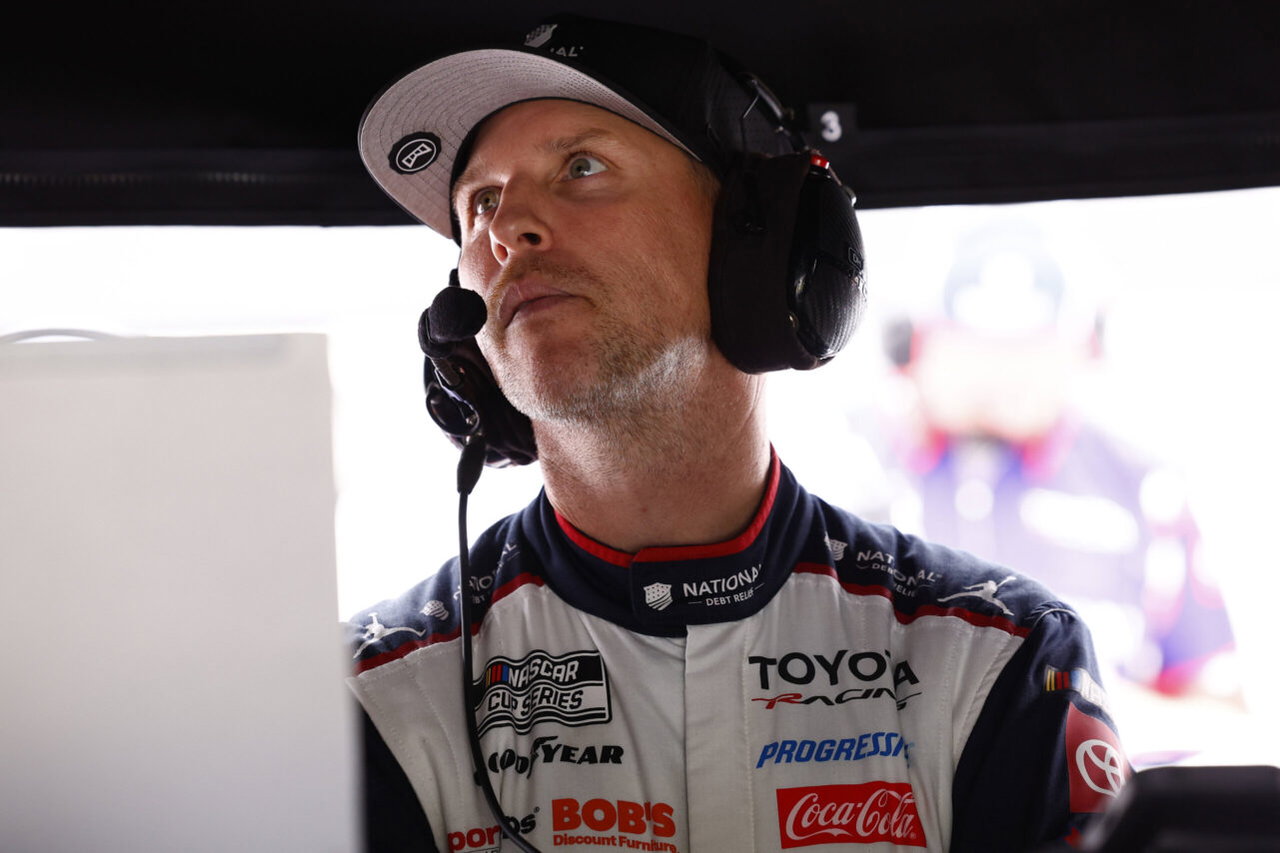
The last regular-season race in Daytona saw the revamped superspeedway package take to the track, with the reduced spoiler size and lowered downforce aimed at tackling the long-debated issue of fuel saving. Despite attempts to curb fuel saving and reduce the falloff in speed for cars running in clean air and in the pack, several drivers still chose to lift their foot off the gas for chunks of the Coke Zero 400, including Denny Hamlin.
Watch What’s Trending Now!
On the latest episode of his Actions Detrimental Podcast, the No. 11 Joe Gibbs Racing driver spoke about how the new superspeedway package improved the mileage from 40 laps on a full tank to the mid-50s, meaning that cars could go longer on less fuel. Earlier in Daytona, teams would have a green-flag stop in the third stage because they needed fuel to get to the end, now with the added milage, fuel savings could reduce time lost on a fuel stop.
“When they dropped the green for the third stage, it was, and they tell me, ‘if you save a lot, we can make it.’ Well, I mean, I’m not gonna race then,” said Hamlin while discussing his pit strategy as compared to those who pit during the last stage.
“Cause I don’t wanna have to pit. Like, that’s a whole lap worth of extra time. So um I think that some were chapped by the fact that, you know, in the third stage, if they did not have track position, they couldn’t go get it because they did, they weren’t gonna have enough fuel to make it to the end.”
While fuel saving was one aspect meant to be tackled by the new package, which, according to Hamlin, didn’t really work out as well, another aspect was supposed to be the speed of the Gen seven car.
During the single-car qualifying at Daytona, Hamlin expected the cars to be much quicker in comparison to the earlier superspeedway package. But according to Hamlin, who was expecting around a half-second pace increase, that change was just a few tenths instead.
With the first race using the new package having failed to deliver on its targets, the championship leader has a rather radical proposition for NASCAR to ensure they are getting not just the most out of the package but also the racing laps.
“Honestly, what NASCAR would do, or if I were in charge of it, would be to make the stages in five laps before full fuel run,” said Hamlin. He suggested that this would allow drivers to race all-out throughout every stage, adding that it wouldn’t matter much if the final stage ended up slightly longer or shorter after adjusting the stage lengths.
Hamlin also believes that this radical change in how the stages are currently laid out would address both fuel savings as well as provide more racing action through the races. Currently, the number of laps lost under caution for stage breaks is something that is under heavy criticism by both drivers and fans.
While in a way the changes NASCAR made seem radical, given these changes are coming not just mid-season but also just over a year after they had been last tweaked. But according to Hamlin, the changes haven’t been radical enough.
Hamlin said that NASCAR had more options in terms of making the spoilers even smaller, having reduced them from seven inches to four inches, and he believes that NASCAR didn’t want to go all out. That move will probably come before the 2027 season, after NASCAR has assessed the impact of the current changes.
“We room that we can go, cuz I didn’t think the pace of the actual field was that much faster,” said Hamlin. “If anything, maybe a little bit from what the fast pace was with the big spoiler and big drag. I think that there’s things that can be done, and certainly I would still love to see these things be a little bit faster yet in single-car qualifying.”
The Chase begins this weekend. With 10 races to go until a champion is crowned, there is just one superspeedway remaining en route to the finale in Homestead.
Talladega will host the third-to-last race this season, and that is exactly when we get to see this new superspeedway package in action again. While the gains weren’t clear in Daytona, in Talladega all eyes will be on how much lifting and coasting is seen from the drivers.
The pace may remain the same, but the race in Talladega will provide NASCAR a good understanding of how much further they can push the superspeedway package to improve racing and reduce fuel savings at tracks like Talladega and Daytona in 2027.