
Max Verstappen and George Russell traded the lead 35 times in 50 laps, with 352 overtakes reshaping the order every few seconds. Lando Norris and Oscar Piastri stayed in the fight, and the order kept shifting as drivers used the long straights to close in and strike back. By the checkered flag, Verstappen had beaten Norris by just 0.639 seconds. For Mercedes-AMG Petronas F1 Team Principal Toto Wolff, the spectacle brought together three familiar names in American motorsport.
Watch What’s Trending Now!
“These regs are great entertainment, and we saw a mega race, particularly for the Americans. I guess it was Indy 500 and NASCAR and Formula 1 mixed! … The instant feedback I got from friends watching, our sponsors, was that it was awesome,” revealed Toto Wolff.
His comparison was more than a passing remark. The repeated slipstream battles, changing positions and strategic decisions made Las Vegas feel different from the more familiar rhythm of a Formula 1 race. Even after Mercedes lost a potential podium in the closing laps, Wolff was impressed by the show. He acknowledged that the same spectacle might not happen at every circuit, but Las Vegas had given fans something special. So, what exactly made the comparison work?
Looking at three elements — the gaps between the leading drivers, fuel saving, and energy deployment — offers a useful way to understand why the race resonated with fans of NASCAR and IndyCar.
The gap between the top 10: How close is the fight between the three disciplines?
The first thing that stood out in Las Vegas was how little separated the leading group. Verstappen won, but the top five finished within 2.927 seconds of one another. The top 10 were covered by 17.554 seconds. For a 50-lap Grand Prix, it was a remarkably compact result.
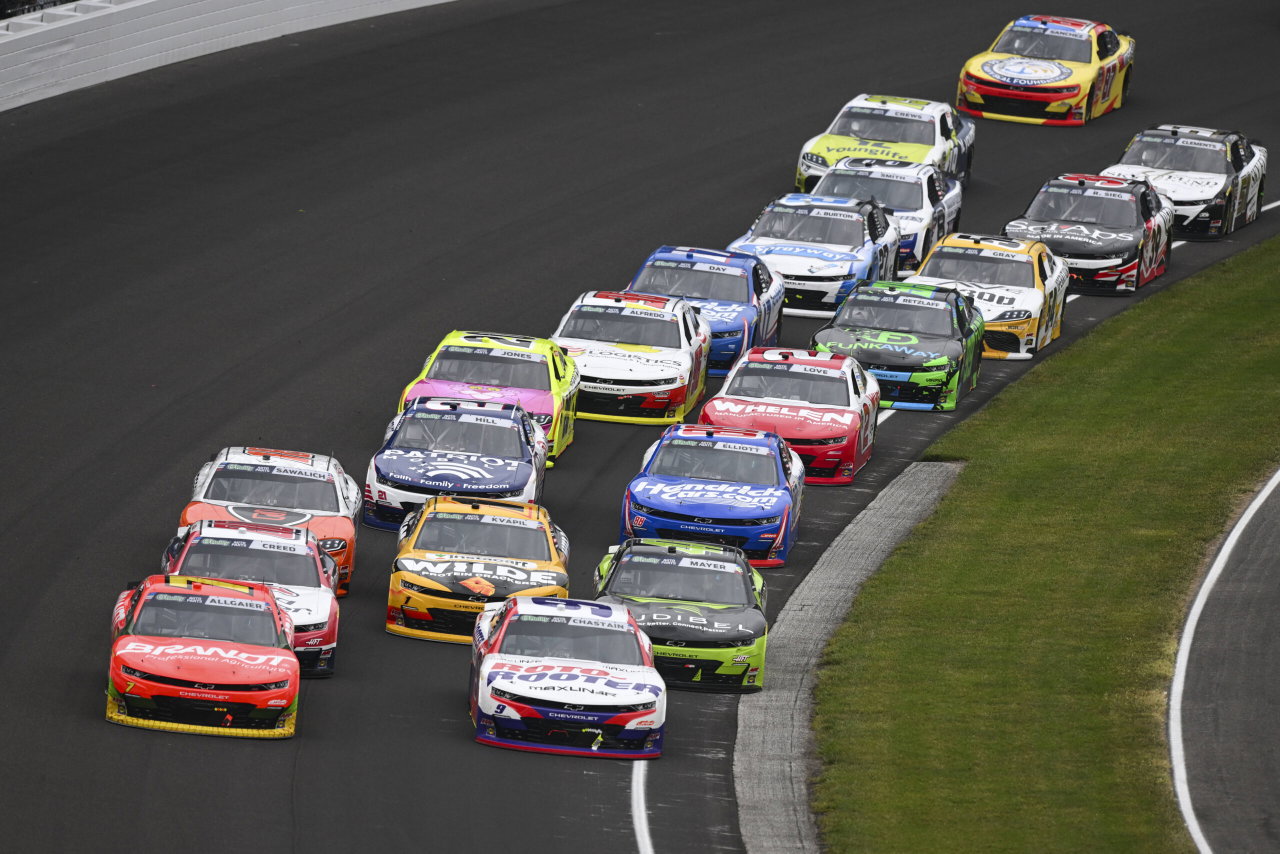
NASCAR fans, of course, are familiar with close finishes. At the 2026 Pennzoil 400 at Las Vegas Motor Speedway, Denny Hamlin held off Chase Elliott by 0.502 seconds. More notably, the top 10 finished within 12.056 seconds of one another over 267 laps. This was not a Daytona or Talladega-style pack race. At the intermediate oval, track position, clean air, and the ability to maintain pace shaped the contest.
Will NASCAR’s Planned 800-Horsepower Package Make Racing More Exciting?
IndyCar offered an even more dramatic example at the 2026 Indianapolis 500. Felix Rosenqvist edged David Malukas by just 0.0233 seconds in the closest finish in the event’s history. The top five were separated by only 0.436 seconds, while the race produced an event-record 70 lead changes.
These are not perfectly comparable measurements. Race distances, caution periods and circuit layouts all influence finishing gaps. But they illustrate why Wolff’s comparison resonated: in all three races, the winner had to fight for the result rather than simply disappear into the distance.
Fuel saving: Knowing when not to push
A NASCAR race can be won by a driver who knows when to lift. Fuel mileage is a familiar part of the Cup Series‘ strategic equation, with drivers balancing pace against the need to make it to the next pit window. The calculation changes from track to track. At Daytona and Talladega, the draft can make conserving fuel easier; at a short track such as Martinsville, heavy braking and acceleration make it more complicated.
The 2026 Indy 500 provided a particularly good example of how fuel strategy can shape a race. Rosenqvist and Pato O’Ward were among the drivers who made their final stops earlier than the chasing group, attempting to reach the finish without another green-flag stop.
Rosenqvist had two more laps of fuel than O’Ward and used the Mexican driver’s draft to conserve even more. Their strategy put them in contention before a late caution changed the complexion of the race. Rosenqvist eventually won the last-lap duel with Malukas.
Formula 1 has its own fuel equation. With refueling prohibited during races, teams must manage the fuel loaded at the start, while drivers can use lift-and-coast — easing off the throttle before a braking zone — to conserve fuel. However, fuel saving should not be confused with the main reason for the constant overtaking in Las Vegas. That was much more closely connected to the new electrical energy rules and the circuit’s long straights.
The common thread is that pushing flat-out every second is not always the quickest route to the finish. Sometimes, saving a little now creates the opportunity to attack later.
Energy deployment: Where the comparison gets interesting
This is where the three series take different routes.
NASCAR’s Cup cars do not have a comparable hybrid deployment system. Their strategic battles revolve around the combustion engine, fuel management, aerodynamics and track position. The draft at Daytona or Talladega can give a driver a powerful advantage, but it is not electrical energy being stored and released for an additional burst of power.
IndyCar, meanwhile, introduced its hybrid system in 2024. It recovers energy and stores it in an ultracapacitor, allowing drivers to deploy additional horsepower when they choose. The system is available on ovals as well as road and street courses. On the latter, drivers can combine hybrid deployment with the separate Push-to-Pass system.
Formula 1’s 2026 regulations put electrical energy management much closer to the center of the racing. Drivers must balance harvesting and deploying energy throughout a lap. The new Overtake Mode gives a driver within one second of the car ahead an additional electrical energy allowance to help mount a pass.
Las Vegas showed just how much that decision could matter. In the closing laps, Kimi Antonelli was trying to stay behind Verstappen before making his move. According to Wolff, the Mercedes driver lifted on the back straight and reapplied the throttle, but the sequence left his battery depleted. Without the energy to defend, he was passed by both McLarens and fell from second to fourth.
It was a striking example of how a decision made in a matter of seconds could change a driver’s finishing position. And it was not lost on observers outside the F1 paddock.
NASCAR veteran Kenny Wallace shared a friend’s reaction to the Las Vegas race on social media, introducing it with the question, “Should NASCAR be worried?” The friend described the on-track product as “simply amazing” and argued that both NASCAR and IndyCar should rethink the layouts of some street and road courses to create more sustained racing and passing opportunities.
The friend even compared the action to IndyCar racing on an oval. It was the friend’s assessment that Wallace shared, rather than a direct statement from Wallace himself.
How the three disciplines came together to make one unforgettable night
Wolff’s comparison was never about claiming that NASCAR, IndyCar and Formula 1 have become interchangeable. Their cars, rules and racing traditions remain distinct. But Las Vegas brought three familiar ingredients into focus: a close fight for position, the strategic value of saving fuel, and the growing role of energy management in deciding when a driver can attack.
For NASCAR fans, the spectacle had the back-and-forth quality of a race in which the lead is never guaranteed. For IndyCar fans, the repeated exchanges and fuel calculations offered echoes of the series’ own strategic battles. And for F1, it was a striking demonstration of what its new regulations could produce on a circuit with long straights and powerful slipstreams.
Wolff acknowledged that the same spectacle would not happen everywhere. Las Vegas was a particular combination of circuit layout, racing conditions, and new technology. But for one night, the three disciplines found common ground — not in how their cars were built, but in how they kept the race alive. And that, more than any single statistic, was what made the comparison worth talking about.