
On Sunday, Indy racecars went screaming past the US Capitol, the Washington Monument, and the Smithsonian National Air and Space Museum. They were doing it on Pennsylvania Avenue, one of the most heard of streets in the world, which had never seen anything remotely like this before. The Freedom 250 Grand Prix was the first motor race ever held on the National Mall. It was messy, it was deafening, and somehow it came together.
Watch What’s Trending Now!
By the time the winner crossed the line, one of the most powerful men in Washington had already moved on to his next idea, and it had nothing to do with IndyCar. Transportation Secretary Sean Duffy did not need much time to say what was on his mind.
“I’m an old Southern boy. I’m a NASCAR boy,” Duffy said in a Fox Sports video on X. “It’s time to bring NASCAR to DC. NASCAR can handle anything. We need NASCAR in DC as well.”
The Freedom 250 happened because President Donald Trump signed an executive order titled “Celebrating American Greatness with American Motor Racing.” The circuit itself was 1.7 miles long, with seven turns, and nearly half a mile of that running straight down Pennsylvania Avenue with the Capitol sitting right at the end of it. A hundred and forty-seven laps over roughly 250 miles. An American winner. And a question that nobody was ready to answer. It’s knocking at the doorstep now: if IndyCar can do this, what happens when NASCAR shows up?
What it took to actually pull this off
Before anyone turned a wheel in anger, Washington had to be changed in ways the city had never been before. More than 200 manhole covers across the circuit were welded shut. The reason is specific and worth knowing: open-wheel cars generate enough suction at speed to literally pull a manhole cover off the road surface. The National Gallery of Art ran studies on how vehicle vibrations might affect its collections and moved some outdoor sculptures indoors as a precaution. The Smithsonian’s National Air and Space Museum, which is right alongside the circuit and houses Neil Armstrong’s spacesuit among other things, had curators on edge throughout the weekend. Air traffic into Ronald Reagan Washington National Airport was paused for three hours to clear the skies for military flyovers.
The backstory to all of this goes further back than the executive order. Trump claimed that IndyCar boss Roger Penske had spent two decades trying to get a race in Washington, making 211 trips to government offices without success. Previous administrations turned him away. Previous mayors said no. Trump said it took 15 minutes after Penske sat down in front of him. Whether that is precisely accurate or very Trumpian math, the result is the same. The race happened.
On race day, Trump took a ceremonial lap in his armoured limousine before waving the green flag, though Melania Trump and Command Sergeant Major Matt Williams had to sort him out on how to actually hold the flag properly first. Interior Secretary Doug Burgum, sunglasses on, got the honor of bellowing the command to start engines. A trained bald eagle was released near the start line and swooped overhead before returning to its handler. A B-2 stealth bomber flew over the National Mall. It was exactly as much as you would expect from an event designed to celebrate 250 years of American independence.
How’d the race go?
Kyle Kirkwood won it, and he did not make it look easy even when he was in front. Kirkwood, driving for Andretti Global, went past championship leader Alex Palou on lap two and led the rest of the way through six caution periods, any one of which could have reshuffled everything.
Christian Lundgaard was second for Arrow McLaren. Andretti Global’s Will Power, an Australian who spent his afternoon racing American streets past American monuments, finished third.
The championship story, though, belonged to Palou. The four-time series winner and defending champion came into Washington having already won six races this season. He left classified in 20th place. A drive-through penalty for clipping a tire with his pit box during a caution stop cost him early. A slow pit stop made it worse. He worked his way back from 21st all the way up to seventh, and then with 25 laps remaining, hit the wall at turn four. Kirkwood closed to within 91 points of him in the standings.
When Kirkwood got on the radio after taking the checkered flag, it was raw.
“This is incredible. I’m almost in tears here. This is a big moment for us. Big moment for America here, the 250, right?” he said. “Big moment for Andretti, big moment for Honda. These guys gave me the equipment, this car right here, to go out there and perform. That was a hard race.”
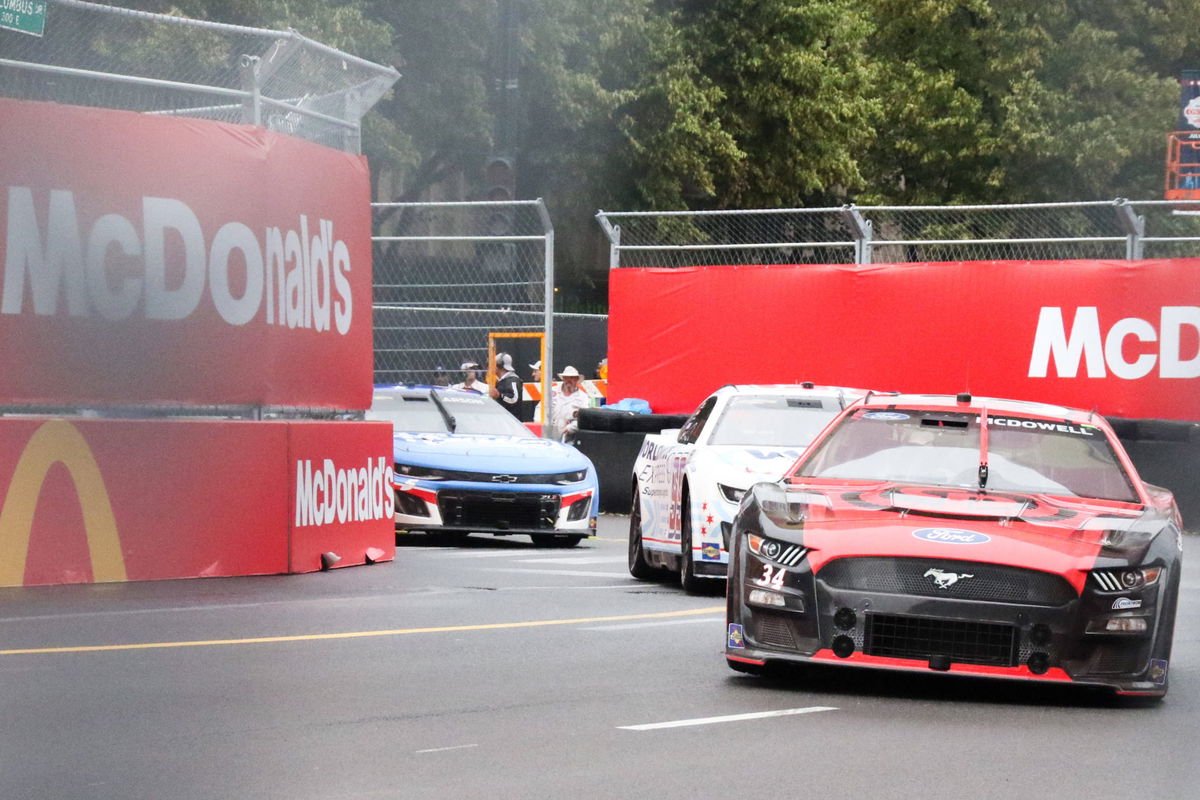
Hard is the right word. Six cautions on a 1.7-mile street circuit means the field is constantly bunching up, restarting, and doing it all over again. NASCAR had a similar experience this year at Naval Base Coronado, but taking Next Gen cars in the streets of Washington is going to be a tall order.
NASCAR and IndyCar are not the same
Here is where Duffy’s idea gets complicated, and why it is worth taking seriously rather than dismissing. IndyCar runs about 25 cars at most events. The NASCAR Cup Series fields close to 40. An IndyCar car is narrow, light, and built to avoid contact wherever possible. A Cup car weighs over 3,200 pounds, is built wider, and runs in traffic that would destroy an IndyCar within ten laps. Contact is part of NASCAR’s DNA. The cars are built to take it. The streets of Washington are not.
The pavement question alone is significant. IndyCar teams were already describing the circuit as bumpy, and their cars are a fraction of the weight of a stock car. Running 40 Cup cars for 300 miles over the same surface is a different conversation entirely. The road would need to be assessed for load-bearing capacity, expansion joints, surface heat management, and drainage before anyone could responsibly sign off on it.
That is before you get to pit road. The Freedom 250 placed its pit lane on Pennsylvania Avenue between turns one and two. NASCAR’s pit operation is a different scale, with 40 crews working at the same time, fuel rigs, and NASCAR officials all needing room to function safely.
Then there is the crowd question. The Freedom 250 reportedly generated over 288,000 ticket requests. NASCAR’s fanbase is enormous and intensely loyal. There is no parking around the National Mall. Getting that many people in and out safely would require metro coordination, shuttle systems, pedestrian zones, and remote staging areas on a scale that would test even the most experienced event organizers.
Add the security requirements around federal buildings, restricted government zones, and one of the most surveilled pieces of land in the world, and the planning becomes as complicated as the race itself. None of this is a reason it cannot happen. It is a reason to understand what it would actually take to happen properly.
The argument NASCAR cannot afford to look away from
IndyCar answered the question that nobody could even ask before last weekend: will Washington allow it? The mayor participated, the federal government signed an executive order, the infrastructure went up, and of course the museums adapted. The manhole covers also got welded. A hundred and forty-seven laps happened without a single monument coming down. That is the proof of concept that did not exist before Sunday.
It is worth noting that NASCAR is on the lookout for a street circuit. Their deal with the Windy City didn’t go through for 2027 season, and they haven’t announced the dates for a potential return to Naval Base Coronado. NASCAR has been bullish about promoting the sport with events at different venues and cities.
The Clash toured the LA Coliseum, and then NASCAR even went international, with a points race in the Mexico City. They have proved that they have the means and muscle to pull off such an undertaking. But the one thing that could push them away from this event is scheduling and dates.
NASCAR has to look out for their partners and dates at a particular race track. This year in particular, they have reduced the number of road and street races. In fact there are no road course race in this year’s Chase. This only adds to the challenge that NASCAR faces, and the fan sentiment is another important aspect they need to consider.
While the street race in Chicago from 2023 to 2025, it was mired by weather and promotions of controversial EV race car. On the surface, it looks nice, but for diehard fans, they’d rather have another oval track on the schedule over a street course.
The only way NASCAR can get a feel if a race in Capital will be a success story or not is by giving it a shot.