
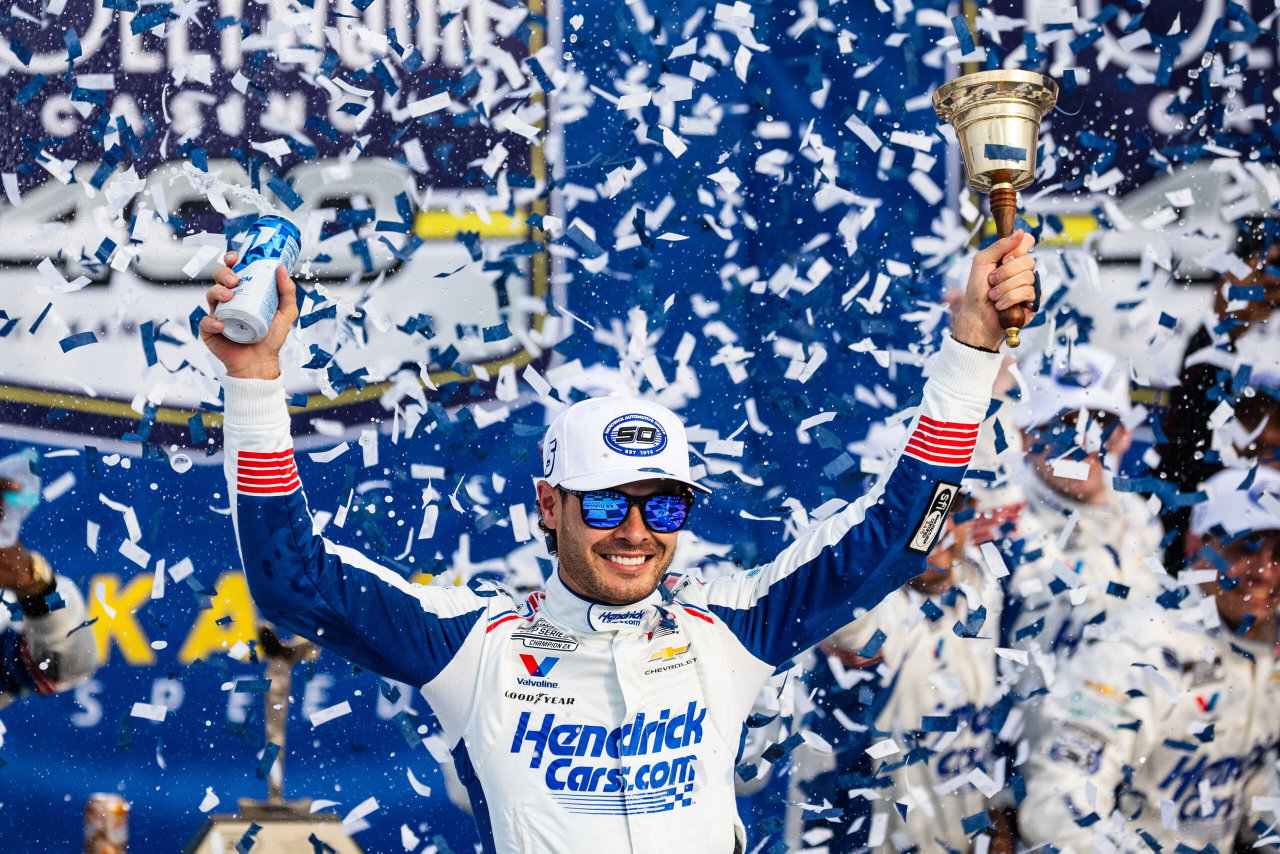
Kyle Larson did more than secure his third NASCAR Cup Series championship in 2026; he put together a postseason run that could have survived almost any championship scenario. The Hendrick Motorsports driver entered the Chase with plenty of ground to make up but found another gear when the pressure intensified. His dominance eventually left Christopher Bell and Denny Hamlin with little chance of catching him. Now, a closer look at the points reveals just how extraordinary Larson’s performance was, even under a completely different championship starting position.
Watch What’s Trending Now!
“So Larson could have started as the worst driver, and he had such a good Chase that he still could have won the championship. How crazy is that? He ended up scoring, you know, everybody kept talking about 40 points a race, 40 points a race. He ended up scoring 45.6 points per race. Bell actually scored 40.2, and again, still got outscored by 54 points. So in a lot of years, I think going forward, Bell would have been the champion, but Larson just had that good of a Chase,” Jeff Gluck explained on The Teardown podcast.
Gluck’s calculations put Kyle Larson’s 2026 championship run into an entirely different perspective. The Hendrick Motorsports driver did not simply overcome his poor regular-season form to win another title. According to the motorsports journalist, Larson performed so well across the 10-race Chase that he could have started from the bottom of the standings and still beaten Christopher Bell and Denny Hamlin. Even the advantage normally reserved for the top seeds would not have been enough to stop him.
Larson entered the Chase as the seventh seed, carrying a 55-point deficit to regular-season leader Hamlin. Bell started sixth, 50 points behind the No. 11 driver. However, Larson quickly erased that disadvantage. Across the 10 races, he collected 456 points at an average of 45.6 per event. Bell managed 402 points, averaging 40.2, while Hamlin finished with 345. Larson therefore outscored Bell by 54 points and Hamlin by 111.
That gap is what makes Gluck’s hypothetical so remarkable. Under the 2026 Chase seeding system, the 16th seed would have started 100 points behind Hamlin. If Larson had entered the postseason in that position but maintained his actual Chase performance, he would still have finished four points ahead of Bell and 11 ahead of Hamlin. In other words, the No. 5 team could have entered the championship battle as the lowest-ranked contender and still emerged with the trophy.
The achievement becomes even more impressive when considering where Larson stood before the postseason. He went through all 26 regular-season races without a victory, extending his winless streak to 50 races. He averaged just 27.85 points per race, compared with Hamlin’s 39.5, and entered the Chase as the seventh seed. The No. 5 Chevrolet had shown speed, but Larson and crew chief Cliff Daniels struggled to turn that potential into consistent results.
Everything changed once the championship stretch began. Larson opened with a fifth-place finish at Darlington. He followed it with four consecutive finishes inside the top two, including victories at Gateway and Kansas. The Kansas performance was particularly dominant, as he swept both stages, led 235 of 267 laps and collected 76 points. A difficult 34th-place finish at Phoenix briefly threatened his advantage, but he responded with another victory at Talladega. He ultimately finished the Chase with three wins, six top-five finishes and eight top-10 results.
Larson’s 2026 season numbers look surprisingly similar to his previous championship campaign. NASCAR statistics show that he recorded three victories and 15 top-five finishes in both 2025 and 2026. He also collected 22 top-10 finishes in 2025 and 21 this year. His average finish changed from 13.2 to 14.5, while his Driver Rating actually improved from 94.3 to 96.1.
However, the route to those identical win and top-five totals could hardly have been more different. Larson won three times during the opening 12 races of 2025, but struggled to maintain that form through the remainder of the regular season.
He eventually secured the championship at Phoenix after finishing third, despite going winless throughout the postseason. The 2026 campaign flipped that pattern completely. Larson could not find Victory Lane during the regular season, but produced three wins during the Chase itself.
That contrast also highlights how Larson has adapted to two different championship systems. He won his 2025 title under the elimination-style format by surviving the Championship 4 finale. In 2026, the restored 10-race Chase rewarded sustained performance, and Larson built such a substantial advantage that he clinched the championship before the final race was completed.
Gluck’s 16th-seed calculation underscores the achievement: regardless of where Larson started, his postseason performance was good enough to make him a champion.