
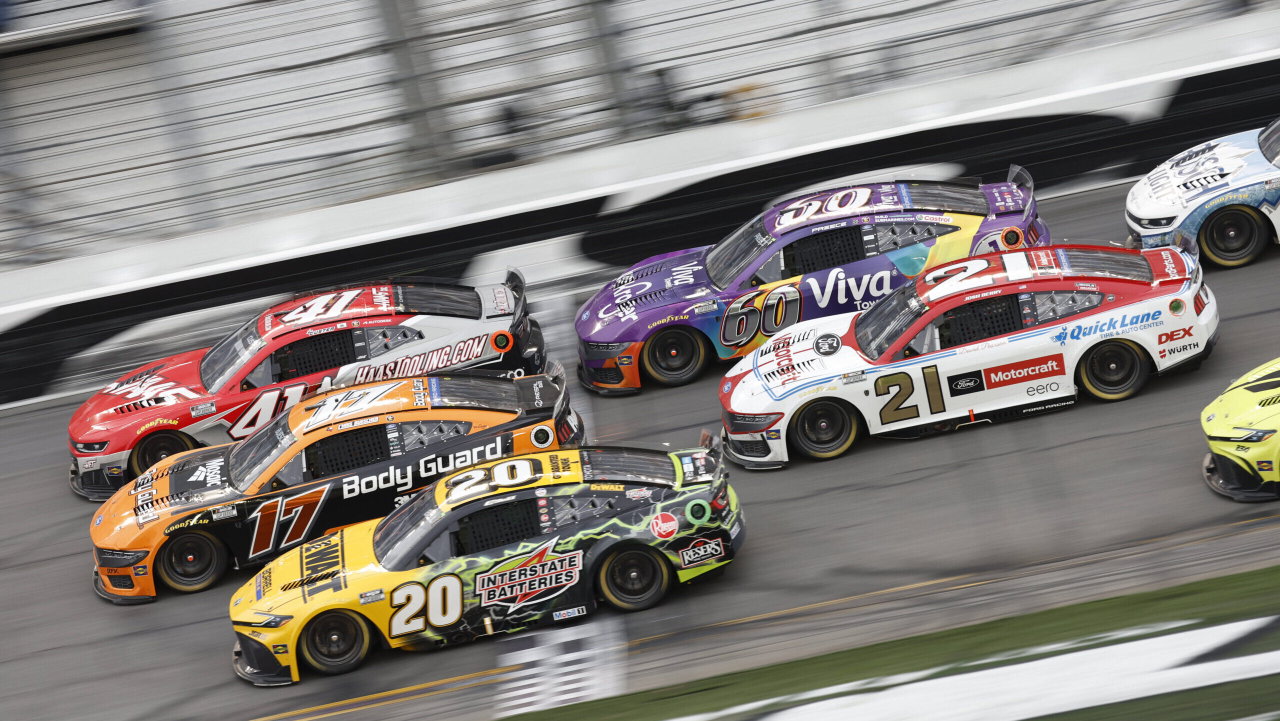
Twenty-five races and nearly eight months of competition. Now we’ve reached Daytona, the last stop before the Chase begins. It has a way of turning into chaos right when it matters most, and that’s exactly what’s on deck this weekend. The Coke Zero 400 closes out NASCAR’s Cup Series regular season, and the stakes couldn’t be higher for a handful of drivers. Thirteen spots in the Chase are already locked up. That leaves three spots open, with four drivers scrapping to grab them before the checkered flag falls.
Watch What’s Trending Now!
The gap between the driver sitting in 16th place and the one just outside it is 31 points, a number that sounds meaningful until you remember that at a superspeedway, one wreck can wipe out an entire season’s worth of work before a driver even completes a lap. That is the situation. But the real story runs deeper than four names and three spots.
“I’m on offense. I’m not playing defense,” 17th-placed Ryan Preece said ahead of Daytona, via Autoweek. “Hopefully, Daytona is gonna love me back for once.”
NASCAR’s New Old Rulebook
For the first time since 2016, NASCAR brought back the Chase format. The old win-and-you’re-in playoff system is gone. Instead, the top 16 drivers in points after 26 regular-season races advance to the Chase, a 10-race championship that runs like a self-contained mini-season. Points reset at the start of the Chase, with the top three seeds starting at 2,100, 2,075, and 2,065 respectively, while seeds 4 through 16 drop in five-point increments down to 2,000.
The argument for this format is that it rewards the best drivers across a full season rather than the ones who happened to win at the right track on the right weekend. No more situations where a driver with two wins and a shaky average coasts in ahead of someone with eight top fives.
In theory, it is a cleaner system. In practice, it only holds up if the 26 races themselves are a fair and consistent measuring stick. That is where complications enter the picture, or the track.
Joe Gibbs Racing’s Denny Hamlin is going into the Coke Zero 400 as the top seed with 1,001 points, four wins, and a 77-point lead over Team Penske’s Ryan Blaney in second. Below them, the Chase field reflects what a full season of racing should produce. Tyler Reddick, Ty Gibbs, Christopher Bell, Chase Briscoe, Kyle Larson, Chase Elliott, Joey Logano, Chris Buescher, Carson Hocevar, William Byron, and Daniel Suarez have all clinched their spots. Bubba Wallace is 75 points above the cutline in 14th place and needs a catastrophic weekend to fall out.
The real fight is between Shane van Gisbergen in 16th, Austin Cindric in 15th, and Preece in 17th. Van Gisbergen holds a 31-point cushion over Preece heading into Daytona. Cindric sits 44 points clear. Neither gap is comfortable when the venue is a superspeedway.
At New Hampshire Motor Speedway last weekend, Van Gisbergen led 30 laps on wet-weather tires and built a nearly six-second lead. When the track dried and the field switched to slick tires, he dropped from the front to 20th in a matter of laps.
“Being that fast on wet weather tires and falling that fast shows that we were missing something to have grip on the slick tires,” Van Gisbergen said. “Connor and I just went backwards as fast as we could when the track dried. It’s just a disappointing way to end the day.”
Preece finished ninth at New Hampshire and cut 19 points off the deficit. Not enough, but something. Still, the math heading into Daytona is brutal and the reason for that goes all the way back to May.
One Decision That Changed Everything
At Texas Motor Speedway in May, RFK Racing’s Preece grew frustrated with how Ty Gibbs was racing him. He keyed up the radio. “All right, when I get to that 54, I’m done with him. F**king idiot.” Shortly after, Gibbs came down on him, Preece held his ground, and the No. 54 slid into the wall.
NASCAR penalized Preece 25 driver points and fined him $50,000. Preece was direct when he addressed it afterward. “I hate that he wrecked,” he said. “But decisions you make on the racetrack, there are repercussions, and I try to race everybody with an amount of respect that I’d like in return. When you don’t do that, I’m not going to cut you a break. That’s what happened.”
The penalty stood after an appeal. Then, in July at Chicagoland Speedway, two incidents were similar or arguably more obvious reasons. Van Gisbergen made heavy contact with Austin Hill. Zane Smith wrecked Carson Hocevar. Neither driver was penalized. NASCAR’s position, unspoken but clear, was that Preece’s radio call before the incident was what separated his case from the others. He announced his intentions out loud. That is what they penalized him.
Preece responded by selling a t-shirt that read “Don’t Hit the Button,” a reference to the radio button he apparently should never have pressed.
The shirt is funny, yes. But what it denoted was not. Preece has averaged 22.2 points per race this season. NASCAR effectively docked him more than a full race’s worth of points for something that, by any fair comparison, was no worse than what went unpunished at Chicagoland two months later. Without the penalty, he would be six points outside the cutline rather than 31. The final two races would be a legitimate fight. Instead, he is heading to Daytona needing close to a miracle.
There is one notable wrinkle. The penalty applied to driver points, not owner points. Preece’s No. 60 RFK Racing entry sits just six points outside the owner’s Chase. Even if the driver standings gap cannot be closed, RFK Racing will be pushing hard for owner points and the season-ending bonus money attached to them. The two battles at Daytona could look very different from each other depending on how the race unfolds.
Coke Zero 400 Is Not a Fair Judge
Set the penalty argument aside for a second, because the format itself raises a real question. NASCAR wants its championship to reward the 16 most deserving drivers, then turns around and puts the final qualifying race at Daytona. That’s a problem. Daytona is a 2.5-mile superspeedway where cars run in packs at nearly 200 miles an hour, and the gap between finishing fifth and finishing 30th can come down to a wreck two rows ahead that has nothing to do with how well someone’s driving. Skill only gets you so far there. Past that point, it’s chaos, and no track on the schedule serves up more of it than Daytona.
Preece knows better than most how unpredictable Daytona can be. In August 2023, his car rolled around 13 times down the backstretch after flipping. Then, in the 2025 Daytona 500, his car once again went airborne, flipped onto its roof, and slid into the outside wall. He walked away from both crashes. To date, he still hasn’t scored a top-10 finish in a points-paying Cup race at Daytona.
This year, there is more uncertainty, if not less. The field arrives with a new superspeedway aero package that nobody has raced before. Teams are walking in without a clear playbook.
“I guess we’re all on a level playing field when we go into that one,” the No. 60 driver said. “If you worry about the things you can’t control, it’s gonna eat you alive. I’ve always just worried about the things I can control and make sure I do them well.”
That is a measured answer from a driver who has earned the right to say it. It also shows the absurdity of the moment. The final gatekeeper to NASCAR’s championship is a venue where even the participants tell you the race is too unpredictable to plan for.
The System Works, Until It Doesn’t
None of this is a full indictment of the Chase format. Thirteen of the 16 spots are settled, and most of them reflect exactly what happened on the track this year. Hamlin, Reddick, Blaney, Gibbs, and Bell are all in because they earned it across 25 races. For those drivers, the format did precisely what it was supposed to do.
The problem shows up at the margins, and championship formats always reveal themselves at the margins. A penalty applied differently than comparable incidents that followed. A final qualifying race held at one of the most chaotic venues in motorsport. A driver who has outscored his immediate competition for most of the season now staring at a gap that exists, in large part, because he said something on the radio before a wreck instead of after it.
Hamlin, speaking after New Hampshire, summed up his own standing with the ease of someone who knows he is already through. “These are our bad days, bad-ish,” the Joe Gibbs Racing driver said. “But I feel good about where our team is right now. We don’t have a whole lot of weaknesses.”
Preece does not have that security. He is not driving a dominant Toyota like Hamlin. The RFK racer needs Daytona to break the right way, for the right cars to be in the wrong place, and for two races’ worth of ground to vanish in one afternoon.
It could happen. The Coke Zero 400 has given stranger results. But if it does not, and if Preece misses the Chase by fewer than 25 points, the conversation about how NASCAR applies its penalty system in a points-based championship format is going to get considerably louder. Not because anyone disagrees with the principle of accountability on the racetrack, but because consistency is the one thing a system built on points simply cannot afford to lack.
NASCAR went back to a format meant to reward the best. Whether Daytona validates that or complicates it depends entirely on which side of 31 points you end up on Sunday evening.