
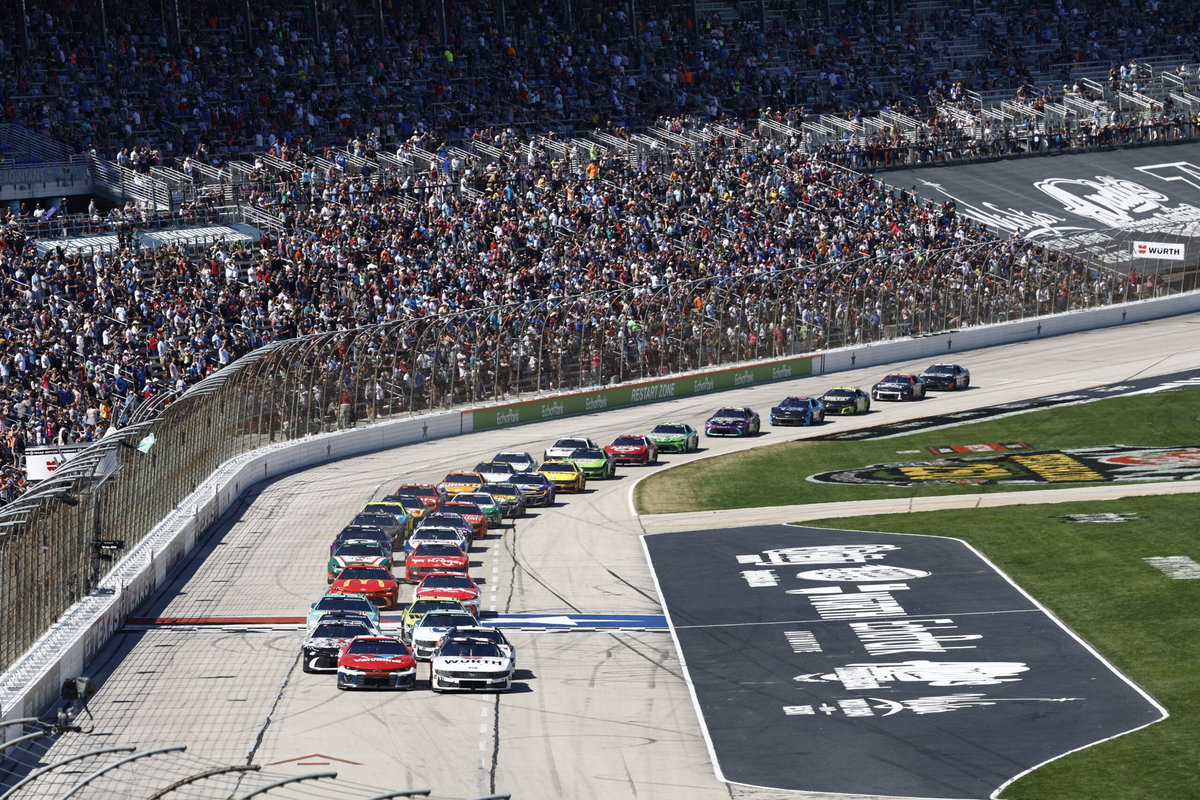
Since NASCAR introduced the Next Gen car in 2022, something about superspeedway racing at Daytona and Talladega has shifted. With pack racing stacked three-wide, last-lap swings, chaos always one push away, these tracks have long been the sport’s wildest stage. But lately, drivers say the spectacle hasn’t matched the feel inside the cockpit. Instead of charging through the draft, races are being dictated by fuel saving and pit timing. And now, one Cup star is calling it out, demanding urgent changes to a package he believes is ruining the very soul of superspeedway racing.
Watch What’s Trending Now!
“So it becomes all about shortening the last pit stop to as short as you can get it, which means you’re still saving fuel on stage two even though you can make it to the end. You know, after that last pit stop… It’s a joke, it’s a complete joke, and I look forward to changes.”
That frustration from Christopher Bell isn’t just a heat-of-the-moment emotion, but it reflects a growing concern across the NASCAR Cup Series garage.
Bell doubled down after meeting with NASCAR officials at Texas Motor Speedway, saying the urgency inside the driver group is no longer subtle. “We desperately need change,” he said. “We needed change for a long time. So hopefully that is the last time that we race that speedway package. I think a lot of us in the industry will be very excited about that.”

Christopher Bell with a passionate plea for immediate change in the drafting-track superspeedway package. Bell: "It's atrocious. ... It's a complete joke. ... It comes down to just a suicide mission of who is going to push the hardest and not get wrecked." @NASCARONFOX
The newer car generates significantly more aerodynamic drag, which makes passing in the draft far more difficult than it used to be. What was once unpredictable, aggressive pack racing has slowly turned into a calculated exercise in track position. And that’s where the problem lies.
Instead of drivers charging through the field, races have become heavily dependent on pit strategy and fuel-saving tactics. Teams now prioritize staying in line, conserving fuel, and executing the perfect final stop rather than making bold on-track moves. The choice has narrowed down to two extremes: either save fuel and play the long game, or take risks that often end in multi-car crashes. Naturally, most drivers are opting for the safer route.
Talladega’s spring race illustrated the issue clearly. Once drivers finally tried to race after extended fuel saving through the opening portions of the event, the push for track position quickly triggered a 27-car crash that wiped out a large portion of the field. Even the finish reflected how difficult passing has become, the race was effectively decided by Carson Hocevar and Chris Buescher holding the front row after the final round of pit stops.
Even NASCAR’s attempts to fix the issue haven’t fully worked. At Talladega last week, officials tweaked the stage format to 98-45-45 laps, hoping the shorter final stages would eliminate fuel-saving scenarios. But the result? More of the same frustration. Drivers found themselves still locked in line, unable to make meaningful moves because of aerodynamic limitations.
“It’s literally a lottery race,” Bell said. “Now the strategy is so spelled out that it becomes all about fuel saving… It becomes all about shortening that last pit stop as short as you can get it.”
Right now, the spectacle is still there. But the substance isn’t. And if voices like Bell’s keep getting louder, change may not just be expected; it may be unavoidable.
NASCAR eyes fixing the superspeedway issue for good
The frustration isn’t staying inside the cockpit anymore. Rather, it’s moving into meetings. NASCAR executive Mike Forde recently confirmed that officials will sit down with a group of drivers, including Denny Hamlin, to discuss potential changes to the superspeedway package. That alone signals a shift.
That process is already underway. During a competition meeting with drivers at Texas Motor Speedway, NASCAR officials acknowledged directly that work still needs to be done after Talladega’s Jack Link’s 500 and assured the field that changes are actively being explored.
For years, drivers have voiced concerns about the direction of racing at Daytona International Speedway and Talladega Superspeedway. Now, it seems NASCAR is finally listening. Interestingly, Tony Stewart recently pointed out that this isn’t a new concept.
Speaking on Barstool Sports’ Rubbin is Racing podcast, Stewart recalled how similar driver committees existed in his era, only for their feedback to be brushed aside. That history makes the current approach feel like a long-overdue correction rather than a fresh idea. And there’s no shortage of suggestions.
Reducing aerodynamic drag, possibly by trimming or even removing the rear spoiler, is one option being floated. Others include adding more underbody downforce to improve racing in dirty air, allowing drivers to make moves outside the draft. Then there’s the most consistent ask from the garage: more horsepower.
Hamlin said he has already shared his preferred direction with NASCAR leadership and believes adjustments to both the engine output and spoiler configuration could be made quickly enough to affect the next superspeedway race at Daytona in August. “I really think NASCAR has a really good idea and direction of where to go,” he said. “It’s going to take some time, but I certainly think… the next superspeedway race will look a little different.”
NASCAR’s internal response has reflected that urgency. Forde revealed that a text from Hamlin outlining possible changes was immediately forwarded by CEO Steve O’Donnell to competition executive John Probst, who has already been running simulation work on potential superspeedway package adjustments.
It’s a simple request, but one that could change how these races unfold. With Steve O’Donnell now showing openness to driver input, the sport appears to be at a crossroads. The current package has clearly worn thin with both competitors and fans.
Other drivers echoed the same message after Talladega. Todd Gilliland described being stuck mid-pack with no options to move forward, calling it “such a frustrating way to race,” while Ricky Stenhouse Jr. and Michael McDowell both pointed to a shared sense across the garage that NASCAR is finally prepared to act before the summer return to Daytona.
What happens next will define the future of superspeedway racing. But one thing is certain: this time, the pressure isn’t fading—it is building.