
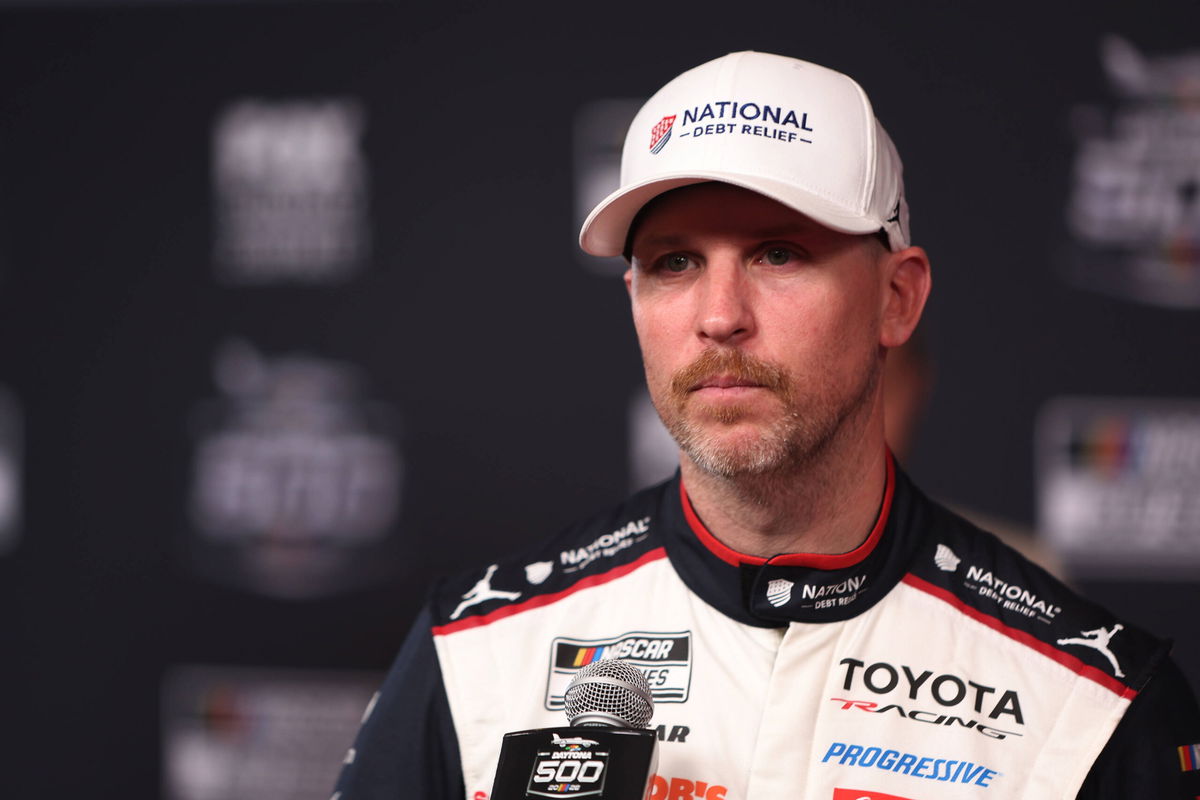
Denny Hamlin started on the pole last week in Nashville, which is exactly where every NASCAR driver wants to be. But before the race could even start, he was immediately thrown to the back of the pack. And Michigan has now produced an oddly similar scenario – kind of like a déjà vu. Hamlin won the fastest lap in qualifying once more, but he would be returning to the back of the field (once more) before the green light due to damage from a flat tire. Here’s what the man himself had to say on this matter.
Watch What’s Trending Now!
“When you go in practice, you drag a little bit. But then I saw that mine was significant compared to cars that hadn’t had a flat and so I knew that that was not good. I basically shrugged my shoulders to say there’s nothing do about it, it’s scr—,” Hamlin told Jeff Gluck in a press conference.
That insight followed what ought to have been a simple celebration. No. 11 Toyota’s 195.117-mph lap knocked Carson Hocevar’s No. 77 Chevrolet off the top spot by just 0.018 seconds, as Hamlin claimed his 50th career Busch Light Pole Award and his second pole of the 2026 season. Before Saturday, only six drivers in NASCAR history have reached 50 poles and 50 wins — Richard Petty, David Pearson, Cale Yarborough, Jeff Gordon, Darrell Waltrip, and Bobby Allison. So, that’s the version of the story he deserved.
In practice, Hamlin suffered a flat tire and was forced to drive the car back to the pit lane on a flat, causing damage to the underbody. Despite that, the No. 11 team stabilized the car enough for Hamlin to go out last and post the fastest lap of the session. The celebration lasted only a few hours, though. Saturday evening, it was confirmed that the team would need to make further repairs to the diffuser before Sunday’s race, and under NASCAR regulations, any repair made after qualifying clears inspection counts as an unauthorized alteration.

lol @jeff_gluck Denny Hamlin revealing he will have to go to the rear for diffuser repairs I asked DH what he was looking at when he climbed under his car and the 54 after the flat tire.
Hamlin further admitted the qualifying result surprised him, crediting the No. 11 crew with the repairs that made the pole possible in the first place.
“They did a really great job, accounting for the damage on the bottom side,” he said. “They re-balanced it … it was a handful.”
The problem is that NASCAR’s post-qualifying rules make no distinction between repairs done to cheat and repairs done to survive. The rule has bitten some hard this season.
At Phoenix Raceway in March, Zane Smith’s No. 38 Front Row Motorsports Ford was caught making an unapproved adjustment to the underbody during practice and pre-qualifying prep. Car chief Will Norris was ejected for the remainder of the weekend, and Smith, who had qualified 24th, was sent to the rear and handed a pass-through penalty after taking the green flag.
That same weekend at Phoenix, Carson Hocevar, who had qualified seventh, was also sent to the rear after his No. 77 team discovered a fault in the alternator during Sunday morning’s final checks and replaced it, triggering the same consequence for a completely different reason.
But it’s the timing that stings for Hamlin. Last week at Nashville, Hamlin’s first start/restart violation in 735 Cup Series starts sent him to the rear from pole after he jumped the green flag. He took the pass-through penalty, said nothing on the radio, and methodically drove back through the field, eventually seizing the lead in a three-wide battle on the final restart to win by 0.115 seconds.
“Man, what an unbelievable day,” he said afterward. “Starting first, going to last and back to first.”
All that being said, Denny Hamlin is aware that Michigan might need another ideal storm.