
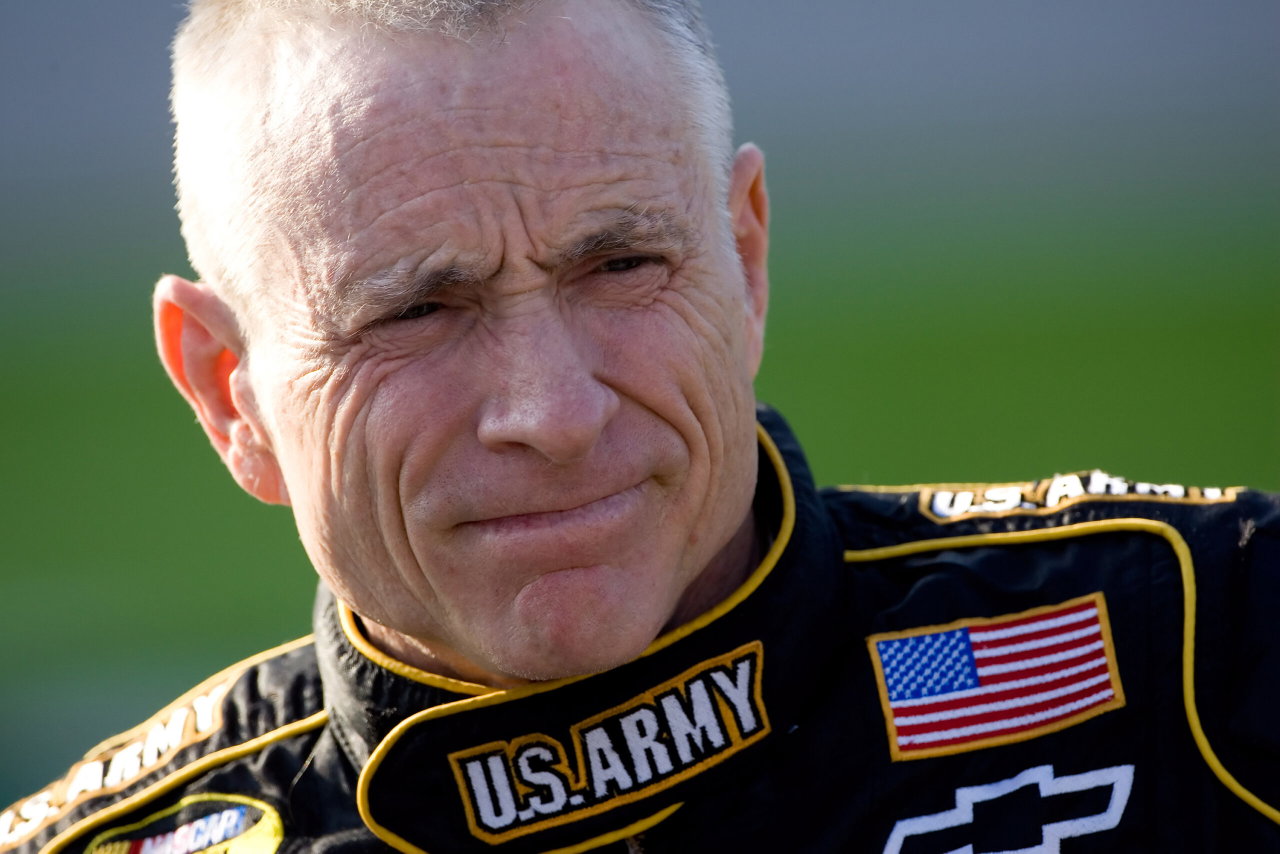
Mark Martin lost out on his first big chance to win the Cup series in 1990 by just 26 points to Dale Earnhardt. In the second race that season, Martin, driving the No. 6 Roush Racing Ford, was handed a 46-point penalty and a $40,000 fine for using an illegal carburetor spacer at Richmond Raceway. Without that penalty, he would have beaten ‘The Intimidator’ by 20 points.
Watch What’s Trending Now!
While it wasn’t to be, his next genuine shot at winning the Cup title came in 1994, and the then 12-year-old son of Martin’s crew chief and competitions director, Steve Hmiel, was nagging his father to give Martin something that may have helped him present a more meaningful challenge to Earnhardt. In conversation with Dale Earnhardt Jr., Shane Hmiel recalled something very intriguing from his time running around as a kid at Roush Racing.
“Your dad was beating them pretty bad through the 90s, and their(Roush) motors were terrible,” Hmiel said on the Dale Jr. Download podcast. “Mark complained all the time, but Jack could take him that Ford money because Jack had the Ford money.”
“And I remember going to the tracks, and I remember being a 12-year-old kid and like begging for my dad to get a Yates motor. Like, if the six cars had had Yates motors, Mark Martin would not be a zero-time champion.”
At the time, Yates made the C3 cylinder head layout, which was popularly known as the Yates Head. That Ford engine unlocked an extra 50 horsepower. And this was the very engine that a young Shane Hmiel suggested to be put in Martin’s No. 6 Roush Ford. But it is unlikely that the child understood the weight of what he wanted Jack Roush to do for Mark Martin.
Back in the 1990s, before Roush and Yates eventually came together to form a partnership in 2003, both Roush and Yates were manufacturing Ford engines for Cup cars. And the rivalry between the Ford engine makers ran through multiple layers.
Roush and Yates were premier Ford engine dealers, and on that front alone they were competing in the market. But when both engine makers began running their own Cup Series programs, the battle of the Ford engines began in the premier stock car series as well. Interestingly, Roush Racing began in 1988, and Robert Yates Racing began in 1989.
Yates’ engines were powerful. It was a Yates engine that powered Richard Petty to his 199th and 200th Cup wins. Yates’ masterful engineering was then utilized to its fullest potential as Dale Jarrett won RYR his first Cup Series title.
But by then the foes had turned into friends. The Ford rivalry ran so deep that NASCAR had to come up with a ruling to enforce uniformity across all Ford Cup Cars.
The issue became that Ford was competing within itself, as the Blue Oval’s target was to beat the likes of Chevrolet and Pontiac. To ensure all Ford teams were benefiting from the power that Yates had unlocked through the head technology, Yates was required to provide it to all Ford cars. To accommodate that demand and ensure quality, Yates transitioned from hand-grinding parts to mass-producing those components using CNC machinery.
Before the 2003 merger, Yates engines had powered 77 Cup victories, while RYR itself finished with 57 of those wins and the 1999 Cup title.
Hmiel’s call for Yates engines seemed more like a dream than a reality, but once the engine makers came together, what would have gone through Mark Martin’s mind? Would he be wishing that the chords of friendship had been strummed a decade earlier? But hindsight is always 20-20. Martin will forever be remembered as the best driver to never win the Cup Series.
Apart from 1990 and 1994, the No. 6 Ford driver would finish second in 1998 when Jeff Gordon won the title for Hendrick Motorsports, and in 2002, a year before the merger, when Tony Stewart won the championship. He would finish second for one last time in 2009, but that was when he was driving for HMS as his teammate Jimmie Johnson won his fourth of five straight titles.
Hmiel, who would run seven Cup races himself, praised Martin as someone he looked up to for the sheer understanding that Martin had about his car.
“I remember Mark saying, ‘Well, if you get the car to go faster down the straightaway, I won’t have to use as much brake.’ And it was just stuff I learned that I have advantages over people.” Hmiel said, “Mark mechanically understood the car. He knew when the clip needed to be changed. He knew what, you know, when he’s talking about the motor heights and crank heights and all that stuff, he knows what he’s talking about.”
Martin wouldn’t become a Cup champion, and Hmiel was only able to run seven races, so he couldn’t utilise all the information he had picked up shadowing his father at Roush Racing. Some stories are meant to remain incomplete.