
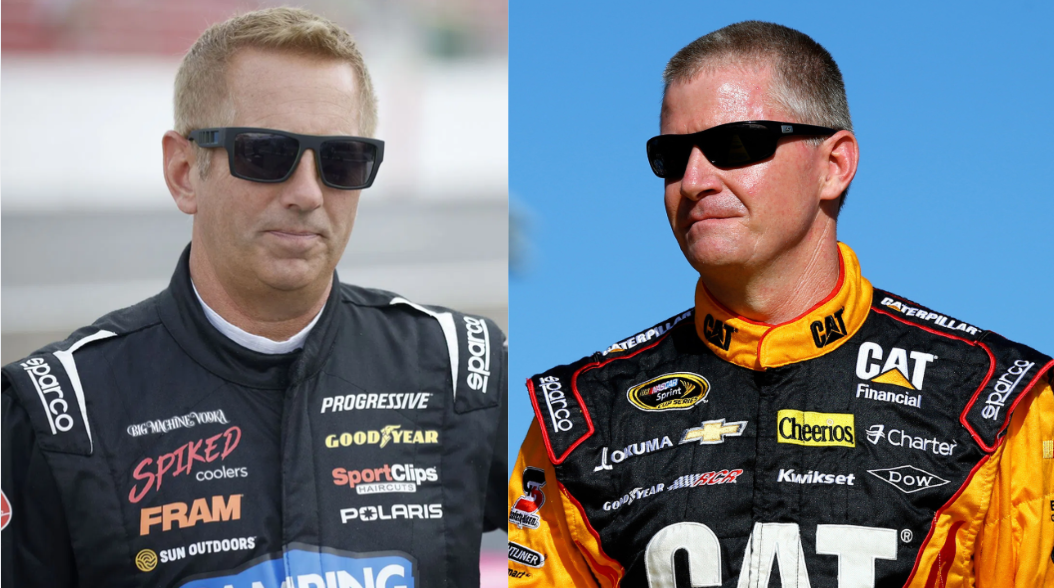
The NASCAR Hall of Fame Class of 2027 officially welcomed Jeff Burton, Kevin Harvick, and Larry Phillips. And they are all deserving in their own right to sit on this throne. But while two of them are celebrating, Burton finds himself in a more complicated spot.
Watch What’s Trending Now!
It’s a bittersweet moment for Burton, because alongside his own induction, there’s also the reality that a close friend of his, Greg Biffle once again got left out of the induction. After the snub, Burton didn’t really sit back and process it quietly; he spoke up, and you could tell it came straight from the heart.
“Look, Greg Biffle was also a Roush driver and a teammate. And we had a lot of good times together. He won a lot of races, rallies, and truck championships. And he definitely deserves to be in the Hall of Fame at some point. When that is, that’s not for me to decide,” the 58-year-old driver said, reflecting on his long-time friendship with his former teammate.
“But it’s horrible — horrible — we lost Greg and everybody that was on that airplane. What a devastating moment. And for those that are left behind, seeing him in the Hall will mean a lot.”

Understandably there's been some emotional responses to Greg Biffle not getting voted into the NASCAR Hall of Fame this go-round. Jeff Burton (who was teammates with Biffle at Roush) was actually asked about Biffle's HoF chances moving forward and said Biffle "definitely deserves Show more
Their connection goes all the back to their Roush Racing days. Then they weren’t just teammates but longtime rivals and friends who went through the wraths of the season together. And honestly, they were closer than many might think, and their friendship continued even after Burton exited Roush Racing.
Burton in fact also spoke at Biffle’s public memorial earlier this year after the former Roush Fenway Racing star passed away in a plane crash near Statesville in December. Burton’s words linger not because of their shared history but also because of how close the call fell once again for Biffle.
According to NASCAR’s official voting release, Kevin Harvick dominated the modern era ballot with 46 of 50 votes. Burton secured the second available spot with 32% of the ballots cast. Behind him came Neil Bonnett, Randy Dorton, and Biffle, who ultimately finished fifth even though he had won the NASCAR.com fan vote. The disconnect once again shows how differently fans and the official panel view Hall of Fame worthiness.
Moreover, while Burton no doubt is deserving, it is borderline a discussion on how Biffle is not in the picture, given his resume is just as good as Burton’s.
Burton retired with 21 Cup Series wins and 27 Xfinity Series victories, becoming one of the only 10 drivers in NASCAR history with at least 20 wins in both divisions. Biffle, meanwhile, collected 19 wins while becoming the first driver ever to win championships in both the truck and Xfinity series. But if you were to look at the separation factor, it’s not the racetrack where Biffle lost to Burton.
Burton’s influence across NASCAR extended far beyond statistics. Nicknamed “The Mayor,” he became a respected intermediary between drivers and NASCAR officials through the Drivers’ Advisory Council and later emerged as one of the sport’s most recognizable broadcast voices with NBC. Biffle’s post-racing legacy, however, built a different kind of admiration.
Following Hurricane Helene in 2024, the Mooresville resident famously used a helicopter to deliver supplies into isolated parts of western North Carolina, earning widespread praise across the racing world. He was later awarded the Myers Brothers Award by the National Motorsports Press Association.
And recently, the Biffle family’s legal troubles have only added another painful layer. A $15 million lawsuit filed by representatives of Dennis and Jack Dutton, who also passed away in the crash, has been brought against Biffle’s estate, making it a difficult period of grief for the family.
This was also the second time Biffle was nominated, and sure, he will be nominated again, but an earlier Hall of Fame induction would have offered the extended family at least one moment of uncomplicated celebration.
Even veteran NASCAR journalist Jeff Gluck admitted he expected emotion to play a larger role in the room during Tuesday’s vote.
“I was surprised there wasn’t more of an emotional push for Biffle following his tragic death in a plane crash late last year. But ultimately, it wasn’t his year to get in. The problem is there’s a bit of a logjam right now with drivers like Burton, Bonnett, and Biffle, all of whom won a relatively similar amount of Cup races, in addition to deserving crew chiefs and engine builders,” Gluck noted.
That said, Biffle’s omission and now Burton’s comments highlight one question.
Should the voting process be examined?
There are 15 finalists on the NASCAR Hall of Fame ballot, and they’re split into two groups. Ten nominees from the Modern Era, from which only two are inducted, while five nominees from the Pioneer Era have just one move on. And this structure has become more and more of a bottleneck.
Since the Hall opened in 2010, NASCAR has purposely kept induction classes small, unlike the NFL and NBA, to maintain a sense of exclusivity and not burn through its pool of candidates too quickly.
The rationale works on paper, but the system, as it operates now, is not really separating the elite from the rest. The format often pits Hall-worthy names against each other for artificially limited spots, with accomplished names like Greg Biffle repeatedly left on the outside of the Hall despite credentials many feel are already more than worthy.
The issue was clear on this year’s ballot for the Pioneer Era. Ray Fox, Harry Hyde, Banjo Matthews, and Herb Nab, all foundational figures from NASCAR’s early decades, are still on the outside looking in for induction despite their historic contributions to the sport.
A more practical solution would be to move from fixed class sizes to a threshold of some percentage of votes. For example, MLB inducts any candidate who receives 75% of the vote, with no limit to the number of people who can be inducted each year. Also, voters are not limited to picking just a few names; they can pick multiple names.
If NASCAR were to follow suit, voters wouldn’t have to compare Kevin Harvick vs. Jeff Burton vs. Greg Biffle as if only one resume could matter. Until the process changes, several deserving figures may continue waiting far longer than they should.