
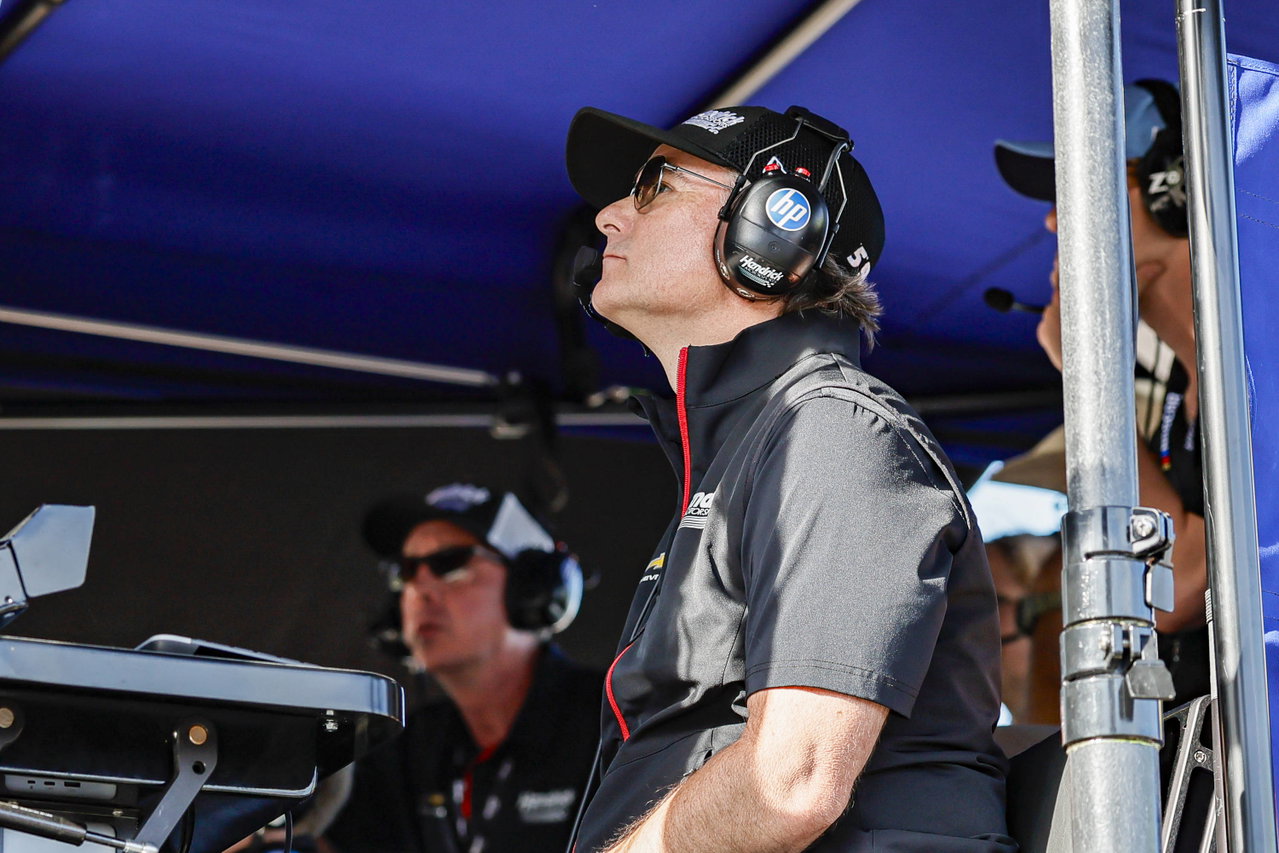
With Ben Kennedy and Steve O’Donnell now leading NASCAR’s front office, an old question has only grown louder: Is the sport evolving, or abandoning the identity that built its fan base? Street courses, unconventional venues and streaming pushes have fueled criticism that NASCAR is chasing new audiences at the expense of its traditional product.
Watch What’s Trending Now!
That is where Gordon sees O’Donnell as crucial. After decades across NASCAR’s competition and business ranks, the current CEO brings the institutional knowledge to help the sport evolve without losing touch with the fans and traditions that built it.
“I think he brings a lot of strength in asking, ‘Hey, how do we stay true to our core fan? How did we get here?’ He understands the history of it, and let’s not veer too far off from that. But we still have to bring new fans in.” Gordon said about Steve O’Donnell on the Dale Jr. Download podcast.
Ben Kennedy was elevated to COO at the same time, creating what Gordon sees as a balanced pairing. O’Donnell protects NASCAR’s roots while Kennedy pushes innovation.
“Ben comes in right. I think his youthfulness- you know, he’s not afraid to take chances and create new ideas- and I love the things that he’s bringing to the table, and I think the teamwork between him and Steve O’Donnell makes it a reality.” Gordon said in the same podcast.
That balance was on display in San Diego in June 2026, when NASCAR took the Cup Series to Naval Base Coronado for the first time.
The 3.4-mile temporary circuit marked NASCAR’s first premier-series race on an active military base and brought the sport into a fresh market. Gordon saw it as proof that experimentation could work without stripping away NASCAR’s identity.
“I mean, I just look at San Diego this year. I mean, what a home run, right? I mean, that’s everything that I think that we want. We want a new venue in a new market. We get to tie it to the military, which is such a huge part of not just celebrating 250 years, but our sport every year.” Gordon said.
He added that new partners wanted in, fans embraced the event, and even Coronado residents were “partying in their front yard,” creating an atmosphere Gordon said “felt old but new.”
Gordon made clear that experimentation should not come at the cost of NASCAR’s historic venues.
“I love that we’re going to North Wilkesboro. I don’t want us to ever leave there,” he said, also pointing to Darlington and Charlotte.
North Wilkesboro alone explains why.
The track hosted the finale of NASCAR’s inaugural Cup season in 1949 and remained a fixture for decades before losing its dates in 1996 as NASCAR expanded into newer markets.
Its 2023 revival was widely treated as a return to the sport’s grassroots identity, with NASCAR itself describing the venue as a direct link to stock-car racing’s moonshining roots.
The inaugural Brickyard 400 in 1994 was the first event other than the Indianapolis 500 held at Indianapolis Motor Speedway since 1916 and drew more than 250,000 fans, instantly becoming one of NASCAR’s marquee dates. But that aura weakened over time. After years as one of the sport’s best-attended races, attendance fell from an estimated 270,000 in 2007 to 140,000 by 2010, with the disastrous 2008 tire race accelerating the decline.
NASCAR later tried the Indianapolis road course from 2021 through 2023 before returning to the oval in 2024.
“I had always said for the Brickyard that I thought it should only happen every four years,” Gordon said. “From the very beginning, it was so unique, so special, so huge that you knew you couldn’t replicate it every single year.”
His point is to keep marquee races special, not routine.
For Gordon, NASCAR’s future is about expanding without losing what made it matter. His own career reflects that same balance.
Jeff Gordon revealed the reality of his historic Hendrick lifetime deal
Jeff Gordon never left Hendrick Motorsports, but staying was not just about loyalty. When outside opportunities came calling in 1999, Rick Hendrick moved to lock down his superstar with a lifetime contract.
“That’s when we said we’d do the lifetime deal,” Hendrick said. “We put it to bed and never had to worry about it again.”
“I know I want to be here. I want to be here, you know, forever. And he said, ‘Great. Well, let’s do a lifetime deal.’ And I was like, ‘Seriously?’ And he’s like, ‘Absolutely. I don’t want you to go anywhere,’” Gordon recalled.
On the Dale Jr. Download, Gordon pulled back the curtains.
“I think people would be shocked if they saw what my driver contract looked like,” he said. “There were no guarantees… If the car did well on track, if the car did well with sponsorship, then we participated.”
His earnings depended on performance and sponsorship. Already a three-time champion, Gordon added a fourth title in 2001 under the same deal.
When Hendrick wanted to expand to a fourth Cup car for rising star Jimmie Johnson, Gordon agreed to place the No. 48 under the same limited-liability company as his No. 24.
“I said, ‘Yeah, let’s put it under the same LLC.’ He’s like, ‘Fine, you know, then you are going to be responsible for it.’ And I said, ‘Absolutely, I get it,’ which was probably dumb for me to say. Now, looking back, understand how difficult sponsorship is, right? How difficult it is to, you know, to make money racing.”
Gordon’s gamble ultimately paid off, with the No. 48 landing Lowe’s as a major sponsor and Jimmie Johnson going on to win seven Cup championships.
The lifetime deal was not security. It was shared risk, and it pushed Gordon beyond the driver’s seat.