
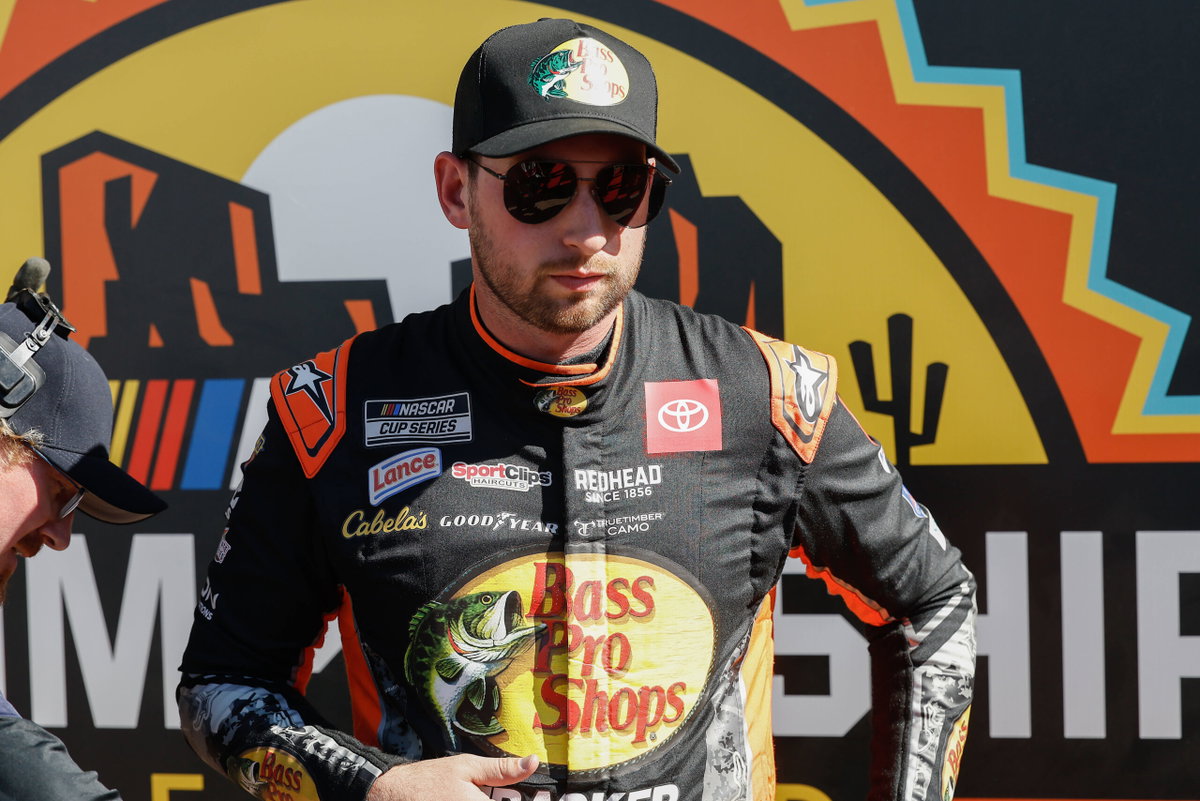
Chase Briscoe looked like he had a genuine shot at beating Kyle Larson at Kansas, but he had to settle for a P4 finish. Now, crew chief James Small has revealed that the No. 19 suffered visible late-race damage, with a rock and what appeared to be concrete lodged in the car, hence damaging its bodywork.
Watch What’s Trending Now!
“It looks like we’ve got some damage there. The rock is all torn open. We’ve got some concrete or something stuck in there, so I’m sure that didn’t help either, but it is what it is,” Small told Matt Weaver after the race.
The damage came during a tense final run in which Briscoe was briefly leading the race. He passed Larson with 30 laps remaining after the final green-flag pit stops. Briscoe appeared capable of pulling away, but Larson stayed within striking distance and eventually reclaimed the lead with seven laps to go. Briscoe then hit the wall multiple times while trying to keep pace and ultimately dropped from second to fourth.
Briscoe had already acknowledged that the car became increasingly difficult to handle during that final stint. He told USA Sports.com (as reported by NASCAR.com) that his Toyota became “really, really, really free” and that he was effectively hanging on as the laps wound down.
That is something Small also expected Briscoe to say after the race, as we will see later in this story.
When asked regarding anything that could have been changed with the car build or the final pit stop, the crew chief admitted that the outcome was disappointing but also said that Briscoe did well to keep the car under him.
“I haven’t spoken to him. I don’t know what he said. I’m sure he’s going to say he got it free, but yeah, maybe not get it free. He just managed to hang on there. So, yeah, it’s just a shame the way it ended,” Small said.
The handling issue was particularly damaging because Briscoe had already been able to make up ground on Larson earlier in the stint. After taking the lead, the JGR driver believed he could pull away. Instead, he found himself trying to manage an increasingly loose car while simultaneously defending the position.
Small admitted there may have been some room for improvement in how the tires were managed, although he also pointed to the difficulty of balancing the car through traffic and clean air.
“Maybe a little bit. There’s a lot of input-related stuff. We’re doing a good job trying to manage him off of two and things like that. You can tell we’re being pretty aggressive there and trying to get back up to the five. It’s obviously always a little harder once you get clean air. It’s hard to manage the balance between traffic and clean air.”
Small also noted that the lapped cars were, to some extent, helping Briscoe, but the balance eventually shifted.
The collapse was especially costly given what was at stake for Briscoe. Entering Kansas, he needed something to keep his title hopes alive, and once Larson took the lead, he admitted he had gone into ‘desperation mode’. Larson did make contact with the No. 19 car to overtake the lead, and Briscoe could’ve returned the favor. But he never got the opportunity because of the damage on his race car.
“I just started kind of letting loose and just running as hard as I could, and got into the wall and obviously went from second to fourth,” Briscoe said as per NASCAR.com. “Just went into desperation mode, truthfully. I had to win to kind of stay in contention for the championship and came up short.”
Briscoe also believed he could have been more aggressive, as he added, “I could have, playing it back in my mind, been more aggressive with changing lanes and being unpredictable – kind of like he was doing when he had the lead. He was doing an amazing job. I was superior to him, and I couldn’t pass him.”
Briscoe finished fourth, losing 36 points to Larson, and he now trails behind the championship leader by 123 points, with six races left to decide the championship.
Small’s damage revelation adds another layer to what was already a frustrating Kansas finish. Briscoe had the pace to challenge Larson for the win, but a combination of tire management, an increasingly loose balance, and late-race damage ultimately left them watching another opportunity slip away.