
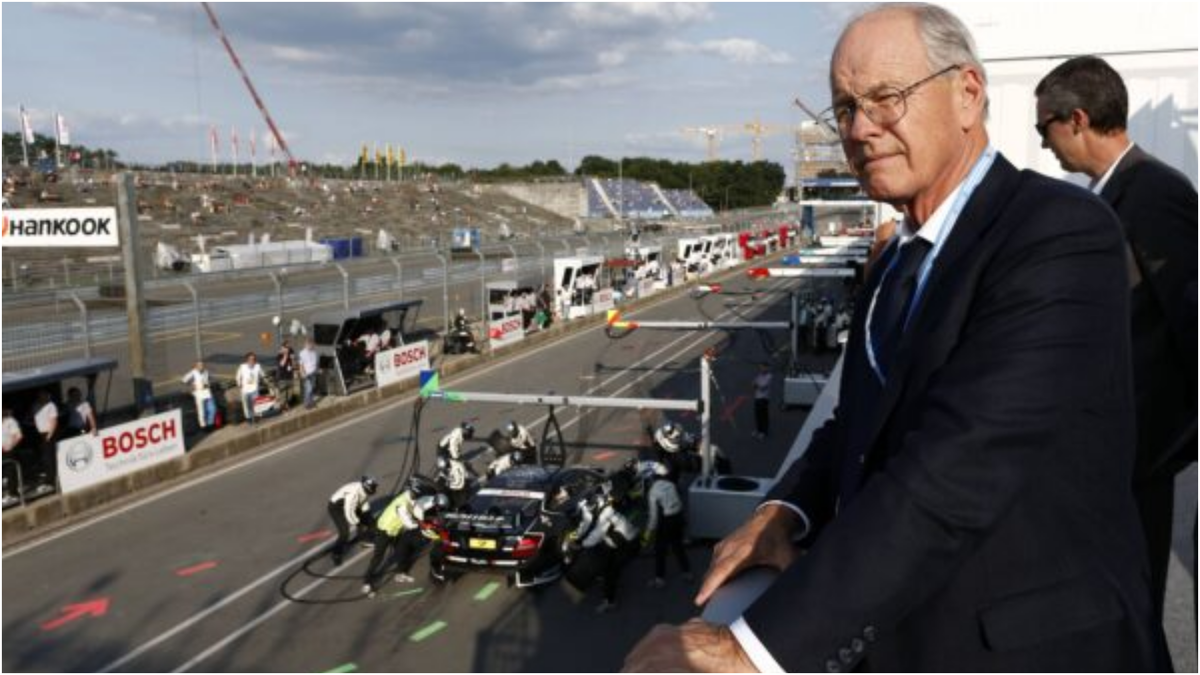
In 1959, 14-year-old Jim France took his first step into the family business, helping his father, the founder of NASCAR, build a racing empire. Over six decades and working through every level of management, he has been that family wall. He then stepping up as CEO to save a family name in crisis. But a lot has changed since last year, when Michael Jordan and Denny Hamlin tussled with the France family in court. It sure ended in a settlement but if we are to go by the latest updates, it seems like the lawsuit fast-tracked the power dynamics. Now eight years since he took over the role of CEO, he has to hand the keys to NASCAR. And to someone outside the France bloodline.
Watch What’s Trending Now!
According to Athletic’s Jordan Bianchi, Jim France is going to step down from his role as the CEO and will be replaced by current NASCAR president, Steve O’Donnell. He now becomes the first non-France family member to serve as CEO in NASCAR’s 78-year history. Now that’s a first, and while it looks like this is a genuine change at the leadership level, you might want to keep your expectations in check.
This seismic change will also see Ben Kennedy, France’s great-nephew, take up the role of COO. And given how current leadership is slated to change hands, he is being groomed to take over the family business in the near future. Kennedy will also take on a larger role in competition oversight, with senior leadership now reporting directly to him instead of O’Donnell. It is worth noting that NASCAR hasn’t officially confirmed this change, but the report states that it will be made public at Talladega during the NASCAR race weekend. But is this move really decentralizing power within the NASCAR ranks? Let us try to find out.
Jim France has a 54 percent ownership in the family business, whereas the other 46 percent of the company is owned by his niece, Lesa France Kennedy, Ben Kennedy’s mom. NASCAR confirmed this news ahead of the Talladega race weekend. France will step down as CEO but remain chairman, ensuring the family still maintains control at the top level.
“What I’m going to do is go out and do a lot of listening, especially the first 90 days. We’ve got so many talented people in the industry — team owners, drivers, track, sponsors, even our own internal personnel that I want to go have some conversations with about what do they see and what are the opportunities? I think the great news is, we’ve got an unbelievable foundation, right? We’ve got a great broadcast deal. We’ve got charters in place, a strong schedule. So all those nuts and bolts are there, and it’s really taking that and looking at how do we make NASCAR an absolute must-have sport in the future.”
So on the surface, it looks as if this is the new era for the sport, but the actual power remains within the France family. Steve O’Donnell does seem like a nice choice for the job, but even he didn’t come out clean from the lawsuit.
.@NASCAR scheduled a meeting with teams today to discuss a forthcoming executive change that will result in Steve O’Donnell being named CEO, Ben Kennedy being named COO and Jim France remaining on board as chairman, per sources.
➡️ France had been chair and CEO since 2018. pic.twitter.com/2SpnzbGS6i
— Adam Stern (@A_S12) April 24, 2026
He was the one leading the charter negotiations and forced the teams to sign a “Take it or leave it” agreement. Moreover, the discovery process also shed light on his role in trying to sabotage the SRX series, which was growing as NASCAR’s direct competitor in the stock car racing segment. He has also drawn fan criticism for admitting stage breaks were designed to fit more TV commercials and for backing the “Next Gen” car.
Yet, O’Donnell now has the full scope of operations—the Cup Series, the NASCAR O’Reilly Auto Parts Series, and the Truck Series—along with IMSA’s sports car program, company-owned tracks, long-term planning, and financial oversight. This expanded role comes after his promotion to president in March 2025 after Steve Phelps’ move to commissioner, which is a position he later vacated ahead of the 2026 season during the lawsuit fallout. This is why his appointment seems somewhat controversial to many.
Now By no means is this new job going to be easy for O’Donnell, especially after the turbulent past few years, and Jim’s smart yet decisive control over the sport. Jim France, although a silent leader, has steered the ship well in his tenure. His ties to the sport are not just based on his family name. He had been working within the France family’s motorsport operations since 1959, when he joined the International Speedway Corporation at age 14. Over the following decades, he worked through every level of ISC management, eventually becoming its president from 1987 to 2003.
He also founded GRAND-AM Road Racing in 1999 and was the driving force behind its merger with the American Le Mans Series, which formed IMSA in 2014. When he became CEO, he was someone who had spent 60 years building the core of NASCAR. It goes without saying that his departure could lead to a big transition for the sport; for good or bad, we’ll have to wait and watch.
A string of events that made a leadership change inevitable
The biggest pressure point came from a lawsuit filed by 23XI Racing, co-owned by Michael Jordan and Denny Hamlin, along with Front Row Motorsports. The teams sued NASCAR over its charter agreement, claiming the organization operated as a monopoly and used that power to limit team rights and revenue sharing.
The case went to trial in late 2025 and was settled in early 2026, with NASCAR making a major concession: permanent charters for teams. It was a change that led with a message: the old way of doing things had limits.
The legal battle also created collateral damage internally. Steve Phelps, who had been NASCAR’s first-ever commissioner, resigned in January 2026. Leaked text messages and testimony from the trial had cast a shadow over leadership, and Phelps’ exit felt like the first sign that more changes were coming.
Ben Kennedy’s growing visibility in the months leading up to the announcement had not gone unnoticed either. France’s great-nephew had been attending more events, increasing his public presence, and was already the vice president and chief venue and racing innovations officer. Many reporters alluded to such observations over time.
@Jordan_Bianchi reporting Jim France stepping down as NASCAR CEO, will be replaced by Steve O’Donnell & that it will be announced this weekend. Bianchi reporting NASCAR is also promoting Ben Kennedy, France’s great-nephew, to chief operating officer from his current position as… pic.twitter.com/7gvzNfMWrC
— Claire B Lang (@ClaireBLang) April 24, 2026
In the broader context of things, declining Cup Series ratings compared to the sport’s peak in the 2000s, expansion into new markets, and the ongoing need to modernize how NASCAR operates commercially, only reinforced why a clean handover made sense now rather than later.