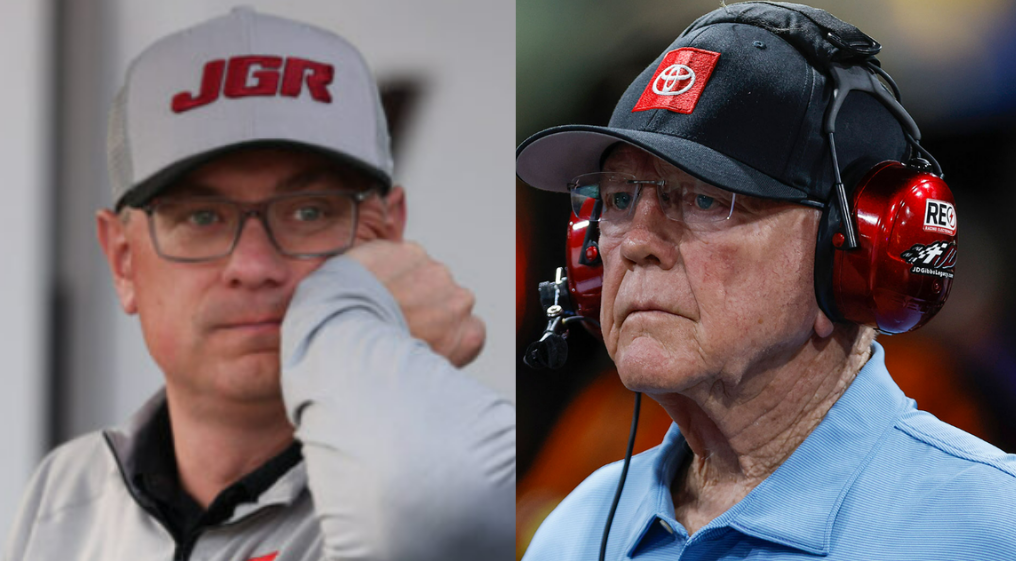
The legal battle between Joe Gibbs Racing and former competition director Chris Gabehart has taken yet another explosive turn. JGR has already accused Gabehart of orchestrating a “brazen scheme” to steal confidential data and hand Spire Motorsports a competitive edge, allegations Gabehart firmly denies. But now, the situation in the JGR lawsuit has intensified. A new whistleblower from within the organization has stepped forward, adding fresh claims to an already volatile case. With internal voices emerging and tensions escalating, the lawsuit is shifting from a contractual dispute to a full-fledged organizational reckoning.
Watch What’s Trending Now!
JGR’s core argument
Joe Gibbs Racing’s latest filing zeroes in on how Spire Motorsports publicly described Chris Gabehart’s new role. They claim that it mirrors his former responsibilities at JGR almost exactly. They note that Spire co-owner Jeff Dickerson openly stated Gabehart would oversee competition across Cup, Truck, ARCA, IndyCar, and more, with broad autonomy to guide the NASCAR program.
New filing from Joe Gibbs Racing states that Spire’s articulation of Chris Gabehart’s role at Spire, Chief Motorsports Officer, is the same as his competition director role and wants the court to consider this argument before reaching a restraining order decision pic.twitter.com/whUYaYvf9T
— Matt Weaver (@MattWeaverRA) March 2, 2026
According to JGR, that description matches the strategic, multi-series duties Gabehart handled internally. Because his noncompete bars him from performing similar services for another Cup or Xfinity organization, JGR argues the court should weigh this heavily when deciding whether to issue a Temporary Restraining Order. This was filed as supplemental authority after the latest hearing in the JGR lawsuit.
What JGR is asking


Joe Gibbs Racing is urging the court to issue a Temporary Restraining Order that would immediately block Chris Gabehart from performing any duties at Spire Motorsports that resemble the work he carried out at JGR. That includes overseeing competition, providing technical direction, or using any information the team deems confidential. Beyond stopping him from working in a similar capacity, JGR is also requesting that Gabehart’s devices undergo a full forensic examination, all confidential materials be returned, and that an injunction remain in place for 18 months.
Their request is rooted in what they call “shocking” forensic findings: that Gabehart synced his personal Google Drive to his JGR laptop, repeatedly searched Spire-related queries during late 2025, stored a “Spire” folder containing “Past Setups,” and possessed more than a dozen images of sensitive JGR screens.
Gabehart had hit back at the allegations. “I look forward to the opportunity to demonstrate to the Court that I have not shared JGR’s confidential information with anyone. In fact, I have already demonstrated that to JGR. A third-party forensic expert retained by JGR recently examined my laptop, cell phone and personal Google Drive and found no evidence to support the baseless allegations in JGR’s lawsuit,” he wrote on a message that he posted on social media as an indirect reply.
Spire’s response
In a sworn declaration in the JGR lawsuit, Spire Motorsports’ Head of People Operations, Heather Masterson, pushed back firmly against JGR’s implications, outlining a clean and documented hiring process. She states that Chris Gabehart did not begin working for Spire until February 16–17, at which point he signed both a confidentiality agreement and an NDA explicitly prohibiting him from sharing any JGR proprietary information.
Moreover, Gabehart’s formal employment contract was executed on February 17 via DocuSign, though compensation was retroactively applied to February 9. Masterson emphasizes that Gabehart performed no work for Spire prior to February 16 and was not even present at the Daytona 500.
Spire’s position is clear: Gabehart was hired properly, with legal safeguards in place. As co-owner Jeff Dickerson told FOX Sports’ Bob Pockrass, “We have a competition director of the Cup Series team. It’s Matt McCall. What Chris is going to be doing is overseeing several racing programs.”
Todd Berrier’s declaration
The most consequential development comes from veteran JGR employee Todd Berrier (ex-crew chief with drivers like Kevin Harvick and Kurt Busch), whose declaration directly supports JGR’s timeline. Berrier states that Chris Gabehart informed him as early as October 21, 2025, that he had already begun discussions with Spire leadership.
“On or about October 21, 2025, Gabehart told me that he had a meeting with the co-owner of Spire, Dan Towriss, about a potential job,” Berrier wrote in the declaration. “Later that night, Gabehart texted me to confirm that he had that meeting.”
This is a crucial point for JGR in the lawsuit. It helps establish their argument that:
- Spire was actively recruiting Gabehart months before he left JGR,
- Communications between the two sides began well before any official notice,
- And the transition was not sudden or clean, but part of a longer-running engagement.
Berrier’s statement strengthens JGR’s claim that Gabehart’s departure and the data concerns surrounding it require urgent court intervention.
The ‘Indemnity’ search
JGR’s forensic expert, Clark C. Walton, added another intriguing detail: on December 2, Chris Gabehart met with Spire co-owner Jeff Dickerson. And just two days later, on December 4, Gabehart searched the meaning of the word “indemnify,” Walton testified.
To JGR, the timing is no coincidence. They argue this suggests:
- Spire anticipated legal conflict from the beginning.
- Spire may have assured Gabehart they would indemnify him, meaning Spire would cover any legal costs if JGR pursued litigation
JGR is using this subtle yet pointed detail to build the narrative that Spire knew the risks, expected a lawsuit, and moved forward anyway. It reinforces their theory of coordinated, premeditated recruitment rather than an innocent career transition.
Expedited discovery request
JGR is pushing for expedited discovery within five days, seeking rapid access to evidence before the judge rules on the injunction. The team wants immediate clarity on several key points: the true scope of Gabehart’s role at Spire, whether Spire is indemnifying him against potential legal fallout, the complete timeline of communication between Gabehart and Spire, and whether any trade secrets were accessed or transferred after job discussions began.
It’s an aggressive legal maneuver. JGR is pressing for answers now, not weeks from now, aiming to bolster its case for a Temporary Restraining Order and potentially stop Gabehart from continuing his work at Spire in the immediate future.
What this case is really about
At its core, the legal fight rests on three major battlegrounds:
Noncompete Scope
Is Gabehart’s new title of Chief Motorsports Officer functionally the same as a Competition Director?
If yes: JGR’s request for a TRO becomes far more compelling.
If no: Spire can argue Gabehart is working in a broader, non-conflicting role.
Trade secrets
JGR is attempting to show that Gabehart:
Kept or accessed confidential JGR information,
And may have done so after conversations with Spire began.
Much of JGR’s argument hinges on timing, supported by forensic findings and digital activity.
Tortious interference
Did Spire knowingly interfere with Gabehart’s employment contract? The October 21 meeting with Dan Towriss is crucial here. JGR sees it as the beginning of intentional recruitment while a contract was still in force. These three pillars determine whether this case becomes a routine contract dispute or a blockbuster lawsuit with potential long-term implications for competitive boundaries in NASCAR.
The strategic positioning
JGR’s strategy hinges on painting a picture of coordinated movement between Gabehart and Spire. They aim to show that his new role mirrors his responsibilities at JGR, that Spire began recruiting him months earlier, that indemnity planning suggests both sides anticipated legal conflict, and that the timing elevates the risk of coordinated handling of trade secrets.
Spire, meanwhile, is positioning itself as clean and compliant in this JGR lawsuit. They emphasize a clear hiring date, adherence to confidentiality agreements, and the argument that Gabehart’s new role is a broader executive oversight position rather than a direct equivalent to his JGR duties, minimizing any notion of overlap.
Why this filing matters
This latest filing is more than routine legal paperwork. Rather, it’s a targeted effort by JGR to influence the judge ahead of the Temporary Restraining Order decision. By reinforcing a narrative of early recruitment, possible indemnity planning, and the potential risk to trade secrets, JGR is attempting to frame the situation as a deliberate, coordinated move that threatens competitive integrity. Each detail, especially the “indemnify” search, is crafted to raise suspicion and shift judicial perspective in their favor. This maneuver increases pressure on Spire and builds leverage, whether for a stronger injunction or a settlement push.
What happens next in the JGR lawsuit?
The next steps in the already-blazing JGR lawsuit lie entirely in the hands of the court. The judge will evaluate whether JGR has demonstrated a likelihood of success on the merits, whether irreparable harm is at stake, whether expedited discovery is necessary, and ultimately whether a Temporary Restraining Order should be granted. The ruling will define the next phase of this escalating conflict, determining whether Gabehart continues working at Spire or is forced to step aside while the case unfolds.
If the court grants the TRO, Gabehart could find himself temporarily sidelined from his new role, giving JGR a significant early victory. But if the TRO is denied, Spire emerges with strong momentum, weakening JGR’s claims and shifting leverage in its favor.
Either way, the fallout will shape the trajectory of one of NASCAR’s most consequential legal battles in years.
Related Newsletters