
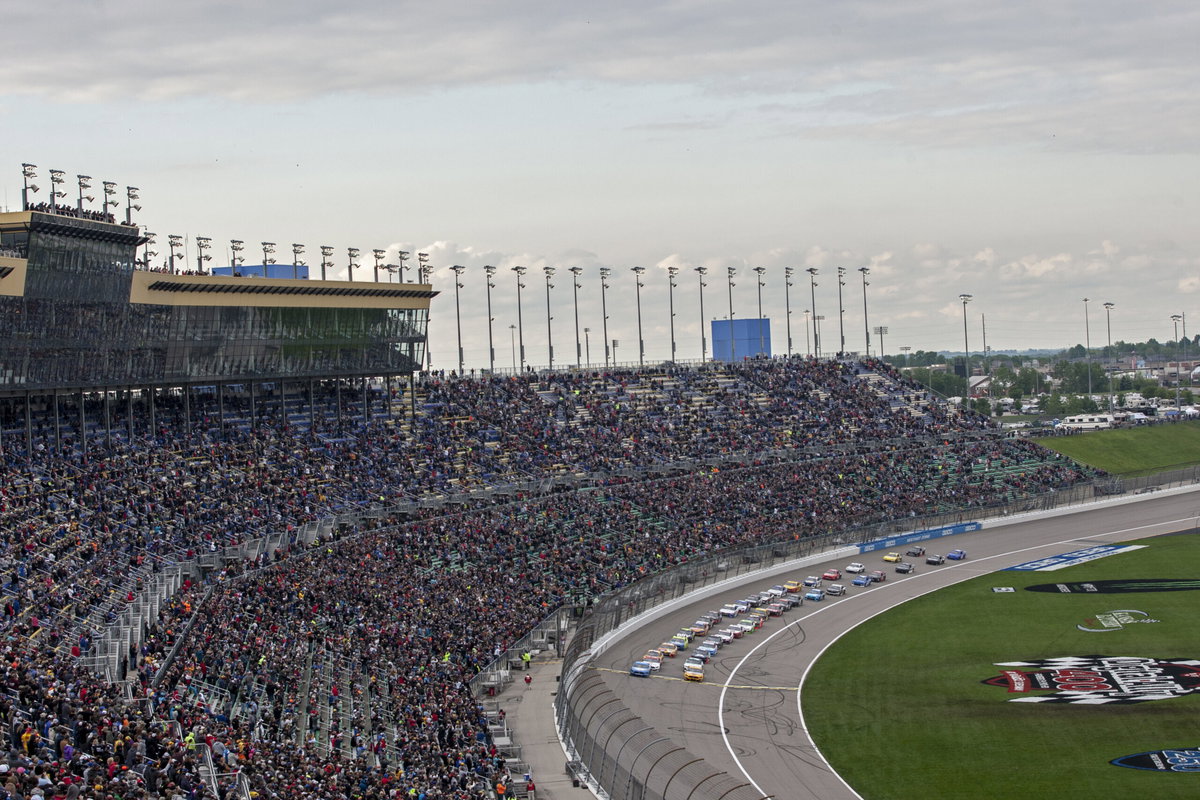
Is NASCAR really on a downward spiral when it comes to viewership? After all, only two of the eight races had an increase in viewers. The rest? They were down. But the most recent Cup race at Kansas was one that saw an increase in viewership, which is a sign of progress. However, NASCAR Insider Jeff Gluck seemed wary of that notion.
Watch What’s Trending Now!
Jeff Gluck paints a bigger picture for Kansas’ viewership increase
After NASCAR lost out on 100,000 viewers last weekend at Bristol, the Cup race at Kansas saw a gain of 600,000 viewers on Fox. Last season, an estimated 2.32 million fans tuned in to FS1 to watch the Cup race. On Sunday, that number went up to 2.93 million on Fox.
This meant that Tyler Reddick’s headlining fifth-win made the event the most-watched Kansas spring race in a decade since the 2016 Saturday night race on FS1 got 3.1 million.
But Jeff Gluck, journalist and co-host of The Teardown podcast, pointed out why the increased viewership and high number in a decade may not be as promising as it seems on the surface.
“The idea of NASCAR getting less than 3 million viewers for a non-delayed Sunday race on network TV this early in the season would have been absolutely shocking not all that long ago. The increase of 600k due to Fox vs. FS1 is great, but it also seems low. For example: An April 2022 Fox race from Richmond got 3.96 million viewers. Not to be a downer, but just being honest,” Gluck wrote on his X account.
Looking closer at the Kansas viewership from this weekend, it’s a bit of a mixed bag.
The Cup race had 2.93 million viewers on Fox, which naturally increased a lot over last year’s Kansas race (2.32 million) — which was on FS1 (cable vs. broadcast) and in May (no direct date…
— Jeff Gluck (@jeff_gluck) April 22, 2026
To Gluck’s point, the Kansas Cup race surely gained because of being on broadcast compared to being on cable, which is a dying medium. In fact, the Richmond race on FS1 last season itself brought in 3.87 million viewers, which was a huge increase from the 2024 number of 2.10 million.
Therefore, Gluck’s caution about celebrating the increase in viewership is justified, especially considering how the trend has been so far this season.
The Daytona 500 saw an increase of +11% in viewership, but it fell -2% at Atlanta, -5% at COTA, rose +1% in Phoenix, then dropped -8% at Las Vegas, -4% at Darlington, -1% at Martinsville, and -5% at Bristol.
In fact, the -5% viewership of Bristol compared to last season led some fans to realize that not long ago, the viewership wasn’t hovering in the 2-3 million range. It was close to 10 million, with the 2013 race getting over 7 million viewers.
So clearly, the Cup Series is not trending upward in its audience numbers. However, the one NASCAR series that is on an upward curve is the O’Reilly Series.
Anyway, The CW continued to shine with 1.18 million viewers for the O’Reilly race — up from the Rockingham race on this weekend last year.
One side of NASCAR is hitting home runs consistently with fans
Under the new NASCAR media rights deal worth over $7 billion, the Cup Series has seen bumpy numbers in terms of viewership with FOX Sports, NBC Sports, Amazon Prime Video, and TNT Sports under Warner Bros. Discovery.
But on the other hand, the O’Reilly Series under the CW has seen massive gains. In 2025, the series saw a 10% increase in viewership from 2024 to an average of 1.03 million viewers across 33 races. Interestingly, this was the best average since 2021.
And that success has been carried forward from 2025 to 2026 as well. While the viewership dipped for the Cup race at Bristol, it soared for the O’Reilly race. The race saw a 22% increase from 2024 and became the most-watched Bristol spring race ever.
The growth was once again consistent a week later at Kansas. The CW reported 1.18 million viewers, which was up from the Rockingham race on the same weekend last season.
All of this suggests that NASCAR is in a tricky spot with one of its series thriving and the other being a hit or a miss with fans. But even before they start to diagnose the problems, they’d have to acknowledge them.
After all, an increase in viewership from last season might just come across as a moment to celebrate if it isn’t looked at under a larger context.