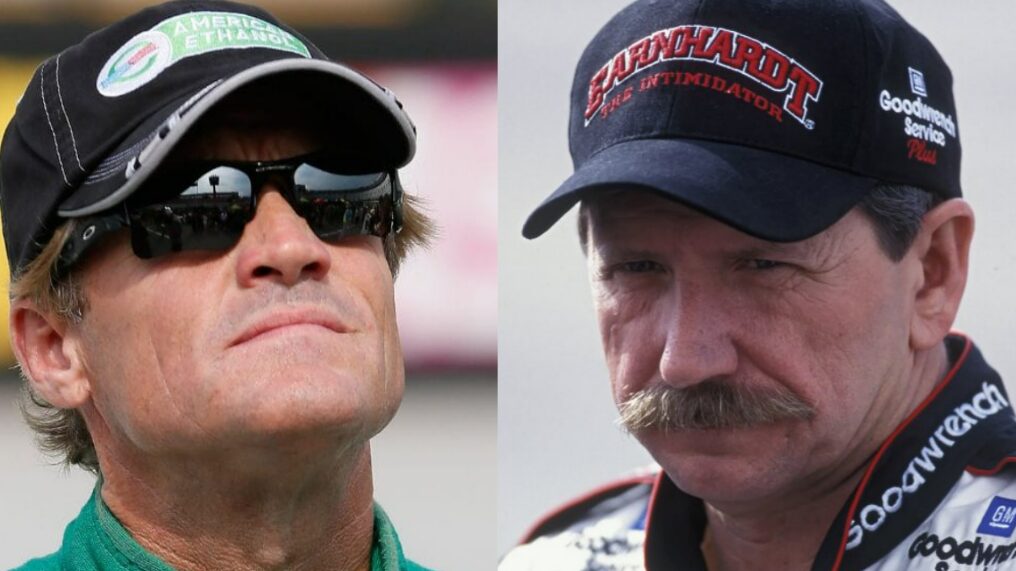
This isn’t an experience any parent would ever want their child to live through. However, for Kenny Wallace’s daughter, it unraveled in a sixth-grade gym class. As the NASCAR world reeled from the devastating loss of seven time cup series champion Dale Earnhardt at Daytona in 2001, the tragedy beyond the race track followed, took a cruel turn, one that left a deep emotional scar on Wallace’s daughter, a moment that won’t fade away anytime soon.
Watch What’s Trending Now!
While speaking on Coffee with Kenny, Brandy Lowder shared a moment from her childhood that still sticks with her, a reminder of just how unhinged the emotional aftermath of Dale Earnhardt’s death became.
“So we were in gym and my whole class was like gathered together and he said everyone raise their hand if they wish that Kenny Wallace died over Dale Earnhardt and there were very few kids that raised their hand but it still just was like ‘Oh my god’ and so you just try to like, oh my god,” she said, experiencing that trauma once again for a split second.
The grief definitely spilled over in ugly ways. And the center of it all was her father, Kenny Wallace, although he had nothing to do with that fatal crash.
Wallace was driving the No.27 Pontiac that day, starting 23rd and finishing 25th, nowhere near the leaders when Earnhardt went down on the final lap.
Wallace’s only incident came earlier in the race during a massive 18-car pileup, the kind of wreck Daytona is infamous for, but Wallace walked away and continued the race.
Growing up #NASCAR came with a lot of perks but kids can also be mean at times@Kenny_Wallace Conversation with his 3 daughters
Full show: https://t.co/8aXOdoosX1 pic.twitter.com/59sfUBHi5K
— Kenny Wallace Media (@KWallaceShow) January 15, 2026
The Intimidator’s fatal crash happened at the front of the back as he ran third, blocking behind Michael Waltrip and Dale Earnhardt Jr., with contact from Sterling Marlin and Ken Schrader catapulting his car, leading to his tragic death instantly.
Still, the shock of losing NASCAR’s biggest icon left some fans desperate to point fingers. Logic disappeared. Grief turned into anger, and there was no remorse shown.
And for Brandy, hearing kids her own age say they wished her father had died instead was a cruel snapshot of how deeply that tragedy affected the sport and the people around it.
While the community has learned to live with Earnhardt’s passing, his legacy has never been forgotten. February 18 this year marks 25 years since the loss of the Intimidator.
This incident shook the world. In its aftermath, NASCAR committed itself to making driver safety a top priority.
How NASCAR changed its safety game
Dale Earnhardt Sr.’s death was not just the loss of an icon; it became the catalyst for sweeping, long-term changes that automatically improved driver safety and virtually eliminated fatalities in the top NASCAR series since then.
The most significant change was the required use of the HANS device (head and neck support), which was made mandatory in NASCAR’s top three series just months after Earnhardt’s death.
This carbon fiber collar dramatically reduces the risk of basilar skull fractures, the type of injury that killed the intimidator, by keeping the head synchronized with the torso during high-impact crashes.
In the years following the crash, NASCAR implemented SAFER barriers (Steel and Foam energy reduction) around oval tracks. These soft walls absorb much of the force from high-speed impacts, reducing crash violence and the likelihood of serious injury.
The death also prompted NASCAR to open a research and development center in 2002, where specialists study crash data, test safety technologies, and continuously refine safety standards.
Thanks for this collective advancement; there hasn’t been a driver fatality in NASCAR’s top three series since Earnhardt’s crash. This star safety improvement stands as a testament to the reforms spurred by that moment.
Related Newsletters