
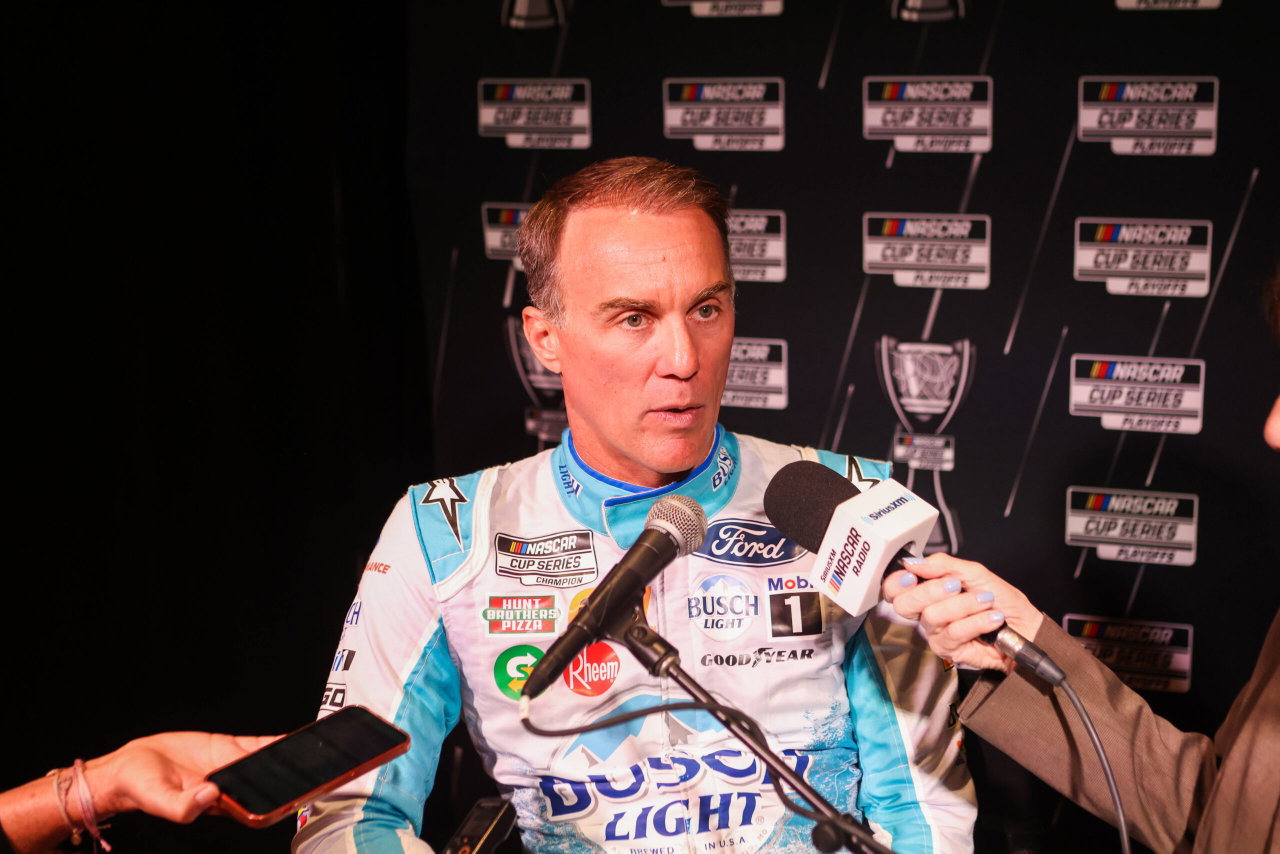
Few drivers can describe what too little power feels like in a Cup car as bluntly as Kevin Harvick. The 2014 Cup champion spent 23 full-time seasons in NASCAR’s top series and collected 60 wins along the way. Since stepping away after 2023, he has used his microphone to say what many in the garage only whisper. This week, NASCAR handed him plenty to talk about.
Watch What’s Trending Now!
“NASCAR came out this week, talking about a whole bunch of things that they have on the docket for 2027 to be able to get more power back in the cars. So they’re going to have a small runway to get to around 800 horsepower with the Cup cars on the short tracks,” Harvick said on Speed with Harvick and Buxton.
NASCAR’s November 20 announcement put dates on the plan. Intermediate-track horsepower will climb from 670 to 750 beginning with the Coca-Cola 600 at Charlotte Motor Speedway on May 30, 2027. A week earlier, the All-Star Race at North Wilkesboro on May 23 will serve as a test bed for an experimental 800-horsepower package.
NASCAR and the engine builders will study the results before deciding whether to expand it to other short tracks and road courses, with Bristol in August the earliest possible landing spot.
Kevin Harvick knows the switch cannot happen overnight. Manufacturers and engine builders need time to source new components, and he stressed how long that process takes.
Was Jeff Gordon the Biggest Victim of NASCAR’s Format Changes?
“This is a difficult thing to do because you’re going to have to work with all the engine manufacturers. In order to get parts and pieces and things that you need, the lead time to get those parts is months and months. We’re talking six, eight months on a lot of these parts and pieces,” he explained.
“So they have to give the engine shops enough time to get the parts and pieces they need to not just throw everything away that they have.”
Power is only one piece of the 2027 package. NASCAR is also preparing aerodynamic changes for short tracks and road courses, including removing the splitter stuffers from the Cup cars, and qualifying tweaks at Daytona and Talladega aim to push speeds back above 200 mph.
The Next Gen car, which debuted in 2022 with 670 horsepower on larger ovals, has faced persistent calls from drivers for more power and less downforce.
The push for power has a competitive angle, too. More horsepower makes cars harder to drive on worn tires, which rewards drivers who can manage the throttle and gives faster cars a better chance to pass late in a run. Short tracks like North Wilkesboro, a 0.625-mile oval that hosted the All-Star Race in 2023, are where that difference tends to show most clearly.
“The other news that came out is we’re going to have more horsepower for qualifying at the Clash and the Daytona 500. Brilliant, to get these cars running around 200 miles an hour,” Harvick said. “So I love the aggression. I love the fact that NASCAR and the teams and the manufacturers are figuring out how to get power in the cars.”
The enthusiasm is a sharp turn from his reaction to NASCAR CEO Steve O’Donnell’s State of the Sport address at Homestead-Miami Speedway. Harvick acknowledged improvements to the Next Gen car but argued the Cup Series still needed bigger changes.
He dismissed the immediate need for an entirely new Gen-8 car and instead pitched a Gen-7.5 with revisions to the engine, underbody and structure.
Harvick’s frustration was summed up in a blunt four-word message to NASCAR: “Quit d****** around.” He wanted the sanctioning body to stop making gradual adjustments and take more decisive action to improve the Cup car.
“They finally have come around to needing more power. Just put some more power in the damn car, and they’ve slowly crept it in there,” Harvick said.
He also argued NASCAR should focus on the Cup car rather than altering the O’Reilly Auto Parts Series and Truck Series platforms, which he believes already produce good racing.
Harvick is not alone. Christopher Bell welcomed the direction after the 750-horsepower package appeared at selected tracks, saying in March he hoped “we’re turning the right knob.” Ryan Blaney, after winning at New Hampshire in 2025 with that package, called it the right direction because it creates “comers and goers” and more passing.
Even so, Harvick sees a ceiling with today’s hardware. “I think they feel like they’re getting pretty close to the max power for this parts configuration,” he said, adding that the next step is better engine components.
For Harvick, the changes are a welcome step toward the Cup racing he has been demanding. Harvick’s 60 Cup wins give his opinion weight, but the engine builders, who must deliver parts on a tight timeline, will decide whether the plan works.
The real test arrives in 2027, when the new packages hit the track and show whether NASCAR’s bigger swing translates into noticeably better racing.