
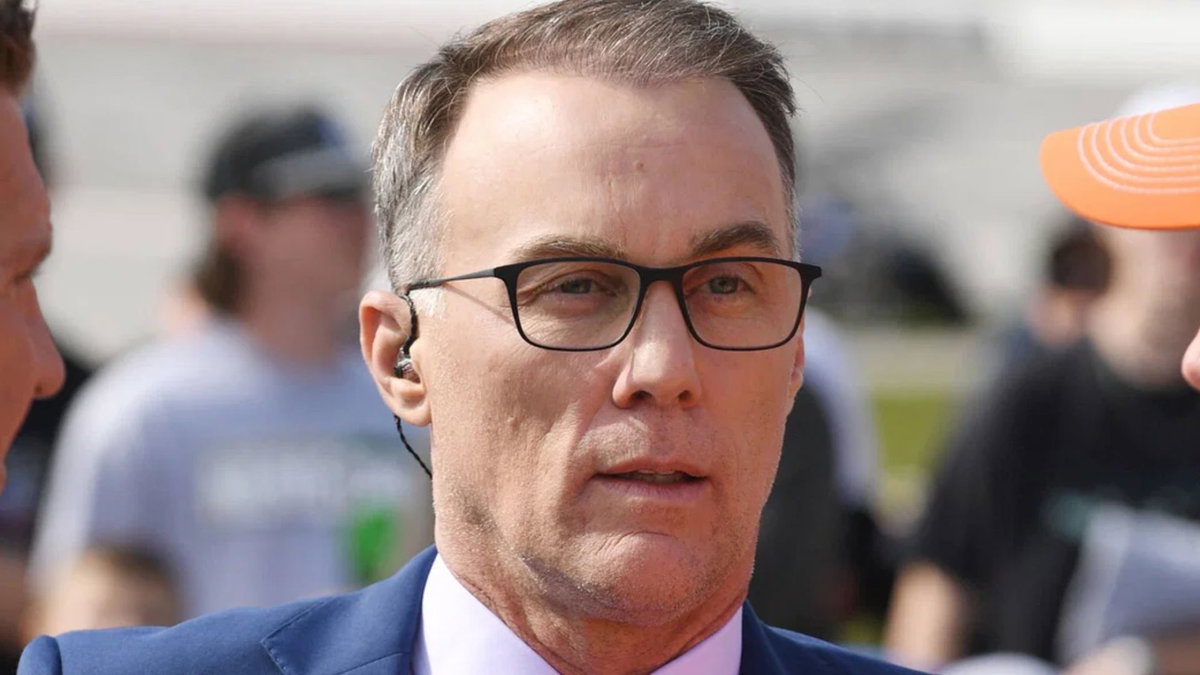
NASCAR is stuck in one big confusion now: Should it give fans the wild racing they love, or keep car makers happy? With less horsepower and more rules, that old madness is fading. That is why Kevin Harvick bluntly said NASCAR should “screw the manufacturers,” and the comment quickly started a debate.
Watch What’s Trending Now!
Harvick’s comments stemmed from FIA President Mohammed Ben Sulayem’s recent revelations that F1 cars would soon return to having V8 engines, whose screaming sounds fans adored. To many, the current 1.6L V6 engine, although more optimal and efficient for manufacturers, does not give the feel of a proper racing car owing to the lack of sound, something those in charge of F1 noted and decided to work on. Harvick praised MBS and opined that what he said perfectly described what was wrong with NASCAR.
Speaking about engines with Will Buxton on Speed with Harvick and Buxton, he said, “You knock all the horsepower out of it. You try to make it so that it fits in your Honda Civic, uh, so that they can build the V6 or four-cylinder. Nobody cares about that!… Screw the manufacturers and all the things that they want to do to have it apply to their street cars… ”
Before NASCAR’s modern aero-heavy packages, the cars produced around 850-900 horsepower in the early to mid-2010s. But in 2015, the output was reduced by about 100 horsepower. It got worse with the 2019 rules package, when it dropped to 550 horsepower. The Next Gen cars introduced in 2022 brought a slight increase to around 670 horsepower at most tracks.
But is that enough? Harvick and a large section of the fanbase do not think so. “The fans want to see things that are out of control go fast and loud,” he added.
Kaulig Racing CEO Chris Rice, however, disagrees with the former Cup Series champion. He believes appeasing OEMs is an important part of NASCAR’s survival, as manufacturers are heavily involved in funding and supporting the sport. According to Rice, going against what companies like Toyota, Ford, and Chevrolet want would not benefit NASCAR in the long run.
Rice also feels that racing in NASCAR would change without OEMs, and that the complaints surrounding engines would increase tenfold without their presence.
“We have to have them. We have to listen to them, and we have to be able to do what they want us to do because at the end of the day, it’s about selling vehicles on the road, right, to your fans or anybody else,” he said.

Kaulig Racing CEO Chris Rice says manufacturers are critical to NASCAR and that teams have to follow what OEMs want because their involvement is tied directly to selling cars to consumers. Find out more on The Daily Downforce dailydownforce.com/nascar-team-ce…

It is not like NASCAR has completely ignored fan concerns. The sport has introduced a few changes in response to criticism, but in the bigger picture, manufacturer influence remains strong. In fact, NASCAR’s continued push toward engine electrification could end up becoming one of the biggest shifts in the sport’s history.
NASCAR’s small fixes and controversial long-term plans
The officials knew that the lack of horsepower was a serious concern for long-time fans of the sport and hardliners like Harvick, who hated seeing the sport get soft. So, they increased the horsepower from 670 to 750 for the 2026 season.
“I would say, like any other change that we are considering for the cars, we listen to the fans a lot,” John Probst said about the change. “We listen to the drivers. We have stakeholders in the broadcast, OEM, team competition, and team business sides, so there’s never a shortage of feedback. Our fans are very passionate, and they provide very candid feedback, so all of that is very important to us.”
At the same time, NASCAR’s plans to push EVs into the series have not been met kindly by fans. It’s the future, according to Probst and the decision-makers. In 2020, the market share for EVs in America was 2%, a figure that jumped to 10% in 2025. “There is certainly a needle to be threaded there along the line of entertainment and sport, and maybe you can even go beyond sport and just say pure engineering,” Probst said in another interview.
However, voices like Harvick are pushing back against it. He feels that this change would take NASCAR too far away from its roots, and considering viewership has declined by more than 15% from 2020 to now, it is something that could cost the sport its core audience.
“I think this is past. I think that there could be a good hybrid version, but I think we should leave them electric cars home… No NASCAR fan wants to see electric cars… Look at these things, they’re cool cars, they’re super cool. But it is 180 degrees from what NASCAR is… They brought the freaking Hemi back… I mean, Dodge is bringing back the Hemi V8… You gotta keep up with the times. Done committee, yeah, let’s be done with it,” he said on his Happy Hour podcast.
Electrification of racing cars is not something fans have responded well to in F1 either, where the 2026 regulations have been heavily scrutinized. Around 50% of the power in the 2026 F1 engines comes from the internal combustion engine, while the rest comes from battery power, which many fans feel does not exactly scream excitement. NASCAR simply cannot afford to go down that road. NASCAR cannot afford to go down that road and upset its already jittery fanbase further.