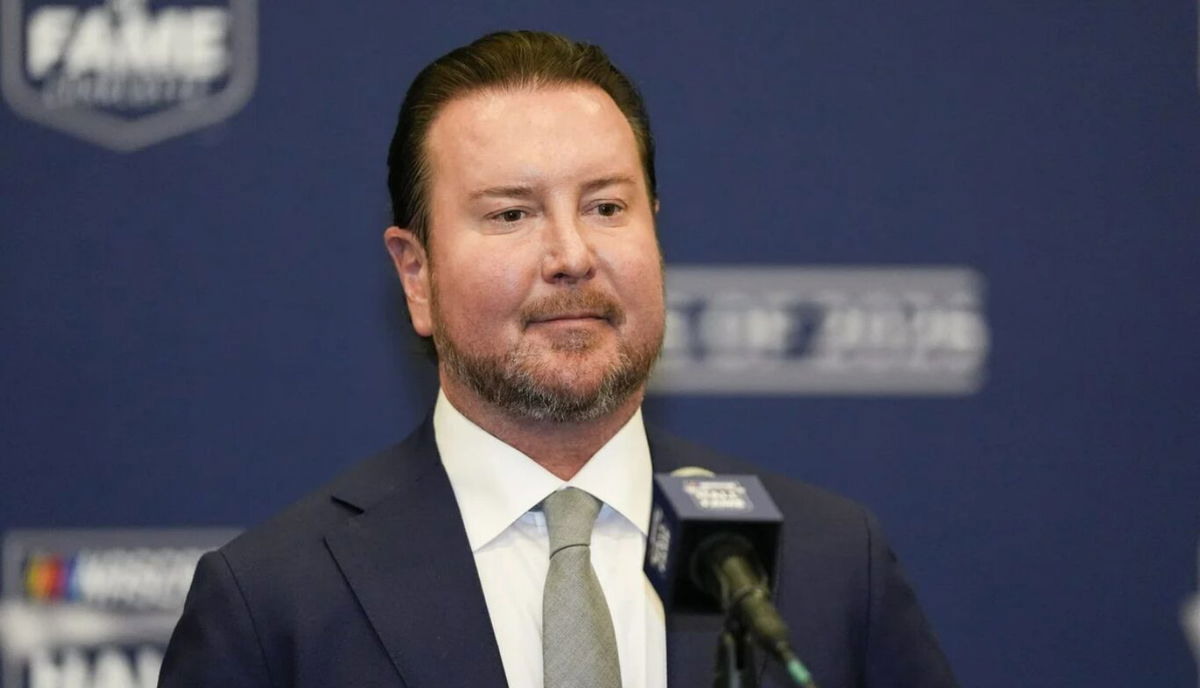
Kurt Busch has always been someone who has never shied away from honesty, both on and off the racetrack. And now, as the 2026 Hall of Famer steps into the elite category, the 2004 series champion has openly reflected on the many influences that shaped his journey and led him to this very moment. Each stop taught him something invaluable, and those moments, now etched in his memory, form the backbone of the legacy Busch will carry long after he hangs up his racing gloves.
Speaking on NASCAR Live, the 2004 Cup champion did not hesitate to reflect on the journey.
Watch What’s Trending Now!
“Yeah, it’s been incredible, all the trips down memory lane, talking with all the different team owners, crew chiefs. And you know, from each team there were certain lessons, whether it was Jack Roush, Roger Penske, and each of the teams over the years. Even racing with Tony Stewart as a team owner and a racer, there were so many drivers that influenced me to be better,” he said.
The road to the NASCAR Hall of Fame was anything but smooth for Kurt Busch, but the people around him influenced him greatly.
The Las Vegas native’s early years with Jack Roush Racing were foundational to both his success and growth as a competitor. After joining the team in 2000, Busch quickly put his speed to use, eventually winning the 2004 NASCAR Cup Series championship with Roush, a breakthrough that marked him as one of the sport’s elite.
But that period was also filled with intense competition within a star-studded lineup and moments of volatility.

Imago
Syndication: The Tennessean Retired NASCAR Cup Series driver Kurt Busch speaks onstage at the 2023 NASCAR Awards Banquet at the Music City Center in Nashville, Tenn., Thursday, Nov. 30, 2023. , EDITORIAL USE ONLY PUBLICATIONxINxGERxSUIxAUTxONLY Copyright: xStephaniexAmadorx/xThexTennesseanx USATSI_22005015
Driving the No. 97 Ford, he raced alongside multiple championship-caliber teammates such as Matt Kenseth, Mark Martin, and Greg Biffle, an environment that Busch himself later described as a crucible for learning how to work with and beat top talent week in and week out.
Moreover, Busch’s tenure with Roger Penske’s team from 2006 through 2011 brought new challenges and opportunities for refinement. Penske welcomed him immediately after his departure from Roush, signaling confidence that his speed and competitive fire could thrive within a highly structured, disciplined organization.
Early on, he scored a victory at Bristol Motor Speedway and added multiple wins and strong points finishes over subsequent seasons, contributing to Penske’s sustained competitiveness.
Fast forward to today, his time with those organizations is part of the broader tapestry of teams, good and bad, that taught him discipline and respect. And all those moments led up to the day he etched his legacy at the Hall of Fame event.
Plus, working with NASCAR entities who are Hall of Fame material has definitely helped shape his mindset and outlook on the achievement.
However, Busch understands this responsibility a bit better now. And he did not shy away from reflecting on his level of maturity during his NASCAR ride.
Busch reflects on the lack of maturity in early career
Earlier in his career, he was relentless in crossing the line, straining relationships, and creating friction within the garage. That fiery temperament, while fueling his competitive edge, also drew unwanted scrutiny and, at times, overshadowed his talent behind the wheel.
His six-year run with Roush Racing abruptly ended in 2005, and he was suspended for the final two races after a confrontation with police near Phoenix, an episode that capped a string of on- and off-track tensions with the organization.
At Penske Racing, moments of brilliance were punctuated by volatility, including being parked during a 2007 Dover race for an incident on pit road and ultimately parting ways after an altercation with the media in 2011.
Looking back on those moments, Busch’s perspective today echoes his Hall of Fame reflections, admitting that he often rode too high on his highs and too low on his lows.
“There is definitely the knowledge and wisdom thing that youth doesn’t have,” Busch said before the ceremony. “And so if I could, I would have told my younger self to have more patience and to not get so animated or so excited when things went wrong. It was like I was on too high of highs and too low of lows. If I could have just mellowed it out a little, I think that would have made for an easier path for me, so to speak.”
Busch now frames these clashes not as regret but as hard lessons and evolution, from the brash young competitor who jumped straight into Cup competition at 22 into a veteran who understands how much respect, awareness, and measured reactions matter in sustaining a long, meaningful career.
Related Newsletters