
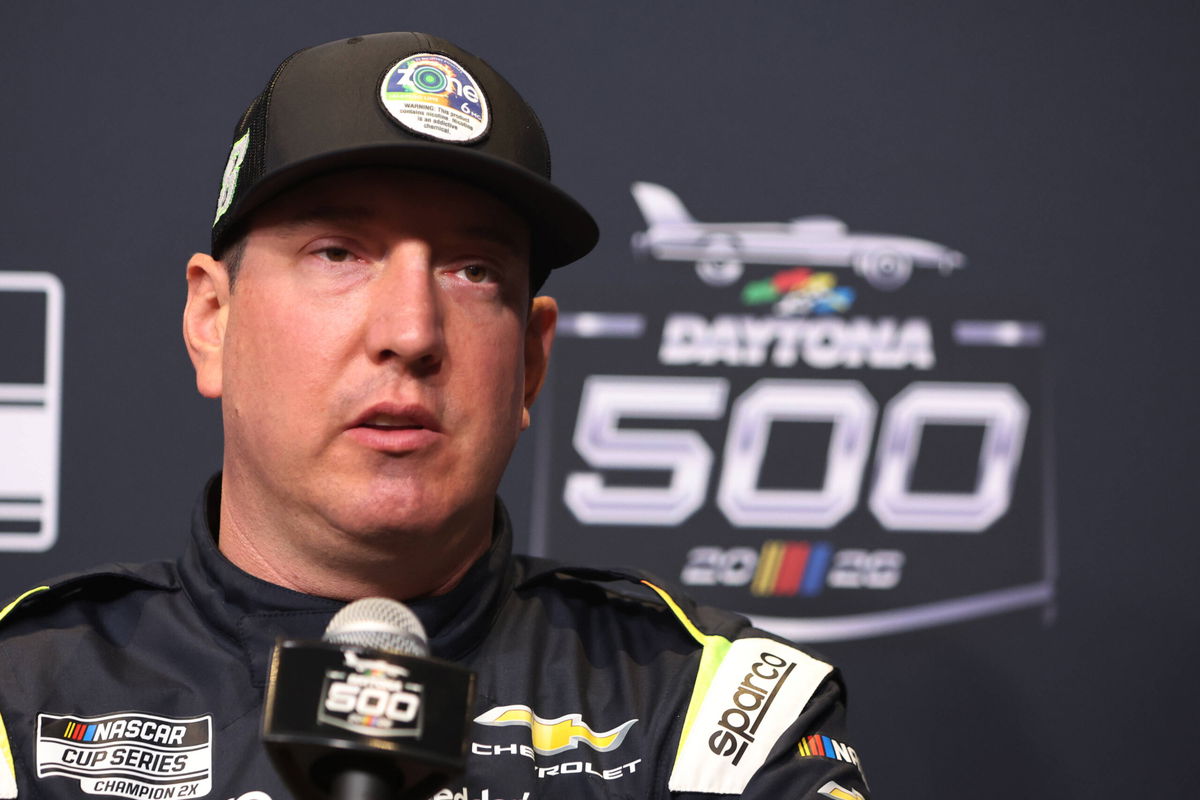
Following a commanding victory in the ECOSAVE 200 at Dover Motor Speedway, Kyle Busch resembled the seasoned masterclass that fans have witnessed for almost twenty years. Busch led 147 of 200 laps while driving the No. 7 Spire Motorsports Chevrolet, swept both stages, and easily defeated Ty Majeski by more than three seconds. Afterwards, however, Busch seems much more concerned with talking about something far more significant than the race victory: the slow demise of racing etiquette itself.
Watch What’s Trending Now!
“I think other people have said this as well, where it starts from the top down, right? So from the Cup series and down the line. And I’ve raced against the likes of Mark Martin and Bobby Labonte, and those guys, Jimmy Johnson in their heyday, Jeff Gordon. And then it changed. Like the guard changed, and the driver etiquette on the racetrack changed years ago where it’s just all out, all the time, balls to the wall,” Kyle Busch said after the Truck race at Dover Motor Speedway.
The remarks followed a tumultuous and violent evening in the ECOSAVE 200, where tempers and damaged trucks were a common occurrence. After getting loose and slamming into the wall, Destiny Spurlock sustained severe right-front damage, officially ending her race.
Later, when fighting Brendan Queen (better known to short-track fans as “Butterbean”), Luke Baldwin was struck hard in the inner wall after contact. Shortly after another incident involving Mini Tyrrell and Brandon Jones, the caution flag flew again as the race kept descending into survival mode.

“The guard changed a few years ago and the driver etiquette on the racetrack changed years ago to where it’s it’s all out all the time, balls to the wall” @KyleBusch on the declining racecraft in the #NASCAR national series.
But for Kyle Busch, the problem goes far beyond one crazy Truck Series evening. He has been warning about this for a while now. Before the commencement of the 2026 season, the two-time Cup champion identified the root of the issue as being at the grassroots level of racing, which he again highlighted yesterday.
“When you watch all the children that race all year long in the ARCAs and Late Models and the other things, you see that stuff already. They’re taught from a very young age to dive bomb and run into them, and door that guy. I remember watching a race of Josh Berry at Myrtle Beach. The last. I think it was the last Late Model Stock race at Myrtle Beach. The guy goes almost a lap down. Under a green flag run and then drives all the way back through the field and makes it back to the front. Not a mark on his car wins the race. I’m like that’s craft like, that’s skill.” Kyle Busch said earlier this year.
Things have gotten out of hand lately. Last year at Martinsville, Brandon Jone, Taylor Gray, and Sammy Smith were involved in a late race tangle which eventually ended in a wreck. And Austin Hill, who had been using his bumper throughout the race, made the most of the chaos to clinch a win. This was untidy and unprofessional, maybe well beyond rubbing is racing. Denny Hamlin was sick of the sight and vented out on X, “God, I wish I were in the booth. Id get fired but I damn sure would call these idiots out.” Even NASCAR had to get involved and have a meeting with the drivers to keep them in check. But each year, this trend seems to continue, and that is what irritates RCR star.
According to Kyle Busch, aggression throughout the formative years is no longer being fixed. Rather, it is rewarded. And after watching the sport evolve over the last two decades, Busch doesn’t sound particularly optimistic that things will change anytime soon. “How do you fix it? I don’t think you do,” he gave his verdict.
However, Kyle Busch once thrived on the same chaos
Kyle Busch’s remarks are particularly intriguing because, in the early years of his career, he established himself as one of NASCAR’s most aggressive drivers. Busch was the one who drivers dreaded seeing in their mirror long before he became the seasoned voice discussing manners and racecraft.
His hard-nosed, take-no-prisoners driving style is actually the source of his well-known moniker, “Rowdy.” Busch rarely backed down from confrontation, whether it was post-race feuds, intense pit-road altercations, or bumping competitors for victories. Busch frequently competed with the same competitive edge he currently sees through the garage in his early years with Hendrick Motorsports and then Joe Gibbs Racing.
However, he seems to be highlighting one important distinction: aggression used to coexist alongside technical racecraft and patience. Drivers like Jeff Gordon, Jimmie Johnson, Mark Martin, and Bobby Labonte still placed a strong emphasis on long-run strategy, tire management, and setting up passes back then. Kyle Busch feels that a lot of that has been lost in favor of pure aggression in modern short-track and developmental racing.
Ironically, the same driver once criticized for being “too aggressive” now sounds like one of the loudest voices asking NASCAR to slow down and rediscover the finer details of racing craft before they disappear completely.