
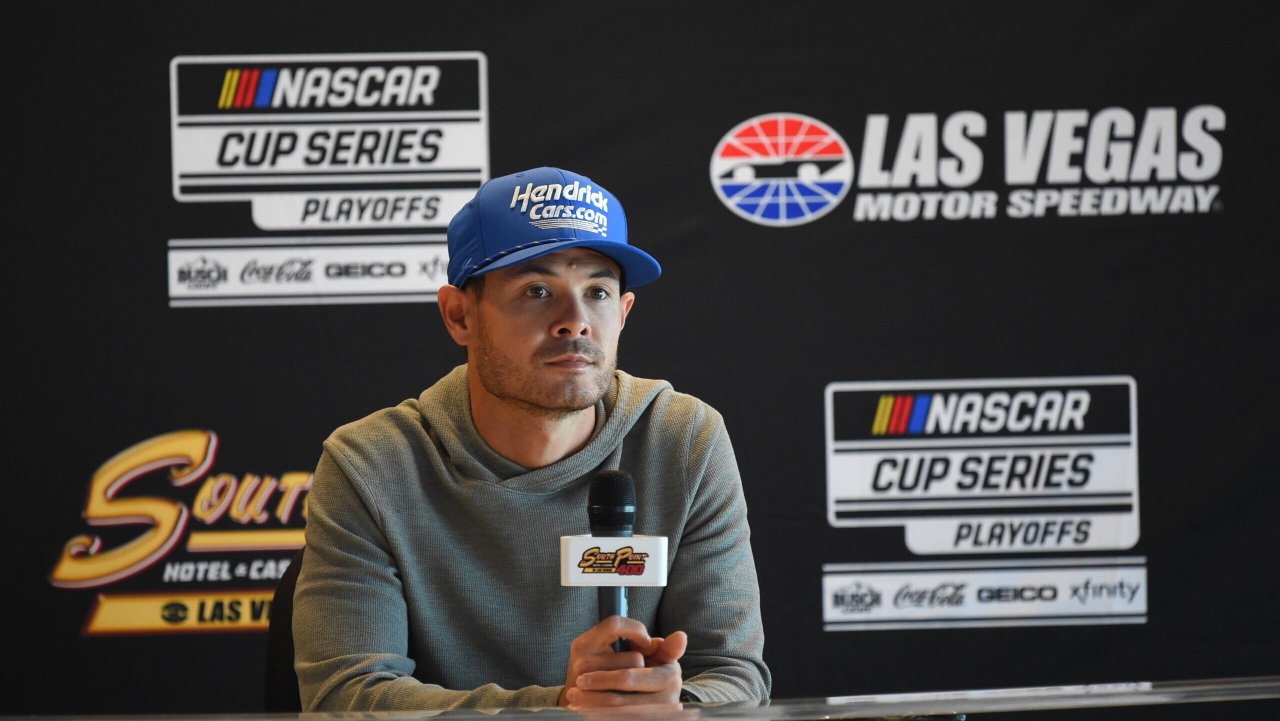
Kyle Larson was supposed to be the one Hendrick Motorsports could lean on at Watkins Glen. California dirt kids are built for places like this. But the road-course struggles at Watkins Glen especially raised eyebrows, and now Kyle Larson himself has openly admitted HMS simply “was really bad” last weekend.
Watch What’s Trending Now!
Kyle Larson admits to HMS’ Watkins Glen meltdown
“We were really bad this past weekend, so, but I think we know, as you know, any of the weekends that we struggled out, I think we’ve learned from it,” Kyle Larson recently admitted in an interview to Frontstretch after one of the strangest road-course weekends Hendrick Motorsports has endured in years.
For an organization that has historically dominated at Watkins Glen, the performance was almost unrecognizable. Early in the race, William Byron appeared to be HMS’s best chance. Byron slowly fought his way into the top 10 and remained there for the first forty-four laps after qualifying 13th as his teammates lingered deep in the field.
However, catastrophe struck just as Stage 2 was coming to an end. Byron’s Chevrolet’s right rear toe link was damaged when he spun into the Bus Stop chicane. He eventually hobbled home in 36th place after repairs put him four laps behind the leaders, essentially terminating his afternoon. He also fell from 10th to 12th in the standings and is only 32 points above the Chase bubble.

.@KyleLarsonRacin talks about how Sonoma is meaningful to him as his home track. He also discusses Hendrick's rough go on road courses and how they strive to improve. #NASCAR
Things weren’t much better elsewhere inside the HMS camp. Larson finished a distant 23rd and never displayed race-winning speed, despite winning at Watkins Glen twice and six road courses in his career before this attempt. And after spending the majority of Sunday stuck in 30th place, Chase Elliott (possibly the organization’s best active road-course specialist with seven victories of his own) managed to finish in 24th place.
Equally uncompetitive, Alex Bowman, reached the finish line in 25th place while still attempting to find his rhythm following his recent injury break and return. Sunday was a total and utter catastrophe for a squad that has won at Watkins Glen eleven times and regularly enters road-course weekends as the benchmark organization. That run has even prompted insiders like Freddie Kraft to come up with a theory that Corey Day could replace him, despite Bowman having the most understandable health-related issue behind his bad days on tracks.
That said, it took only three years for the team and driver lineup that has won a combined of five consecutive Watkins Glen races from 2018 to 2023 to linger at the back of the pack. And unfortunately for them, the last all HMS drivers finished outside top-20 at a road course was in 2005, at Sonoma.
Now, Elliott has won twice this season, so naturally, all eyes turn towards him to save the organisation. The past example of Jimmie Johnson launching himself into championship runs after tough summers also offers some strand of hope to hold onto. However, in 2026, things are a bit different. The major roadblock for the Hendrick group has been the new chevrolet body. They just haven’t been able to figure it out.
The three top-10 finishes at Texas were surely nice and helped, but for a team that’s supposed to be in the championship hunt, that’s not good enough. And with the likes of Charlotte, Nashville and Michigan on the docket, all places where this organization is usually strong, the pressure is beginning to mount. This tough stretch could become a much bigger worry if they can’t start putting together full weekends soon.
Still, Larson believes the struggles may ultimately prove valuable. And fittingly, his confidence about bouncing back ties directly to the unique racing education he received growing up in California.
Why Larson believes California made him a better racer
What Larson experienced in California prepared him mentally for what he is going through right now – a nearly year-long Cup series winless streak.
“California is such a big state, but specifically Northern California, there’s just a lot of racing that you can do. And then you know, as you get further south, there’s even more. I was lucky, you know, growing up racing sprint cars, you know, at tracks that were really difficult to handle, really sticky rough race tracks out here that you got to run really hard at. So I felt like it kind of prepared me for a lot of different scenarios and different race cars.”
For Kyle Larson, that California upbringing became the foundation for the ultra-versatile driver NASCAR fans know today. Larson was up in a family fully engrossed in racing culture in Elk Grove, California. He was born in 1992 and spent most of his early years traveling throughout the state to attend dirt races, frequently attending up to 80 events each year.
He began competing in outlaw karts at the age of seven, and he soon established himself as one of Northern California’s most exceptionally talented young people. And, as you may be aware, Northern California dirt racing is no easy training ground. Many California dirt tracks are brutally tricky, slick, abrasive, and constantly shifting, in contrast to smoother, more predictable tracks in other parts of the nation. Surfaces change throughout the night, forcing drivers to adjust lap after lap.
That is exactly why he remains unfazed by the streak, further noting how difficult the series has become.
“So it just kind of shows how tough the series is. Yeah, I don’t know. I mean, we’re working really hard,” Larson noted ahead of Watkins Glen.
“Just keep fighting. We’ve made this sport, the Cup Series look easy at times, and I’ve never thought it was. So, I’m glad that we can show you that it’s not easy.”
California is still regarded by many drivers and spectators as one of the best grassroots racing destinations in the United States, particularly for dirt racing. Because it requires aggression, flexibility, and a raw feel behind the wheel to survive, the state has produced generations of exceptional drivers. And Larson stands convinced that this racing education will pay off.