
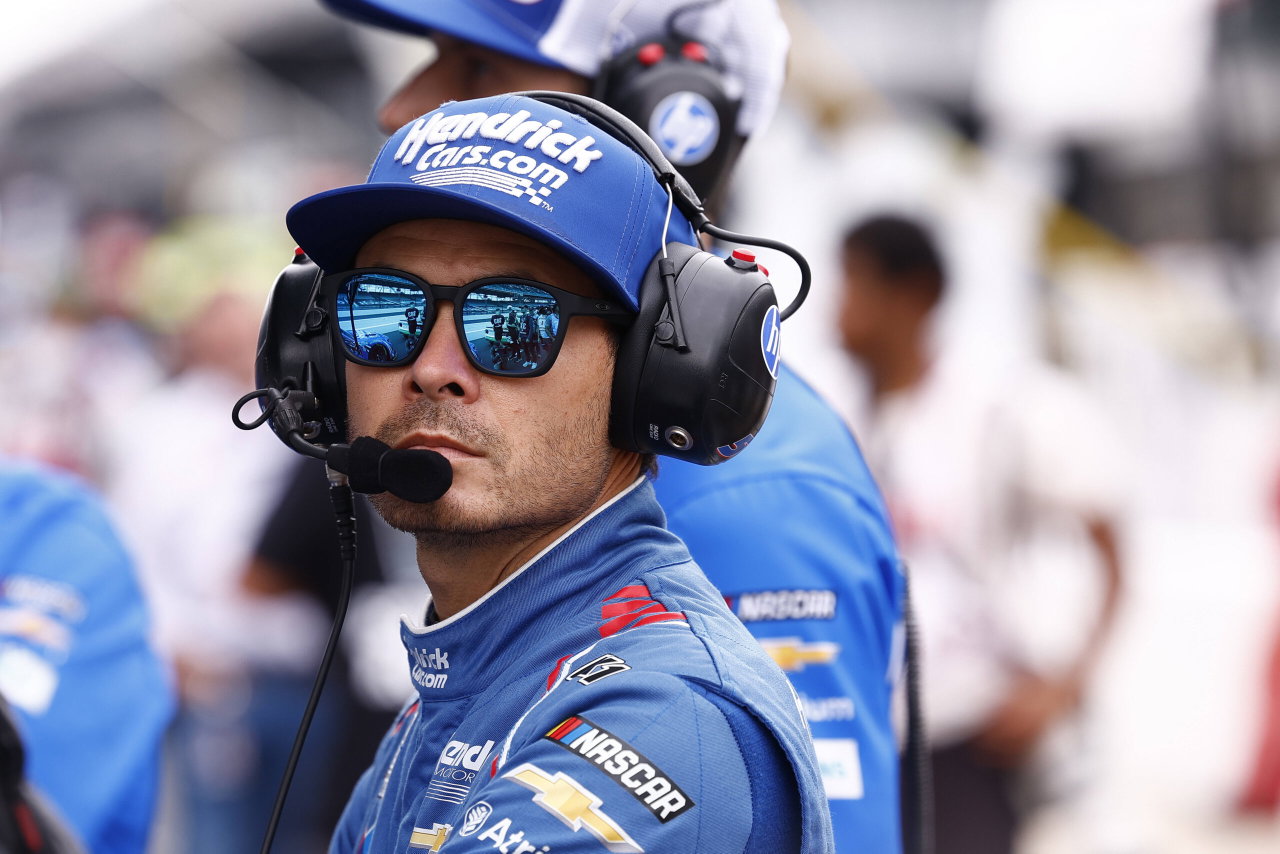
Kyle Larson enjoyed a dominant victory at Kansas, but things could have taken a very different turn with one mistake on pit road. While leading the Hollywood Casino 400, Larson received a late call to pit and had to quickly bring his No. 5 Chevrolet down from the top lane toward the commitment line.
Watch What’s Trending Now!
Did the move look like a disaster waiting to happen? Probably yes. But Larson revealed that his car’s balance and the timing of the call allowed him to pull it off.
“No, I think when you’re leading, you’re in a tough position because the guy in second, or that close, has got the advantage to short you by a lap,” Larson explained on Tuesday’s episode of Kevin Harvick’s “Happy Hour” podcast.
The situation developed during the final green-flag pit cycle. Larson had been leading the race when Chase Briscoe and the No.19 team made their move toward pit road. Hendrick Motorsports immediately reacted by giving Larson a last-second instruction to pit as well and cover the Joe Gibbs Racing driver.
Larson then had to transition from the high lane to the pit entry without compromising the car or missing the commitment line. That was where the risk came in. At Kansas, Larson normally approaches pit road from the bottom lane, which makes the sudden call from the top groove a much more difficult maneuver. A mistimed turn or excessive speed could have sent the No. 5 toward the wall or cost him the track position his team was trying to protect.
The move eventually proved to be pivotal as Larson won the race off pit road, allowing him to retain the advantage over Briscoe once the cycle was complete.
“Thankfully, I think they must have called him with just enough time for our team to call me late,” Larson said.
However, according to Larson, the setup of his Chevrolet made the move easier.
“It worked out because my balance was in a spot where I was having to diamond my exit at that point. So it didn’t really make it that difficult when I got the late call to make a run because my line was already pointed down the track.”
Larson was also dealing with traffic at the time, but according to him, the situation actually helped him reach the commitment line.
“So I’d still ranked really fast, and I think I would have been even faster had I not been behind the 41 car there,” he said. “It was easier to get to the commitment line than it normally feels at Kansas, which typically I do it (pit entry) from the bottom lane.”
In a race that was decided by small differences in strategy, tire management, and execution, that particular decision became a critical factor. Larson emerged from the pit cycle in front, giving him clean air. This allowed him to control the early part of the run and maintain his tire builds, instead of having to chase Briscoe.
That clean-air advantage became especially important because Briscoe was about to mount one of the strongest challenges Larson faced all afternoon. After starting the final green-flag run behind Larson, Briscoe steadily reeled in the No. 5 and passed him for the lead with 30 laps remaining.
Larson had dominated much of the afternoon, eventually leading 235 of the 267 laps and sweeping both stages. However, Briscoe’s charge, although a short-lived one, appeared capable of denying him another win. This is where Larson thought of playing smart.
“I really thought when Chase got by, he was just going to stretch out, but I got some lines going where I could settle in and try to take care of my tires,” Larson said after the race.
That patience ultimately paid off. In an interaction with reporters sometime after the race, Briscoe revealed his Toyota became increasingly ‘loose’ as he pushed to maintain the lead, while repeated contact with the outside wall further compromised the car. Briscoe eventually lost the lead with seven laps remaining and fell to fourth at the finish.
Then in a separate media interaction, JGR crew chief James Small revealed that the rocker panel of the No.19 car was torn open, with a rock or concrete lodged inside, which possibly resulted in the car’s deteriorating state. Briscoe had already described the car as becoming “really, really, really free,” while Small acknowledged that the balance eventually “came apart a little bit at the end.”
This is where Larson was able to cash in. On Lap 261, he moved underneath the No. 19 and completed the winning pass before pulling away to secure his second victory in three races. The result gave Larson a maximum 76 points and opened a 26-point lead over Denny Hamlin in the Chase standings.
Looking back at the pit call, Larson credited the No. 5 team’s ability to react before the opportunity disappeared.
“If I had come out behind him, I probably would have pushed much harder trying to make up that distance,” he said. “So yeah, it worked out. Again, it comes down to execution, and that was really a great, quick call from Cliff and the engineers.”
That execution proved crucial. Kyle Larson’s Kansas victory will be remembered for the late pass on Briscoe and his dominant 235-lap performance, but the foundation for that comeback was laid several laps earlier with a split-second decision, putting him in control of the Chase.