
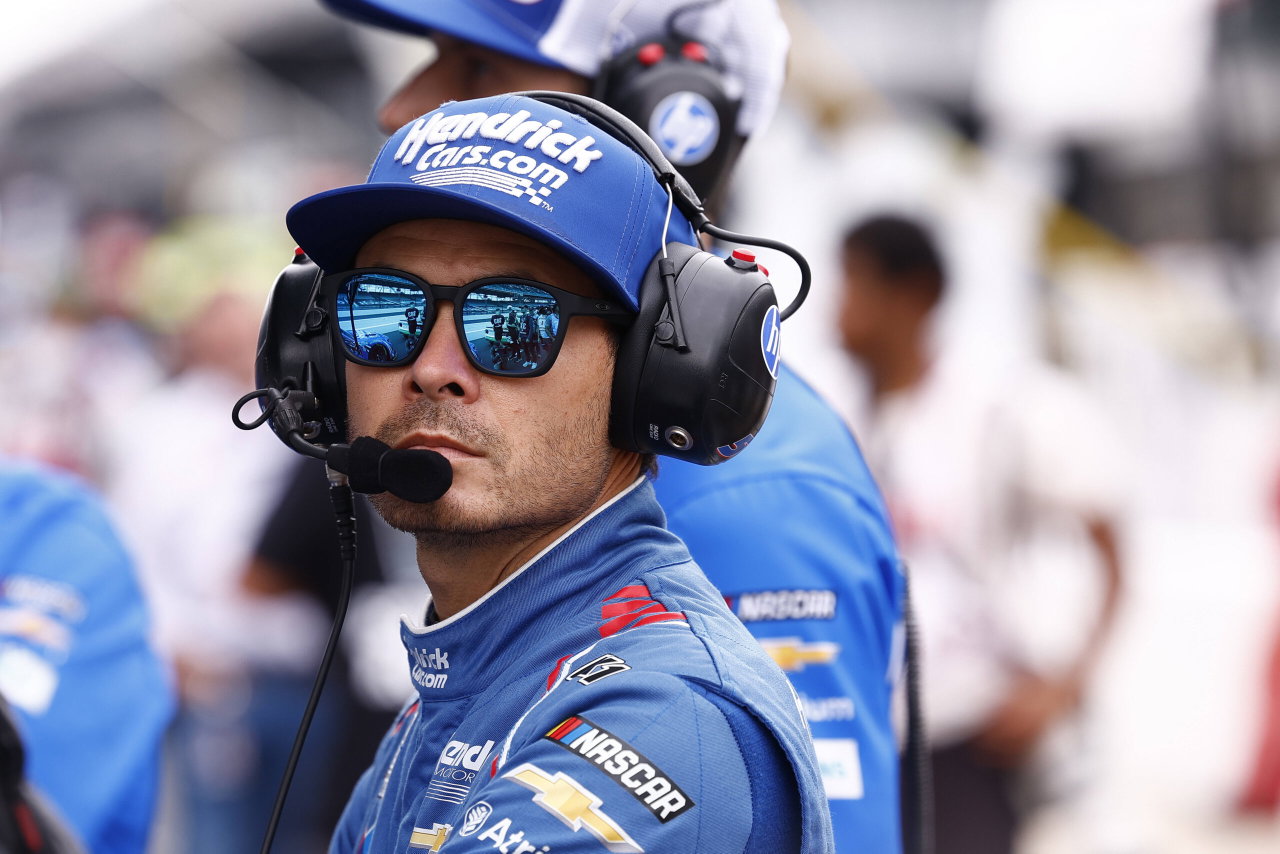
Kyle Larson made a joke at Chase Media Day on September 2. He said winning the 2026 NASCAR Cup Series championship without a single race win would be “sick.” It made Kenny Wallace go home and Google something.
Watch What’s Trending Now!
“In 2003, Matt Kenseth won the NASCAR Cup championship winning one race at Vegas,” Wallace said on his podcast. “Matt Kenseth finished every single lap in 2003. Here’s the question of the day: Would you like to see a champion like Matt Kenseth again, where he possibly doesn’t win but is so consistent?”
Larson has not won since Kansas Speedway on May 11, 2025. That is 51 races. After the Southern 500 at Darlington Raceway, he’s seventh in the Chase standings, 49 points behind Denny Hamlin, with nine races left. He led 99 laps in that Southern 500, finished fifth, and his title is still alive. The joke, humorous or not, comes with a history lesson, and here it is.
The man Kenseth buried in 2003
To understand why this conversation is even happening, you need to know what Matt Kenseth did to Ryan Newman in 2003. Newman won eight races that season. He was the most prolific winner of the year and finished sixth in the championship.
Kenseth won once, in March at Las Vegas Motor Speedway; for the rest of the year, he simply refused to lose badly. He finished top 10 in 25 of 36 races. His average finish was 10.2. He completed virtually every lap of the season. He took the championship lead in the second half and never gave it back. Newman’s eight wins could not catch him; that turned out to be a problem.
The contrast built up to be so unignorable and uncomfortable that NASCAR’s officials got into discussing how they could make wins count for more than they did. Kenseth’s season was the argument, or rather the push, they needed. As a consequence, NASCAR entered a system we are witnessing now, again in 2026. The Chase. Operational from 2004 onwards to cure exactly what Kenseth’s title had put forth for the motorsport.
At this crossover, Larson’s situation enters genuinely new territory. Kenseth won once in 2003. If Larson wins the 2026 championship, he will have zero wins this season. In the entire history of the Cup Series, no driver has ever been crowned champion without at least one win in that year. Not once. Ned Jarrett, Bill Rexford, and Benny Parsons all had at least one in their title seasons. Kenseth, too, had one. What Larson is threatening pushes one step further than anything this sport has ever had.
At media day, Larson said he could see a path where ultra-consistency makes the championship possible. He also said he could win four or five Chase races if everything clicked. He did not commit to either route, though, which tells you how he sees the format working. Both lead somewhere useful.
NASCAR’s answer, and its flaw
The format that Larson is now challenging came from his assumed predecessor. That is, if his claim comes true. It is the 2026 Chase.
So, what happens is 16 drivers qualify through the regular season. The points are reset before the first championship race. Among the drivers, it was Hamlin who won the regular season title. So, he started the Chase with 2,100 points. Larson was the seventh seed with 2,045 points. At the time of the reset, their gap was 55 points.
Now, all 16 of these drivers run 10 races without any elimination. So, no one is going home during these races. Among them, whoever gets the most points after the finale at Homestead-Miami Speedway takes the title.
Changing from the playoffs to this, the biggest change that you could see was that the win value increased. Beforehand, a race win got the drivers 40 points. Now they’re up to 55 points. Second place is 35, and fifth is 32. So, the difference between winning a race and finishing fifth is 23 points. And between winning and tenth place, it’s 28 points. And going down the line between winning and the 28th finish, it is 46 points.
So, it was a deliberate move by NASCAR to broaden that gap so that winning could be significantly more important. But that does not mean the stage points have lost their value. They’re still a part of every race: two stages per event, with 10 points for the top 10 finishers, which means a driver can collect up to 20 stage points before finishing order points are counted.
So, for 10 Chase races, that is as many as 200 extra points for the front runners. These stage points are not accounted for in that winning system. These are the points for those who are inside the top 10 when the stage ends.
So, the 55 points coming from a win are important. But for a driver who is consistently scoring stage points, they do add up to be a good total. So, if one is consistent with these points, they can still have a play at the championship.
That is the flaw NASCAR has, even with its current system, and that is also something it was targeting for a change. This flaw is where Kyle Larson’s statement actually lives.
The math that keeps Larson alive
Now let’s understand how Larson’s challenge is mathematically possible. So, take a driver who finishes fifth in all ten Chase races. That gets him 320 finishing points. He lands at a roughly fourth-place average stage result with around 13 to 14 stage points per race. So, that is approximately 132 to 136 extra points. The total comes down to 456.
Now, put someone else in opposition to this supposed driver who has two wins and six fifth-place finishes with two 28th-place results. He gets 110 finishing points from the wins. His fifth-place finishes would fetch him 192 points. As for his 28th-place finishes, he’ll get 18 points.
Now, before you add up the stage points in there, that driver has 320 finishing points. So, the same number as the consistent one. If both 28th-place results are from, say, an early mechanical failure where no stage points were scored, that consistent driver wins the championship by roughly 27 points.
This is the first one. So, what does this go on to show you? Two wins do not automatically mean that they’re enough to capture the championship. Two wins paired with two disasters can lose to a driver who runs near the front and gets stage points without exception. That is the math according to which Larson’s supposed challenge could come true.
Now, coming on to the actual numbers, his 2026 results go on to show why this applies to him. He has a 32nd at spring Darlington, a 40th at Talladega Superspeedway, and a 34th at the Texas Motor Speedway. He also finished second at Kansas Speedway, a third at the Phoenix Raceway, and third at Sonoma Raceway as well.
So, he’s led a total of 99 laps in the Chase opener. That is not even nearly equivalent to the season that Matt Kenseth had. While he averaged 10.2, Larson’s 2026 average finish is around 16.78, and he’s also had three DNFs.
So, that is not a playbook that Kyle is trying to run currently. He’s doing something that the format is not anticipating. He’s giving out elite performance during stages and running at the front in enough races to keep getting points without actually converting his race run to a win.
Considering the number of his total laps led, which is 758, it can be deduced that the car is fast. His ten top-five finishes confirm that he is getting into position, and his zero wins also confirm that the final step is where it keeps breaking down for him.
However, whatever combination of points and speed he is currently running on, it does, and it can take a dangerous turn for the winning drivers on the field.
What last year already proved
Now that we’ve painted a hypothetical scenario for you, let’s come back to reality. Taking a look at the last 12 months, Larson has already run a version of this experiment. He won the 2025 Cup Series championship without even winning one race in the postseason.
He had three in the regular season, his last being the one at Kansas in May, and then the playoffs started. His 10-race postseason produced such results that he was 19th at Darlington, 12th at Gateway Motorsports Park, 5th at Bristol Motor Speedway, 7th at New Hampshire Motor Speedway, 6th at Kansas, 2nd at Charlotte Motor Speedway Roval, 2nd at Las Vegas Motor Speedway, 26th at Talladega, 5th at Martinsville Speedway, and third at the Phoenix Raceway.
So, that is four top-five finishes with zero wins and, of course, one championship to his name.
However, it’s glaringly obvious that the format was also different last season, and it’s different now. Analyzing that title, it was Cliff Daniels who built it sitting in the pit box.
At Phoenix Raceway, Hamlin was leading and controlling the race. He led a total of 208 laps and looked like he would take the championship. Then William Byron’s tire failure triggered a late caution. That is when Daniels called for two right-side tire changes. The call gave Larson track position on the restart, and he finished third. Hamlin, on the other hand, finished sixth, which handed the championship straight to Kyle.
He did not end up winning the race, nor did he lead a lap, but Daniels manufactured a position for him from which he could win.
The current format, however, removes the Championship 4 element. There is no one-race decider among the four drivers at the end of it. Every point from every single Chase race is accounted for, which means Larson cannot rely on a single master stroke this season. He has to execute a consistent strategy for all 10 events.
But no eliminations also change the risk profile hugely. In the old format, a rough result in the wrong round could end a season. But in 2026, a bad Sunday costs Larson points, but it does not end his championship run. He has the remaining races to recover from that.
For a driver with his volatility, that is a far more forgiving format for him. As for the old and new, his 26th finish in Talladega this year would have been a dangerous feat if we were still following the old system. However, under the Chase, it is a number that he’ll take with him and try to offset it in the next nine races.
Daniels built this floor deliberately
Reverting again to the strategist in Kyle’s team, Cliff Daniels openly talked about what the 2025 season had taught him before the season started. Even in races where there were late failures which hurt the final result, Kyle’s number five Chevrolet had got stage points before the problems started. Those points kept his championship alive on days when the finishing position looked a bit dicey.
His plan for 2026 was to execute the complete race, score well in stages, and convert his run into good finishing positions, while also respecting that there is now more value to winning.
He also began 2026 with four new members on the team. This included engineer Nathan Woodby. Part of the season has been about including those people in the operations rhythm. Daniels said that the group grew more confident in its process throughout the summer, even during stretches when results did not show the internal improvements outright.
That buildup is essential because this is the narrative that has converted Larson into someone who cautiously accumulates points.
Let’s take a look at Darlington. With 27 laps remaining in the Southern 500, Larson was leading the race. Daniels had fresh tires in the pit stall, but he still kept Larson out. The reason for it was simple: pitting would restart Larson behind Christopher Bell and Chase Briscoe on newer rubber. Staying out, however, kept him at the front of the pack and made these faster drivers come to him.
Bell came through for this opportunity. He passed Larson with 12 laps remaining and won the race. Larson, on the other hand, finished fifth.
This call was a gamble for the win, not a concession to the points. When it did not pay off, the floor was still fifth place and 41 championship points. Larson said afterwards that he did not regret the call. He thought that additional cars might stay out, putting more traffic between him and the drivers on fresh tires.
The strategy was about winning, and that was it.
Darlington as the test, Bell as the contrast
Now that we’ve already touched upon Christopher Bell, let’s also see how he fits this narrative. Before Darlington, Bell had finished second seven times. Christopher Bell tied the modern NASCAR record for the most runner-up finishes before finally getting a win in a single season. So, that was a record of coming close enough to the win seven times, but not converting it into one.
But then the conversion finally happened at Darlington, when he won the Southern 500 and jumped straight from sixth to second in the standings, just 12 points behind Hamlin. This is why the winning points were increased. The 55-point bonus was designed to produce such results.
Consistency builds proximity. There is nothing wrong with that. But a win does the heavy lifting for these drivers. Bell’s championship turned completely in one afternoon. So, the format worked as it’s intended.
Larson’s Darlington scenario showed us the other side of it. He led more laps than anyone, finished second in stage two, took fifth overall, and got six points on Hamlin. He did not get a trophy, but on his level, the movement was significant.
So, this is more an outlook on what the Chase format looks like for drivers who are getting varied results. Bell’s arc shows you that conversion does come eventually, and when it does, it can take your season to a wow level. Larson’s arc, on the other hand, tells you that front-running outputs do keep showing up, but they do not have a conversion rate as such.
The place where they meet is a parallel, a contradiction, yes. But there are two storylines running simultaneously here.
After Darlington, Hamlin leads at 2,135. Bell’s second with 2,123. Ryan Blaney’s third at 2,119, and then Tyler Reddick follows at 2,111. Chase Briscoe is fifth in the points standings with 2,098. Ty Gibbs is sixth at 2,096, and then comes Larson, who is seventh at 2,086.
So, the gap between the leader and Larson is 49 points. A race win is 55 points.
The identity that makes this so strange
We’ve read the numbers. We’ve read the scenarios. Now let’s read the man, Kyle Larson.
He won 10 races in 2021, which was his first championship season, then three in 2022, four in 2023, six in 2024, again three in 2025, and now zero through the Darlington opener in 2026. He has 32 career wins in the Cup Series and two championships to his name.
Rick Hendrick compared his willingness to put the car in places others avoided to Tim Richmond. Larson has often talked at length about how racing wing sprint cars has shaped his driving instincts. On dirt roads, grip changes constantly, and a driver has to manage a car that is sliding beneath him on every single corner. That builds a different kind of sensory feedback in them. It’s different to what only driving on asphalt can offer.
He has said that these skills transfer from discipline to discipline, and his results across them do support his claim. He is not the kind of driver who collects points from eighth place. He led 2,581 laps in his 2021 championship season and has already led 758 in his 2026 season, one without winning.
The speed that can get him a win is there, but Larson keeps getting into positions where the conversion just does not come. Sometimes the tire strategy falls short, or a driver on fresher rubber catches up to him, or, as usual, something mechanical falls apart.
He also said at a media day at Phoenix Raceway, which is perhaps the number five team’s weakest track, despite having won both championships there. He expressed relief that the 2026 finale moved to Homestead-Miami Speedway, where he has been strong.
If he reaches that final race within striking distance, the setting suits him better than the one at Phoenix did.
So, that is a driver who has run through different racing formats, and one thing that can be attributed to his name is that although he is a master at his sport, he also has another striking quality, which is survivability.
What this would actually mean for NASCAR
Now that we’ve looked at different angles associated with the scenario, let’s look at a situation where Kyle Larson actually achieves what he’s claiming. A big problem will come out of it. What does this say about the format that NASCAR deliberately brought back?
By bringing back the Chase format now, after 2013, NASCAR clearly wanted to make winning more significant for drivers. It gave them a 50-point increase. That is a cosmetic adjustment. It’s not just a philosophical statement put out there. Beat the field at the finish line and get a big reward.
If the defending champion sits in seventh place after one Chase race with 58 laps led and zero wins and still makes the championship, the 55-point bonus would have succeeded against some drivers, but clearly failed against this one.
The argument will then not turn against or in favor of Kyle Larson. That is a fan debate which will go on irrespective of the result. The argument will turn to NASCAR: whether the formula that it sought to bring back and to make a champion differently actually did what it was intended to do.
While Kenseth’s 2003 season gave NASCAR the evidence it needed to build the Chase, a winless Larson championship in 2026 would hand critics the same kind of evidence about the format NASCAR has been given two years to redesign.
Nine races remain this season, and Hamlin’s still in the lead. Larson is at 2,086 points. The Gateway Motorsports Park race is on Saturday.
Larson’s clearly said that it would be sick to win without winning. He’s already proved he can do that once, even if in a different format. Now let’s see if he’s able to pull this in a format specifically designed to stop that from happening.
So, as a parting question, let me ask you the same thing Kenny Wallace asked his audience: Do you want a #NASCAR champ with no wins?