
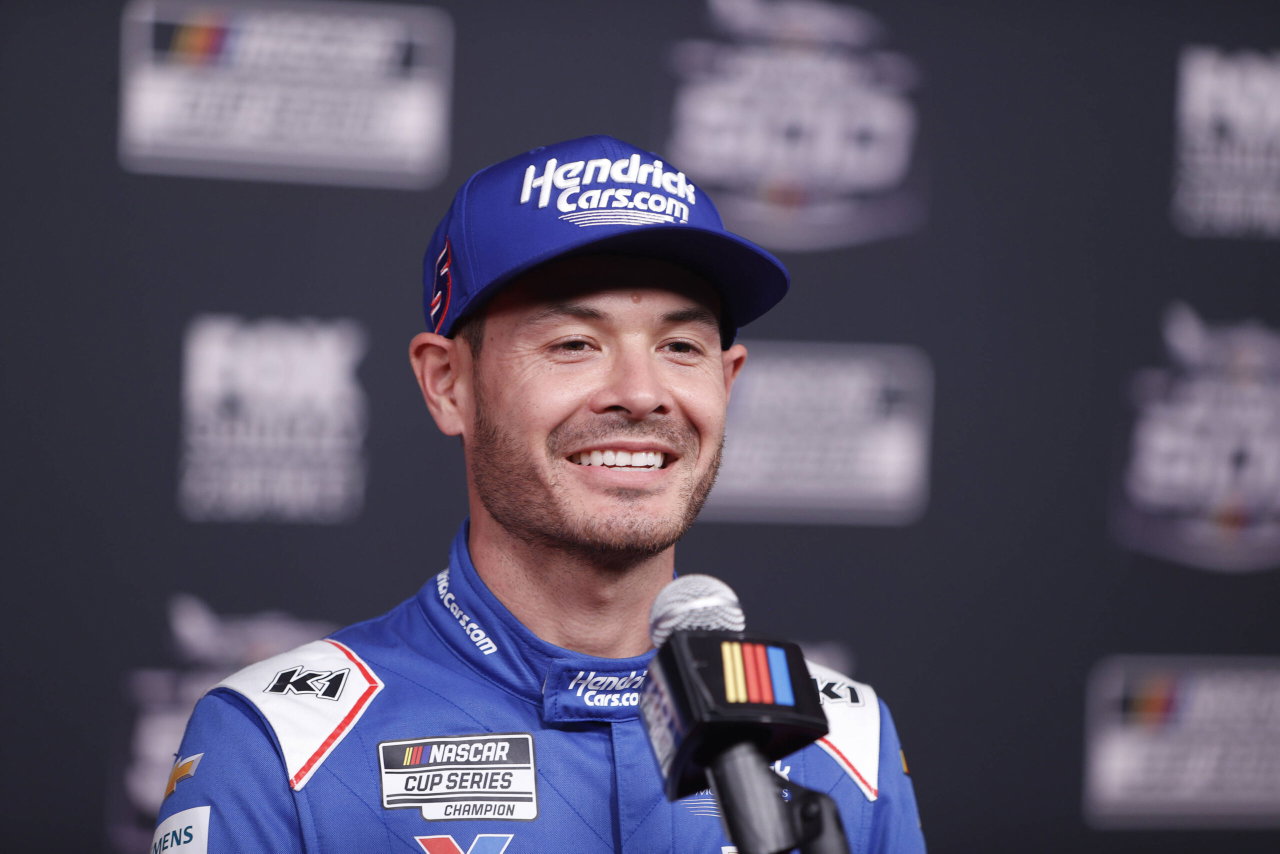
How does a reigning champion find enjoyment in a season where his team can’t seem to find Victory Lane? After a 51-race winless streak with the No. 5 team, Hendrick Motorsports finally turned its fortunes around, with Kyle Larson going on to claim his third Cup Series crown. Yet the three-time champion has revealed an unusual source of motivation during the drought. Having experienced Hendrick Motorsports’ difficult spells before, Kyle Larson found something particularly rewarding about being part of the team’s fightback.
Watch What’s Trending Now!
In conversation with Kevin Harvick and Will Buxton for their SPEED with Harvick and Buxton podcast on November 25, Larson reflected on one of Hendrick’s most difficult seasons in recent years and the team’s remarkable Chase turnaround.
“I said, like, early middle on in the season, I was like, man, I’m having more fun this year than I think I’ve had in other years. And we are running worse than we’ve ever ran at Hendrick Motorsports. And for me, I just enjoyed, you know,” Larson revealed.
Kyle Larson attributed much of his enjoyment to spending more time at Hendrick’s facility, building stronger bonds with the pit crew and getting more simulator work in. He was beginning to see progress in the car’s balance, which kept him motivated despite the disappointing results.
The team’s competition meetings also became more meaningful, with all four teams, their engineers, crew chiefs, drivers and management working together to find solutions. Even Mondays after difficult race weekends became something Larson looked forward to.
Does Sprint Car Racing Put Kyle Larson’s NASCAR Future at Unnecessary Risk?
“I just never have seen the four teams of engineers, crew chiefs, drivers, you know, upper management, like all kind of digging in as deep as we were. So that was really cool to see,” he explained.
Kyle Larson’s 2026 regular season was a stark contrast to his championship-winning campaign the year before. The No. 5 driver failed to visit Victory Lane across all 26 races, carrying a 50-race winless drought into the Chase as the seventh seed. The struggles weren’t limited to Larson, either.
Hendrick Motorsports managed just two victories in the first 23 races, both courtesy of Chase Elliott. Its average finish of 17.6 was also on course to be its fourth-worst since expanding to a four-car Cup Series operation in 2002. For an organisation accustomed to fighting at the front, it was an unusually difficult stretch.
Hendrick’s struggles stemmed partly from Chevrolet’s redesigned Camaro ZL1 body, which altered the car’s aerodynamic balance and left teams having to rethink their set-ups. However, the learning curve extended beyond the new machinery. The No. 5 team, which began the season with four new members, also had to reassess its processes after struggling to find consistent performance.
Kyle Larson’s Crew chief, Cliff Daniels, admitted they had initially taken too many risks while trying to understand their deficit to the competition. Despite occasional flashes of speed, Larson often lacked the equipment and consistency needed to turn those performances into results.
The No. 5 team’s turnaround was reflected in Larson’s remarkable Chase run. He claimed victories at Gateway, Kansas, and Talladega, alongside six top-five and eight top-10 finishes across the 10-race Chase. He had also led 579 laps through the first nine events. Much of that consistency came from crew chief Cliff Daniels, who kept the team focused on maximizing every points opportunity, from stage points to strong finishes.
Having worked together through Larson’s 2021 and 2025 championship campaigns, the pair knew how to navigate the pressure and capitalize on the No. 5 team’s progress, securing Kyle Larson a third Cup title. Their familiarity with each other’s approach, built over two previous championship campaigns, once again proved to be the No. 5 team’s biggest strength when it mattered most.
His teammates, meanwhile, had very different seasons. William Byron finished eighth, but struggled to find consistency, while Chase Elliott, 12th, faded after a strong start that brought him two wins in the first 11 races. Alex Bowman finished 26th after missing four races while recovering from vertigo, making his season particularly difficult.
Hendrick Motorsports has had to fight its way through difficult periods before. In 2005, tensions between Jimmie Johnson and crew chief Chad Knaus threatened to break up a partnership that had yet to deliver a championship. Rick Hendrick intervened, encouraging a more collaborative approach, and the duo went on to win five consecutive titles.
A wider performance slump in 2017–18 prompted changes across the organization before Chase Elliott ended its 21-race winless run at Watkins Glen. Hendrick faced another midseason dip in 2020, but regrouped to put Elliott on course for his first Cup title.
Kyle Larson, too, knows the value of a comeback. After an early playoff exit in 2022, he fought back to reach the Championship 4 in 2023. A 23-race winless stretch in 2025 then tested the No. 5 team, but they found their form when it mattered, securing Larson’s second championship.
Hendrick’s ability to recover goes beyond its resources or history of winning. At its core is a culture built around trust, accountability and collective responsibility. That was particularly evident during the 2026 slump, when Rick Hendrick chose to reassure his teams rather than add to the pressure.
“The only way you’re going to destroy this organization is from the inside,” he added.
The approach resonated. Jeff Gordon recalled how the meeting opened up a “floodgate” of information-sharing across the organization, while president Jeff Andrews pointed to the belief teammates had in one another as central to the turnaround.
“We pointed at ourselves and said, ‘This is not our standard,’” Andrews said. It was a collective effort to restore that standard, rather than wait for one team to find all the answers.
The No. 5 team’s turnaround involved more than finding speed. With four new members joining in 2026, Cliff Daniels refined the team’s approach across race weekends, from practice and qualifying to in-race adjustments. They became more measured with their set-ups, while Larson’s additional simulator work and closer collaboration with engineers helped them understand what the car needed. Although progress was gradual, the team was beginning to see the results of its efforts.
Darlington, the opening race of the Chase, offered the first clear sign. Larson finished fifth and felt the No. 5 team finally had the speed and execution to compete for a win. “I remember leaving that race thinking, ‘man, that’s the first time it’s felt like the five team in forever.’ We were calling a race to win,” he recalled. The performance carried into Gateway, where Larson ended his 51-race winless streak with a victory.
Hendrick’s recovery was particularly significant against a difficult season for Chevrolet, whose teams had struggled with the updated Camaro ZL1. The organization’s ability to turn its early-season lessons into a championship-winning run reflected the strength of its collective approach.
For Larson, the reward was in seeing that work pay off. “The struggle’s fun,” he said. He wasn’t enjoying the poor results, but the process of finding answers and seeing the team improve. Even without the championship, he said, it would have been an enjoyable year.