
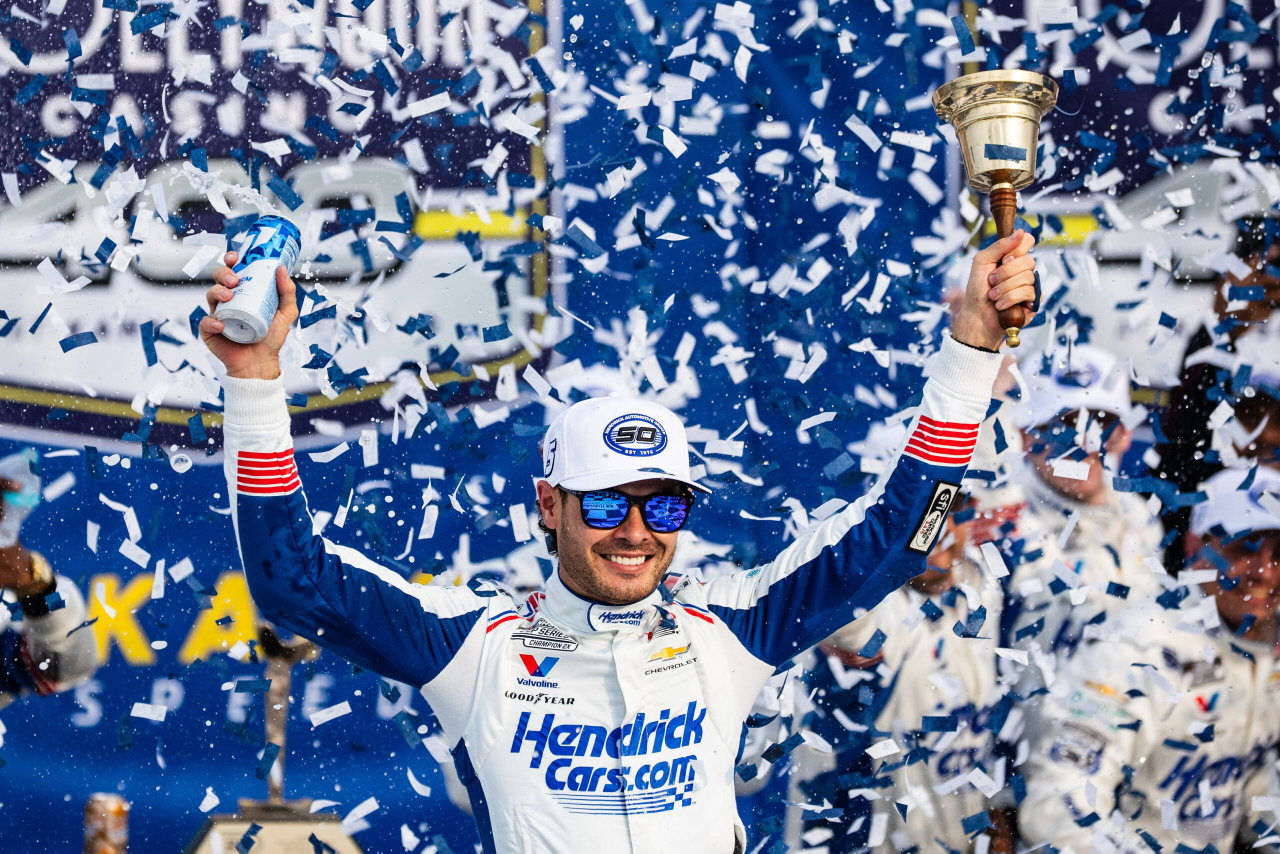
There was a point late at Kansas Speedway when Kyle Larson had every reason to think the race was slipping away from him. He had led almost the entire afternoon, swept both stages, and built what looked like an untouchable advantage, only for Chase Briscoe to drive past the No. 5 Chevrolet with 30 laps to go. For much of 2026, that was exactly the sort of moment that had defined Larson’s season. The car would be fast enough to win, the race would seem to be there for him, and then something would happen before he could collect the trophy.
Watch What’s Trending Now!
This time, Kyle Larson did something different. He did not immediately force the issue. He settled in behind Briscoe, found the lines he needed and started taking care of his tires. When Briscoe’s Toyota began to lose grip and got loose late in the run, Larson was close enough to capitalize. With seven laps left, he took the lead back and drove away to his second victory in the first four races of the Chase. He had led 235 of 267 laps, swept the stages, collected the fastest-lap bonus and scored the first 76-point day of the season.
That is the obvious story coming out of Kansas. Kyle Larson is back in Victory Lane, and after ending a 51-race winless streak at Gateway two weeks earlier, he is suddenly leading the championship by 26 points over Denny Hamlin.
But if you watched what happened at Kansas closely, Larson’s comeback was only part of the story. The more interesting development was what the No. 5 team was able to do before Briscoe ever got close enough to challenge. Larson did not stumble into a win at Kansas. Hendrick Motorsports brought a car capable of controlling an intermediate-track race from the front, kept it competitive as the track changed, made the right calls when the race entered its decisive phase and then gave Larson enough underneath him to go back after the lead when Briscoe took it.
That is significant because Hendrick did not look like this for most of 2026. The organization had spent the regular season trying to solve a problem that was much harder to see from the outside than Larson’s winless streak suggested. The speed had not disappeared. The talent certainly had not. What had disappeared was the consistency with which Hendrick could turn all of that into a complete race weekend.
Larson had speed. William Byron had speed, particularly on the intermediate tracks. Chase Elliott had already won twice. Alex Bowman was still part of an organization with enormous technical depth despite missing four of the first seven races. Hendrick’s No. 5 pit crew was not suddenly incapable of executing. Chevrolet’s new body package had potential.
The problem was that those strengths were rarely arriving together. And that is why Kansas matters so much. It may have been the race that finally showed what Hendrick Motorsports had been building toward all along.
The numbers were bad enough that Hendrick could not explain them away
There was no way to disguise what had happened to Hendrick during the regular season. Through 24 races, its four cars had led 1,073 laps compared with 2,328 at the same point in 2025. Top-five finishes had fallen from 32 to 21, while top-10s dropped from 52 to 37. The organization had also accumulated 13 DNFs compared with eight at the same stage a year earlier. By the end of the 26-race regular season, Hendrick had only two wins while Toyota teams had combined for 14.
Those numbers explain why Larson’s drought became such a convenient way to describe the season. He had not won since Kansas in the spring of 2025. For a driver who had won at least three Cup races in every season since joining Hendrick and had taken 10 victories during his 2021 championship campaign, 51 races without a win looked extraordinary. But the drought was also hiding something.
Larson was not spending 51 races running 20th and wondering where the speed had gone. He was repeatedly putting himself in position to win and then watching the final pieces fall apart. That distinction became especially important because Hendrick’s own leadership was saying the same thing in different ways.
After Kyle Larson won at Gateway, crew chief Cliff Daniels admitted that Hendrick had not fully understood its deficit to the field early in the year. That uncertainty led the organization to take too many risks and try too many different approaches while it was attempting to catch up. Jeff Gordon was even more direct, saying the biggest challenge for Larson was not the mistakes or bad breaks but the fact that Hendrick had not consistently provided cars capable of running at the front.
That is a much more revealing explanation than simply saying Larson had been unlucky. If the driver is making mistakes in a fast car, the team can address those mistakes. If the car is simply slow, the problem is technical. Hendrick’s 2026 problem was somewhere in between. The cars were often fast enough to make everyone believe a breakthrough was coming, but not consistently complete enough to produce the results the organization expected.
The Chevrolet body change at the beginning of the season made that learning curve harder. Hendrick had to understand how the updated Camaro ZL1 behaved while also trying to close a gap to Toyota. Daniels explained earlier in the year that the organization was still figuring out the right balance and, at times, was trying too many different approaches because it had not yet identified exactly where the deficit was coming from.
That is how a team can have plenty of talent and still spend months looking lost. It is also why the improvement had to be gradual.
Kyle Larson’s drought was never the whole problem
The first clue came at tracks where Larson was obviously capable of winning. At Darlington, he led 99 laps and had one of the fastest cars in the field. He stayed out late on older tires rather than making another pit stop, hoping to preserve track position for the final restart. Christopher Bell eventually passed him with 12 laps remaining, and Larson finished fifth.
You can criticize the call if you want, but it would miss the larger point. Hendrick had built a car capable of leading the Southern 500 for long stretches. The problem was converting that speed into the final result.
That distinction followed Kyle Larson through the summer. Then came Gateway.
The Gateway race was hardly a clean, controlled afternoon. There were 18 cautions and 87 laps run under yellow, brake rotor failures created additional chaos, and Larson had to survive two overtime restarts to win. The decisive call came on Lap 201, when Larson’s team took four tires while Joey Logano took right-side tires. Larson did not have the track position coming off pit road, but the fresh rubber gave him the grip to move forward once the race restarted. He eventually took the lead on Lap 227 and held off Logano and teammate Alex Bowman.
That was the first time the pieces really looked connected. The strategy made sense for Larson’s position. The pit crew executed it. The car responded to the fresh tires. Larson took advantage of the opportunity instead of letting the late-race chaos take it away.
And, perhaps most importantly, Kyle Larson himself did not treat the victory as proof that everything was suddenly fixed. He said afterward that he did not believe Hendrick was yet back to the point where it could dominate races the way it had in the past. That was a revealing comment from a driver who had just ended a 51-race drought. He understood that winning Gateway and fixing Hendrick were not necessarily the same thing.
The next two races made that distinction even clearer. Larson finished second at Bristol, giving him top-five finishes in all three Chase races before Kansas. By the time he arrived at Kansas, he had gone from seventh in the starting Chase standings to first, a 56-point swing before the race even began. Larson himself said the execution during those first three races had been “pretty flawless” for his team.
Pay attention to that because he was not talking only about speed. He was talking about execution.
Hendrick had been building speed in different places
While Kyle Larson’s winless streak dominated the conversation, William Byron had quietly been providing one of the strongest clues that Hendrick’s intermediate-track program was not fundamentally broken.
Before Kansas, Byron and Hamlin were the only drivers to finish inside the top 10 in all five traditional 1.5-mile races during the 2026 season. Byron’s finishes in those races were third, seventh, eighth, ninth and fourth, giving him a 6.2 average finish.
That matters because Kansas was the first of three consecutive intermediate-track races in this portion of the Chase. It was not just another stop on the schedule. It was supposed to tell the garage which organizations had actually figured out how to make their cars work on the kind of tracks that now occupy a huge portion of the championship run.
Byron had already been answering that question for Hendrick. He just had not been winning enough.
That is the pattern that makes Hendrick’s season so interesting. One driver was showing the organization had intermediate-track speed. Another was winning at Martinsville and Texas. Kyle Larson was leading races and missing the final conversion. Bowman was dealing with the consequences of a disrupted start to his season.
The information was there but the results simply were not arriving together. That changed gradually as the season progressed. At Richmond, all four Hendrick cars finished inside the top 10, with Elliott fifth, Larson sixth, Byron ninth and Bowman 10th. That did not erase the organization’s problems, but four cars finishing together near the front was a useful sign that the teams were beginning to find a common window.
Then there was another development that is easy to miss when looking only at the results. The No. 5 team itself had been changing.
Larson’s team had to learn how to be Larson’s team
Four new members joined Larson’s group at the beginning of the season: mechanic Mark Hudson and engineers Nathan Woodby, Ryan Bradley and Jarrett Schalch.
That may not sound like the sort of thing that should explain a winless stretch for one of NASCAR’s best drivers, but it matters more than people outside the garage often realize.
A Cup Series team is not simply a group of people assigned to the same race car. It is a system of habits. The crew chief has to understand how the driver describes a handling problem. Engineers have to know which comments matter most and which ones can be filtered out. The driver has to trust that the changes being made to the car are moving it toward the balance he wants. The mechanics and pit crew have to operate with almost no wasted movement.
Add several new people and the group has to develop that rhythm while still competing every Sunday. Daniels acknowledged that the No. 5 team was still learning early in the year. By the time the Chase arrived, however, he was talking differently about the group’s progress. After Kansas, he said Hendrick was “more in the ballpark,” while also stressing that the organization had not yet reached its peak.
That comment is more important than the champagne. Because Daniels was not describing a team that had discovered one magical setup. He was describing a team that had gradually become better at understanding its own race car. That takes time. It also explains why Kyle Larson’s recent results have arrived together instead of appearing as isolated flashes.
What Kyle Larson learned was also reaching the other Hendrick cars
This is where the story gets bigger than the No. 5 Chevrolet. Hendrick has four teams because four teams can produce four different answers to the same problem. The value comes when the organization can take the useful parts of those answers and move them around the building.
That was happening during 2026. Elliott, for example, talked about the benefits of work done by Larson and the No. 5 team during testing at Chicagoland. His own result there was only 11th, but he said there were stretches when his car was running around the top five and pacing the leaders. He pointed to the kind of small gains that can spread through a four-car organization.
“Just a little bit goes a long way,” Elliott said.
That is probably a better description of Hendrick’s improvement than any claim that the team suddenly discovered a breakthrough. NASCAR does not always change because somebody finds half a second.
Sometimes a team finds two hundredths in the center of the corner, another two hundredths on corner exit and another small gain in how the car handles after 20 laps. The driver gets more comfortable. The crew chief has a clearer picture of what the car needs. The engineers have more data to work with. Eventually, a car that was finishing fifth starts finishing second, and the second-place car finally becomes a winning car.
The final Kansas battle was the proof
The final battle with Briscoe is what makes this more than another dominant Larson performance. If Larson had led all 267 laps, the obvious conclusion would have been that Hendrick simply brought an exceptionally fast car to Kansas.
Instead, Larson led 235. That leaves 32 laps in which somebody else was in front, and 23 of those belonged to Briscoe after he passed Larson on Lap 238.
For once, losing the lead did not unravel the No. 5 team. Larson immediately explained afterward that he had expected Briscoe to pull away once he got by. Instead, Larson found different lines, settled into the chase and looked after the tires. The change in his role actually helped him. As he put it, it was easier to be the hunter than the hunted.
That is a small tactical detail, but it says a lot about where the No. 5 team is now. Earlier in the season, a race could go wrong because one decision left Larson fighting from behind or because the car lost the balance it had earlier in the afternoon. At Kansas, the team had enough performance left to adapt when the race changed.
This is not just a Kyle Larson comeback story
The easiest headline after Kansas is that Kyle Larson has finally returned to form. It is not wrong, just incomplete.
The 51-race drought is over. He has now won twice in three Chase races, finished in the top five in all four Chase races and moved from seventh in the postseason standings to a 26-point lead over Hamlin. Kansas was also his fourth victory at the track.
But Larson’s personal turnaround is actually the most visible symptom of a larger change inside Hendrick. The organization spent the first half of the season trying to understand how far behind it was. Daniels admitted the team had taken too many different approaches because it did not fully understand the deficit. Gordon acknowledged that Hendrick had not given Larson the equipment he needed. Larson kept saying he trusted Daniels and the team even when the results made that trust difficult to defend from the outside.
Now the language has changed. Larson is talking about flawless execution. Daniels is talking about being back in the ballpark, while still insisting there is more to find.
Byron has spent the year showing that Hendrick can run near the front on intermediate tracks. Elliott has pointed to information coming from Larson’s group helping the other cars.
And the No. 5 Chevrolet has gone from a car that could lead races without winning them to one that can lose the lead late, adjust to the new situation, and take it back.
That is the real turnaround. Kansas did not create it; Kansas merely exposed it.
For most of the regular season, Hendrick’s strengths were scattered. Larson had the raw speed but could not finish the job. Byron had the consistency on the tracks where Hendrick needed it most. Elliott had the early wins but struggled through the summer. Bowman had to recover from a difficult start. The organization was still learning Chevrolet’s updated body package, while the No. 5 group was learning how to work together with several new members.
By September, those separate threads had started to meet. Gateway gave Kyle Larson the first breakthrough. Bristol showed the consistency was real. Kansas put the whole thing on display.
That is why the next few races matter more for Hendrick than the standings alone suggest. The organization now has three more intermediate-track races in this portion of the Chase, and those races will tell us whether Kansas was simply the perfect Larson weekend or the clearest evidence yet that Hendrick has finally closed part of the gap it spent months trying to understand.
Larson’s recent run gives Hendrick something it did not have earlier in the year: proof. Proof that the car can dominate an intermediate. Proof that the team can execute under pressure. Proof that Kyle Larson can lose control of a race without losing the race itself.
And, perhaps most importantly, proof that the work happening inside the organization is beginning to show up on the scoreboard. That is why the biggest Hendrick story coming out of Kansas is not that Kyle Larson won again.
It is that, for the first time all season, the No. 5 looked like the front end of an organization that had found its rhythm again. Larson just happened to be the one holding the trophy.