
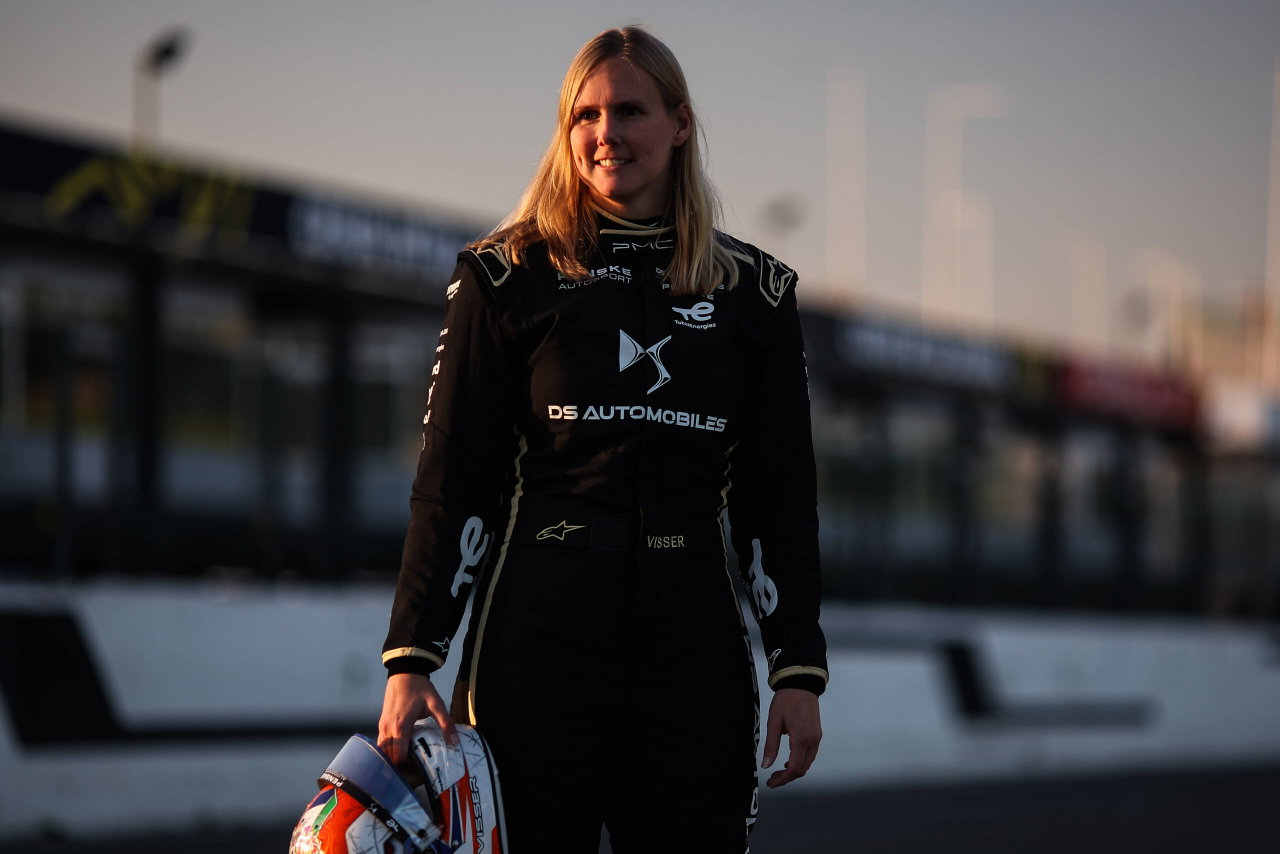
At age five, Beitske Visser couldn’t be pulled away from her kart. More than two decades later, the Dutch racer is still finding reasons to stay behind the wheel. But her pursuit of a racing career has always come at a cost. For Beitske Visser, it has meant near-misses, disappearing opportunities and the challenge of finding a seat in a sport where talent alone doesn’t always guarantee one. Yet the Dutch racer has kept finding her way back to the grid. Her latest chapter came in the NASCAR Euro Series, where a debut-season Lady Trophy victory and a 10th-place finish in OPEN gave her a new milestone to add to a career built on persistence.
Watch What’s Trending Now!
The 31-year-old racer swept the championship in her debut NASCAR Euro Series season. But what makes the achievement noteworthy is her ability to do so while switching teams mid-season.
Her season began on a tough note in Valencia, Spain, where power steering issues made the car extremely difficult to drive. Visser finished P16 but bounced back to P10 and a Lady Trophy win in the second race on the same weekend. By the next outing in Le Castellet, France, she had the championship lead. The next two outings challenged her with mechanical setbacks where she eventually lost the lead only to regain it with a win in one of the two races in the Czech Republic.
By round five in Italy, Beitske Visser had to switch teams. She drove Team Bleekemolen’s No. 76 Toyota. After retiring in Race 1, the Dutch racer bounced back with her fifth Lady Trophy win in Race 2 at the same venue. At the season finale, Visser finished 55 points clear of runner-up Happinessa, with Mariam Davitidze placing third.
Beitske Visser celebrated her 2026 NASCAR Euro Series Lady Trophy triumph at NASCAR Awards night in Charlotte, adding another milestone to a career that has already included the inaugural 2020 W Series Esports League title and two W Series runner-up finishes in 2019 and 2022.
Is Alan Gustafson Holding Chase Elliott Back?
The Dutch driver wrapped up her debut NASCAR Euro Series campaign with seven Lady Trophy race wins, finishing 10th in the overall OPEN standings with 377 points, just four ahead of Dominique Schaak in 11th. It was a strong finish to a season that saw her overcome mechanical setbacks and switch teams for the Playoffs before securing the championship.
But the trophy in Charlotte is only the latest chapter in Visser’s journey through a racing career marked by changing disciplines, unexpected setbacks and a constant search for new opportunities.
For Beitske Visser, her love for racing began at the age of three when she first came across a go-kart. The Lady Trophy Champion would accompany her touring-car-driving father to tracks where she first discovered motorsports and never looked back. When she first got her own kart on her fifth birthday, she never wanted to get out of it. Her father supported her ambition and accompanied her to professional tournaments, working on her car’s setup and more as her mechanic. But her karting career was an eye opener on how difficult it is for women in motorsports to carve their own names in a male-dominated field.
In a 2017 interview, Visser recalled boys deliberately forcing her off track in karting because they didn’t want to lose to her. She said that once she began winning races, they started respecting her. Four years later, she spoke to Females in Motorsport about the frustration of women constantly having to demonstrate their ability to race. She made a particularly revealing point: even when women perform well, their success can be dismissed as luck.
But sexism wasn’t enough to stop the young prodigy from going after her dreams. Visser finished as runner-up in the W Series in both 2019 and 2022, behind Jamie Chadwick on both occasions. But the biggest turning point in her career arrived when the series abruptly came to an end mid-season due to financial losses and funding problems in 2022. Visser was looking forward to receiving her prize money that never came. She later opened up about how she had to sacrifice multiple opportunities because she couldn’t fund her entry in certain prestigious categories.
Visser wanted to pursue a career in Formula 1, but it was no longer an option. Her unwavering determination led her to other motorsports categories, such as the Nürburgring and Nordschleife races and the Toyota Cup in Spain. She had already expressed interest in racing in America before her EuroNASCAR opportunity. Now, after winning the Lady Trophy and finishing 10th overall in OPEN, that ambition has a new context.
So far in her career, Beitske Visser was the first woman selected in the BMW Motorsports Junior Program in 2017, won the inaugural W Series Esports League in 2020, and secured her first W Series pole position at Paul Ricard in 2022. Visser was also part of the first all-female team to compete in the LMP2 category at Le Mans; the team finished ninth in class. Visser’s 10th-place finish in the 2026 OPEN championship is the second-best overall championship finish by a woman in NASCAR Euro Series history. The best finish record belongs to Julia Landauer, who secured 5th in the 2020 Elite 2 (EN2) championship.
Perhaps there has never been a more encouraging time for women looking to make their mark in NASCAR. The 2026 season has brought several milestones, with Hailie Deegan and Mia Lovell becoming the first women to secure a one-two finish in an ARCA Menards Series West race at the season finale.
Earlier, six women took the green flag in the same ARCA West Series race at Phoenix, setting a series participation record and matching the wider ARCA record. These achievements point to a growing presence of women across NASCAR’s development ladder, where opportunities to compete and prove themselves are becoming increasingly visible. While there is still progress to be made at the national level, the 2026 season has offered a glimpse of what greater representation can look like.
Visser’s achievement was also part of a wider celebration of international racing talent, with 2026 NASCAR Euro Series OPEN champion Thomas Toffel joining her and other category winners at the NASCAR Awards in Charlotte.
The Swiss driver had earned his title through a season of consistency, recording three victories and 11 top-10 finishes while holding off experienced competition, including former NASCAR Truck Series race winner Raphaël Lessard.
Their joint recognition in Charlotte underlined the reach of the NASCAR Euro Series, bringing together drivers from different backgrounds and categories under the same NASCAR banner.
Toffel started out as a pocket-bike champion before making the transition to four-wheel racing. His title is the result of years of adapting to a very different machine and gradually building the consistency needed to become a NASCAR Euro Series champion.
Toffel’s championship was the culmination of a four-year progression in the NASCAR Euro Series; he first joined the grid in 2022 before launching his first full-time campaign in 2023. Driving the No. 34 Chevrolet Camaro for THT by Race Art Technology, the Swiss racer opened 2026 with a double victory at Valencia before adding another win at Le Castellet.
He maintained his championship lead through the remaining rounds, collecting five additional podiums and 11 top-10 finishes across 12 races. At Zolder, he needed a top-15 finish in the final race to secure the title and delivered fifth, finishing the season with 528 points, 32 ahead of Thomas Dombrowski.
While Beitske Visser lifted her debut season title trophy, Toffel was awarded the Champion’s ring along with his title trophy. Some other notable names who joined Visser and Toffel at the Awards Night in Charlotte include Vittorio Ghirelli (Italian driver who became the first three-time consecutive V8GP champion), Sandro Tavartkiladze (Master Trophy Champion who won seven out of eight races in the category), Yann Cristovao (V8Challenge Champion), and Thomas Dombrowski (Finished second behind Toffel in the OPEN Championship).