
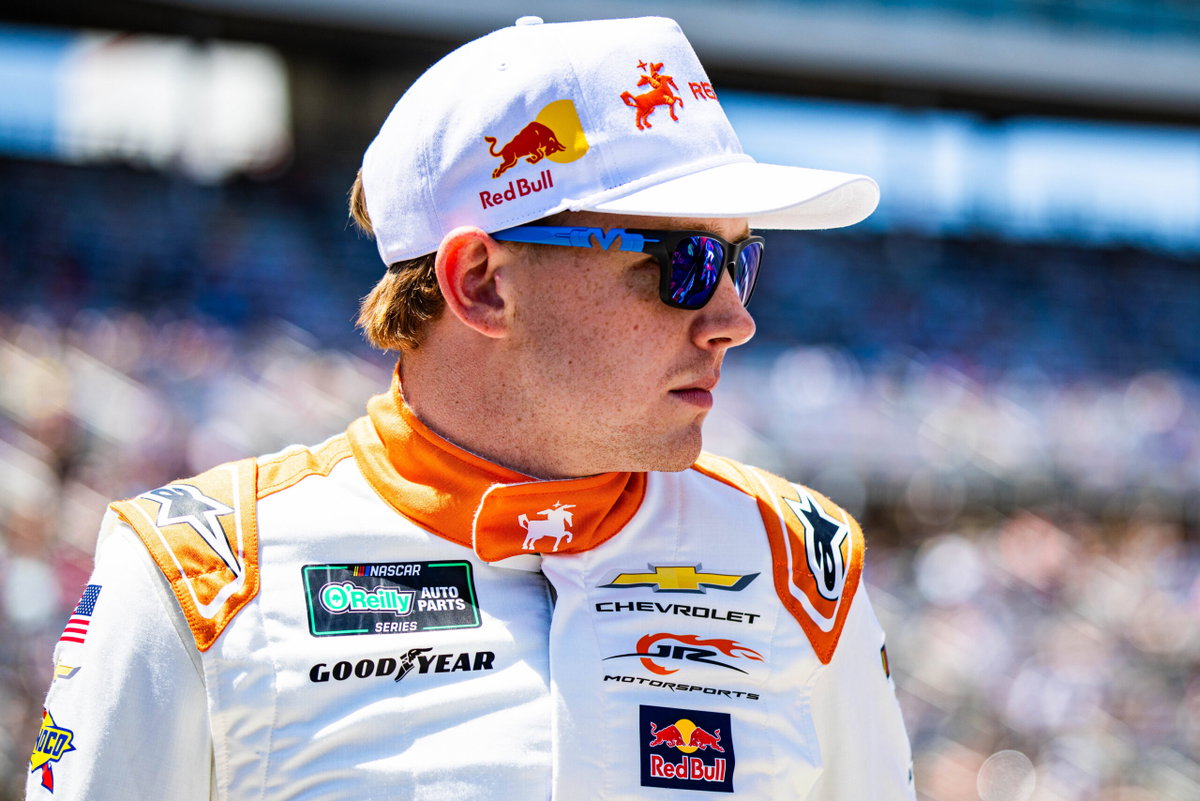
NASCAR has never lacked young drivers with the ability to make it to the top. The bigger challenge has been getting them to consider stock-car racing before another discipline captures their attention. For families entering motorsports, the choices can be overwhelming, and the route to a professional career is rarely obvious. A talented youngster might have the ability to compete at the highest level but never receive the guidance needed to find the right direction.
Watch What’s Trending Now!
Connor Zilisch’s journey illustrates that challenge. His karting success opened doors in international competition, while sports cars and road racing offered opportunities outside NASCAR. It took the right connections and an opportunity with Trackhouse Racing to bring him firmly into the stock-car development system. Kevin Harvick believes that is a situation the sport cannot afford to overlook.
“The ladder system is so hard to explain to people, as to, ‘I want to get into racing; should I start in a go-kart? Should I go to Legend Cars? Should I start in a Bandoleros? What do I do here?’” Harvick said on the Dale Jr. Download podcast. “And I think that Brent Crews, Connor Zilisch—you look at those two. They go to go-karts; they’re going to live the F1 open-wheel dream. Don’t know anything about NASCAR.
“Go to both their parents and say, ‘Hey, you should really look here down the NASCAR side of things instead of going over here and racing sports cars or going to F3, four, two, whatever you got going, because your kids got way more talent than probably most of the kids that are going to go into the NASCAR system.’ Now everybody knows that go-karts is pretty good based upon Connor Zilisch and Brent Crews, and it’s much more on the map than what it used to be.”
The problem starts at the entry level. Young drivers can progress from Bandoleros and Legend Cars into Limited Late Models, Pro Late Models, and Late Model Stocks. Super Late Models offer another route, while regional touring competitions provide opportunities to gain experience against stronger fields. From there, ARCA and NASCAR’s Truck and O’Reilly Auto Parts Series can become stepping stones towards Cup.
However, there is no single progression that every driver follows. Families must understand the different divisions, their costs, and the opportunities each offers. Harvick believes the CARS Tour can help make those connections easier. With Legend Cars, Pro Late Models, and Late Model Stocks sharing events, parents can see the next level of competition and meet the people who operate those programs.
That effort also addresses a problem that has developed over several decades. During the 1990s, regional touring divisions had stronger identities across different parts of the country. The Carolinas and Virginia formed part of the Mid-Atlantic racing landscape, where Late Model Stock competition continues to have a significant footprint.
But the financial support behind grassroots racing gradually weakened after Winston began withdrawing from its involvement in the sport. Its investment had extended beyond the premier series into Saturday-night racing and regional programs. When that support disappeared, the smaller divisions lost an important source of financial backing.
Harvick pointed to the decline of the Southwest Tour, Northwest Tour, and All-Pro Tour as examples of how the regional structure gradually deteriorated. As individual organizations tried to sustain their programs, different technical rules began emerging.
The consequences were significant. Cars built for competition in the Southeast could not necessarily race on the West Coast without modifications. Western organizations developed their own approach, including the 602 crate-engine competition, while other regions followed different technical directions. Instead of a connected national structure, grassroots racing became increasingly divided by geography and regulations.
That fragmentation makes it harder for drivers to move between regions and for families to understand where their children should compete. NASCAR can still discover exceptional talent, but the process becomes less straightforward when the development system lacks a clearly understood progression.
Several current Cup drivers demonstrate what a structured route can achieve. Denny Hamlin began in go-karts before moving into Mini Stocks and Late Model Stocks in Virginia. His 2003 season, which produced 25 victories in 36 starts, caught Joe Gibbs Racing’s attention and earned him a development contract. He made his Cup debut in 2005.
William Byron took a different route, beginning in Legend Cars before progressing through Late Models, the K&N Pro Series East, Trucks, and Xfinity. He won the Xfinity championship in 2017 before moving to Cup the following season. Chase Elliott also came through Late Model competition before progressing through the K&N East and NASCAR’s national ranks, winning the 2014 Xfinity championship before reaching Cup.
Kyle Larson’s background offers another example. His success in sprint cars and USAC gave him a route into NASCAR, showing that the sport can benefit from talent developed outside traditional stock-car racing.
Zilisch’s progression brings Harvick’s argument into sharper focus. After years in karting and success in Trans Am and IMSA, he signed with Trackhouse in 2024. His development program included the CARS Tour, ARCA, and NASCAR national series competition before his rapid rise to Cup. Trackhouse identified the talent, but Harvick’s concern is how many others might never receive similar guidance.
With Dale Earnhardt Jr., Jeff Burton, and Marcus Smith also involved in the CARS Tour, Harvick has a platform to help address that problem. The objective is not to force every young racer down the same route. It is to make sure families understand the opportunities available before another discipline becomes their only consideration.
For NASCAR, rebuilding that connection could be just as important as finding the next winning driver. The sport cannot afford to leave talented youngsters looking elsewhere simply because nobody showed them the way in.