
Ever since the demolition of Auto Club Speedway in 2023, every leaked construction site image or drone shot has hit hard, at least to us who had some sort of connection to the track. It was hard to believe that the 2-mile track was never coming back. The locals couldn’t help but watch its demise from afar.
Watch What’s Trending Now!
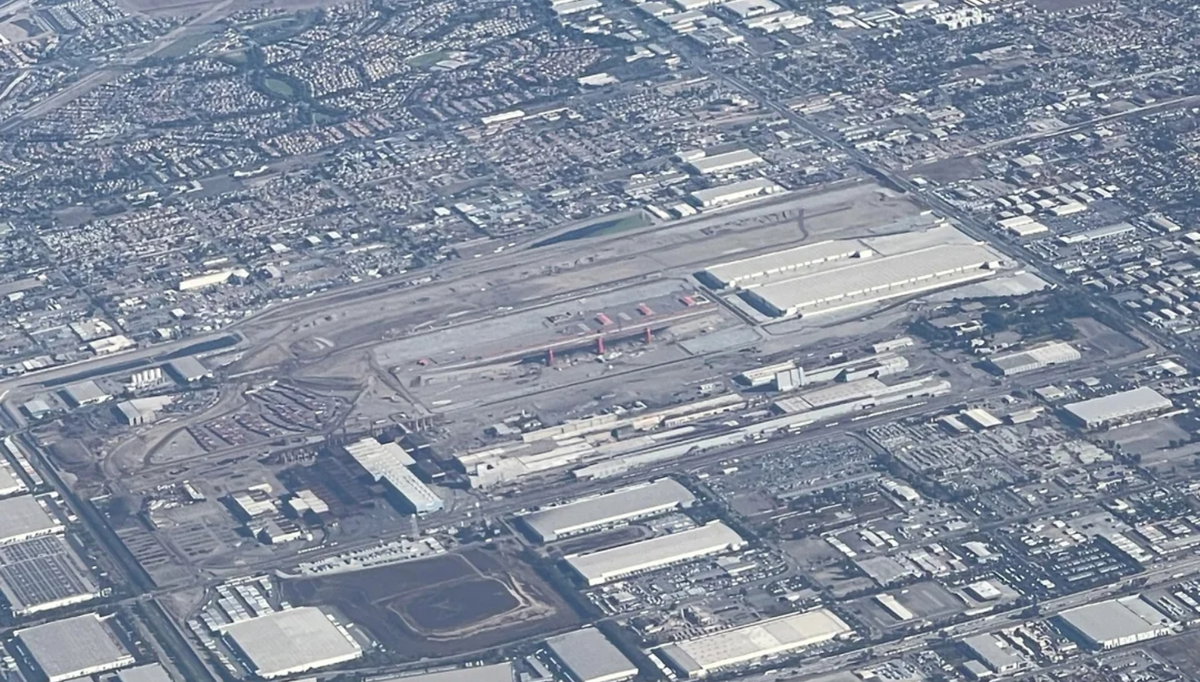
Even worse, plans to redevelop the site as a short track venue stalled earlier this year, leaving the venue gathering dust and rotting away. It’s almost hard to recognize the place now. That’s exactly what a Redditor mentioned after they flew over the place on Friday. “What is left of Auto Club Speedway as of 10/31/25,” they wrote and attached an aerial view image of the track.
It looked nothing like it used to.
Auto Club Speedway, an empty canvas where legends once roared, has been silent for quite some time now. Originally named California Speedway and built by racing mogul Roger Penske on the site of the former Kaiser Steel Mill in Fontana, California, it had a history of ambition, speed, and location. It instantly became a hub for high-speed motorsport, hosting the first NASCAR Winston Cup Series race in June 1997, won by Jeff Gordon.
Back then, the track was one of NASCAR’s best stops each year, and Penske was surprised to see they cracked into such a major metropolitan market. But today, that situation’s far from the same.
The oval’s tenure as a NASCAR fixture officially concluded in February 2023. The decision to abandon the original configuration was not primarily due to poor racing, but rather a strategic business move by NASCAR, which had merged with track owner International Speedway Corporation.
However, as of late October 2025, the demolition process has effectively erased the majority of the speedway from the Fontana landscape. Drone footage and satellite images confirm that the track surface of the main oval, including the asphalt and retaining walls that comprise the two-mile circuit, has been removed in large sections.

Getty
FONTANA, CA – MARCH 17: Austin Dillon, driver of the #3 Dow Coatings Chevrolet, and Kevin Harvick, driver of the #4 Jimmy John’s Ford, take the green flag to start the Monster Energy NASCAR Cup Series Auto Club 400 at Auto Club Speedway on March 17, 2019 in Fontana, California. (Photo by Robert Laberge/Getty Images)
The land where Turns 1 and 2 once stood has already been redeveloped, with massive distribution warehouses and an industrial park now occupying that space, built rapidly after the land sale. While the grandstands, the front stretch wall, and the pit road area were initially spared as potential features for a future motorsports venue, the overall appearance is eerie, showing a vast, empty canvas where the speedway once sprawled.
While the track’s vast size and distance from major population centers presented logistical challenges, the overwhelming value of the property, which sits at more than 500 acres, became the deciding factor in the sale. In a massive real estate transaction, NASCAR sold 433 acres of the site for a reported $544 million, instantly turning the Fontana track into a massive land investment.
The final race on the track was held in 2023, with the understanding that the land value was driven by its superb location near the major I-10 and I-15 freeways, as well as the growing demand for industrial space in the Inland Empire.
The fate of Auto Club Speedway has left many fans saying, ‘lost a special one,’ with many viewing the demolition as a symbol of NASCAR prioritizing business over heritage.
Fans lament the speed of demolition of the NASCAR track
One fan noted, “So weird to realize how easy it is to erase such a large track and make it look like it was never there.” Within two years of its final race, the asphalt oval, which hosted open-wheel speed records and multi-groove stock car battles, has been removed in large sections as bulldozers clear the massive footprint. This was a clear sign that the property’s financial utility for logistics and distribution far surpassed its function as a superspeedway.
Another fan reminisced, “One of the few NASCAR tracks that had no curfew or noise abatement while being close to neighborhoods as well. We really lost a special one.” Unlike tracks like Sonoma Raceway or Charlotte Motor Speedway, which strictly enforce “Quiet Time” for generators and amplified music in their campgrounds, the primary oval at Fontana faced no severe noise limitations on its major race weekends until its closure.
However, the track’s smaller, peripheral venue, the Auto Club Dragway, did experience crippling legal pressure and event cancellations due to noise complaints from nearby residential groups in 2010 and the next few years.
Regardless, talking about the track, a fan wrote, “That was one thing that surprised me the first time I went there. My first two races were Atlanta and Phoenix which are both in the middle of nowhere. So it was definitely a change of pace to go to Auto Club which was still well within civilization, however that part was nice. Being in Western Canada, it was one of the few tracks that was easy to visit, and as such the race weekends in 2013 and 14 are the last times I’ve seen NASCAR live.”
Located in Fontana, the track sits approximately 50 miles east of downtown Los Angeles and, critically, is only about 10 miles from the LA/Ontario International Airport, providing easy access via major throughfares. This contrasts sharply with tracks like Atlanta Motor Speedway in Hampton, Georgia, and Phoenix Raceway in Avondale, Arizona. Another added, “No track’s had a greater redemption arc than Fontana. From one of the most hated tracks on circuit when it stole Labor Day Weekend from Darlington, to now mourned like North Wilkesboro was.”
The track initially drew widespread fan resentment when it was awarded Darlington Raceway‘s traditional, revered Labor Day weekend date starting in 2004. That move stripped the “Track Too Tough to Tame” of its signature Southern 500 date after a 50-plus year run, fueling the perception that NASCAR was prioritizing new markets over Southern tradition. But its late-stage evolution of the racing product led to the track being widely mourned upon its 2023 closure announcement.
Finally, one fan stated, “Strangled is the right word. Riverside was a mainstay on Cops. The whole area was industrial and down trodden. As CA real estate exploded so did the area surrounding the track. Good highway access to i10 and a straight shot to LA. Ontario airport nearby. Land value skyrocketed. It still has a ways to go but I don’t see the track ever coming back. It’s a land investment now for nascar.”
With this, as the grandstands vanish and the asphalt fades, only echoes of roaring engines remain, a bittersweet farewell to Fontana’s legacy.