
Imago
LAS VEGAS, NV – OCTOBER 15: Former NASCAR, Motorsport, USA driver Mark Martin speaks to fans in the Neon Garage before for the NASCAR Cup Series Playoff South Point 400 on October 15, 2022, at Las Vegas Motor Speedway in Las Vegas, NV. Photo by Jeff Speer/LVMS/Icon Sportswire AUTO: OCT 15 NASCAR Cup Series Playoff South Point 400 Icon221015013
Imago
LAS VEGAS, NV – OCTOBER 15: Former NASCAR, Motorsport, USA driver Mark Martin speaks to fans in the Neon Garage before for the NASCAR Cup Series Playoff South Point 400 on October 15, 2022, at Las Vegas Motor Speedway in Las Vegas, NV. Photo by Jeff Speer/LVMS/Icon Sportswire AUTO: OCT 15 NASCAR Cup Series Playoff South Point 400 Icon221015013
For decades, Ford has been synonymous with stock car racing, but now one of its most loyal voices is raising eyebrows. When a Hall of Famer like Mark Martin speaks candidly about the brand he once represented for a little over two decades, it is bound to stir the garage. And this time, his remarks don’t just hint at concern, but point toward a deeper shift that could be reshaping the future of Ford in NASCAR.
Watch What’s Trending Now!
In a candid conversation with the hosts of the Door Bumper Clear podcast, the 67-year-old veteran shared his opinion about Ford’s future.
“Ford just doesn’t invest, and right now it looks like they’re even less. They’re probably shifting their money toward F1. I don’t know,” Martin said. “I’m an outsider looking in, but…I felt like that the reason we were less favored, we being Fords were less favored than other manufacturers, is because they participated less in, you know, outside of they spent less money outside of what they did for their teams.”
The numbers seem to echo Martin’s concern. Ford’s footprint across NASCAR has been shrinking steadily, and by 2026, only a handful of teams are expected to carry the manufacturer’s banner.
The drop is particularly striking in the NASCAR O’Reilly Auto Parts Series, where just a single team is set to represent Ford. For a brand that once thrived on volume and visibility, the decline against rivals like Chevrolet signals a significant shift.
Even at the top level, Ford’s presence feels increasingly concentrated rather than expensive. Heavyweights like Tim Penske and RFK Racing continue to carry the torch in the Cup series, but beyond that, the pipeline appears thin.
The Truck Series tells a similar story with limited unique entries compared to competitors. At a time when development depth matters more than ever, Ford’s narrower spread could prove costly in the long run.
Imago
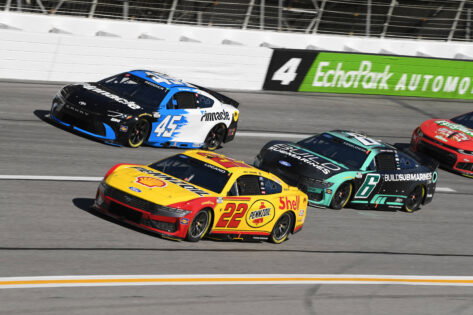
ATLANTA, GA – FEBRUARY 22: Joey Logano 22 Team Penske Shell Pennzoil Ford, Brad Keselowski 6 RFK Racing BuildSubmarines.com Ford, and Tyler Reddick 45 23XI Racing Pinnacle Toyota race through Turn 4 during the running of the NASCAR, Motorsport, USA Cup Series Autotrader 400 on February 22, 2026, at EchoPark Speedway in Hampton, GA. Photo by Jeffrey Vest/Icon Sportswire AUTO: FEB 22 NASCAR Cup Series Autotrader 400 EDITORIAL USE ONLY Icon260222540
Then there is the global pivot. Ford’s high-profile partnership with Red Bull Racing for the 2026 Formula One season signals a major strategic investment. Building engines under new regulations isn’t just ambitious; it is very resource-intensive.
With engineering focus and funding being redirected toward F1, NASCAR programs risk taking a backseat. Combined with Ford’s historically guarded approach to sharing technical data with teams, the result is a manufacturer increasingly reliant on loyalty rather than expansion, at a time when rivals are doing the exact opposite. And Martin cannot help but raise these concerns.
Part of the strain may be rooted beyond the racetrack. The US Auto industry faced turbulence towards the end of 2025 with rising costs and tariffs impacting consumer demand.
Even giants like General Motors saw sales dip, and it’s unlikely Ford escaped unscathed. Tightened budgets often lead to tough decisions, and motorsport programs are rarely immune when financial pressure mounts.
But as Ford finds its footing in F1, Martin cannot help but reflect on how NASCAR teams operate today.
Martin explains why NASCAR teams struggle to keep up
Mark Martin recently shared his take on NASCAR’s competitive nature, explaining that while teams consistently put in an effort, results don’t always come immediately.
Drawing from decades of experience at the top level, the Hall of Famer emphasises the relentless effort teams invest week in and week out, while also noting the results don’t always reflect that work immediately.
According to Martin, success in NASCAR isn’t linear; it comes in waves, shaped by patience, persistence, and constant adjustment
“Competition ebbs and flows, whether it’s a change in the, a little bit, a little bitty change in body shape on the front or the back or something like that,” he said. “Or, or if it’s just competition, it’s always increasing.”
His comments come at a time when Hendrick Motorsports has faced a slow start to the 2026 season. With teams like Toyota and Ford setting the early pace, Chevrolet seems to be taking a backseat despite the introduction of a new body this year.
The frustrating side of the sport is that efforts don’t always translate into immediate results. However, breakthroughs, just like Chase Elliott’s win for HMS, are extremely important.
In a series where tiny improvements can unlock significant performance, Martin explained that a breakthrough often arrives suddenly after periods of stagnation.
“Sometimes they get better faster, and sometimes they get stuck, and they work hard as they can, but they don’t get anywhere for a while, and they fall behind,” he added. “Not because they’re not working, just because that’s how sometimes what you work on doesn’t bear fruit. And then other times it does, you know, bear really sweet fruit.”
His observation reflects the current landscape of NASCAR, where teams are constantly experimenting, refining setups, and searching for that edge that can transform their results from one race to the next.

