
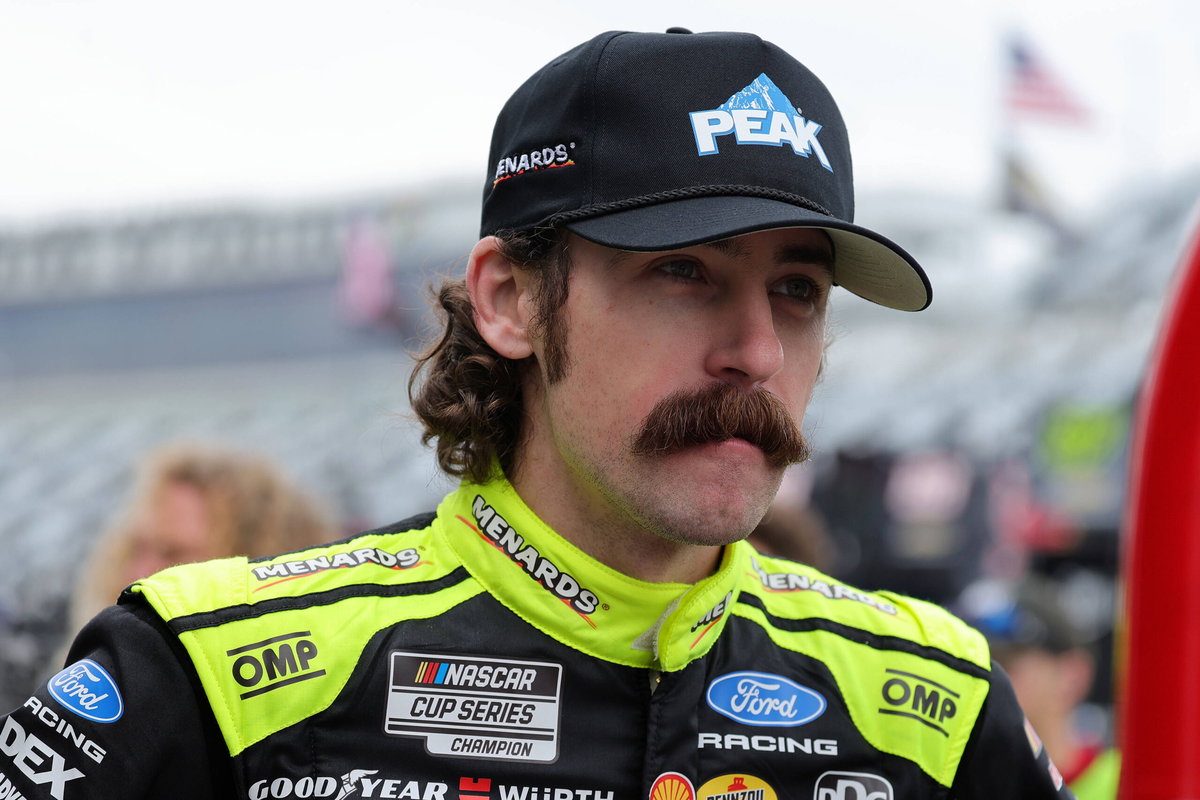
“I’ll take rain,” said Logano, who earned the top starting spot through a combination of his victory last Saturday at Bristol Motor Speedway and the position of his No. 22 Team Penske Ford in owner points. However, turns out, his teammate Ryan Blaney had even more reason to hope for a weather break after today’s race. Forced to start 25th at Kansas, Blaney spent another Chase race paying the price for NASCAR’s metric system, before admitting that maybe rain at Las Vegas could finally work in his favor.
“It’s just everywhere has its difficulties when you have to start in the back, and maybe it’ll rain in Vegas, and we’ll actually be benefited by the metrics,” Ryan Blaney said after the Kansas race.
The comment came with plenty of frustration behind it. Blaney was once again forced to begin a Chase race deep in the field, and this time he had to start 25th. The problem was not a lack of pace from the No. 12 Team Penske Ford. Instead, his starting position was largely a consequence of what had happened one week earlier at Bristol.
Blaney had crashed out of the Bass Pro Shops Night Race while battling Carson Hocevar for second. The resulting 33rd-place finish became particularly costly when Kansas qualifying was washed out, because NASCAR’s metric system was then used to determine the starting order.
The current formula, modified in 2025, places 70% of the weight on a car’s finishing position in the previous race and the remaining 30% on the car’s position in the owner standings. With Blaney finishing 33rd at Bristol, the system effectively carried the damage from one bad result directly into the following Chase race.
It was the third time in the first four races of the 2026 Chase that weather had prevented qualifying. At Darlington, severe weather and nearby lightning forced both practice and qualifying to be canceled. That weekend showed just how much the metric can amplify the consequences of a bad result.
Blaney had entered Darlington carrying the fallout from his Daytona DNF in the regular-season finale. The formula put him 24th on the starting grid, meaning he had to spend the race fighting through traffic rather than beginning from a position determined by his actual qualifying speed.
Yet Blaney turned the disadvantage into an impressive recovery, eventually finishing fourth. Bristol presented a similar situation. Blaney had already been hurt by a brake failure and crash at Gateway, where he finished 35th. The metric subsequently sent him to 29th at Bristol.
What followed was arguably one of his strongest drives of the Chase. Blaney carved through the field, eventually leading a race-high 202 laps. He looked capable of turning another poor starting position into a major result until a late incident with Hocevar ended his night with 43 laps remaining.
The crash left Blaney with a 33rd-place finish and created another problem for the metric. So when Kansas qualifying disappeared because of rain, Blaney was handed the lowest starting position among all 16 Chase drivers.
Blaney methodically picked his way through the field and ultimately brought the No. 12 home fifth. It was another strong recovery. But the repeated need to overcome a starting-position disadvantage has clearly become frustrating for the Team Penske driver.
That frustration is not unique to Blaney. After qualifying was canceled at Darlington, Kevin Harvick offered a particularly blunt assessment of NASCAR’s system on the Happy Hour podcast.
“Let’s be clear, I hate the metric. There is no reason for the damn metric. We should be random drawing for qualifying every week to keep it mixed up.”
The Darlington starting order also highlighted another problem with the formula. Carson Hocevar and Chris Buescher, both caught up in incidents during the Daytona finale, were forced to start 34th and 35th, respectively. Tyler Reddick, meanwhile, had finished third at Daytona and consequently started from the pole alongside fellow Chase driver Daniel Suárez, who had finished second.
The result was a starting grid heavily influenced by what had happened at the previous race rather than what each driver might have produced in qualifying that weekend.
NASCAR did not always determine the starting order this way. Before the metric system, qualifying positions were established through a random draw. This method gave every driver the possibility of receiving a favorable or unfavorable position without carrying the previous race’s result into the next event.
Harvick now believes NASCAR should return to the simpler random-draw approach, and Dale Earnhardt Jr. has also previously expressed support for bringing random qualifying positions back. For Blaney, though, the debate is no longer theoretical.
He has repeatedly shown that he can overcome the metric and charge through the field. But each recovery costs valuable track position and creates another obstacle in a Chase where every point matters.
With six races remaining and Kyle Larson continuing to build his advantage, Blaney knows he cannot afford many more setbacks.