
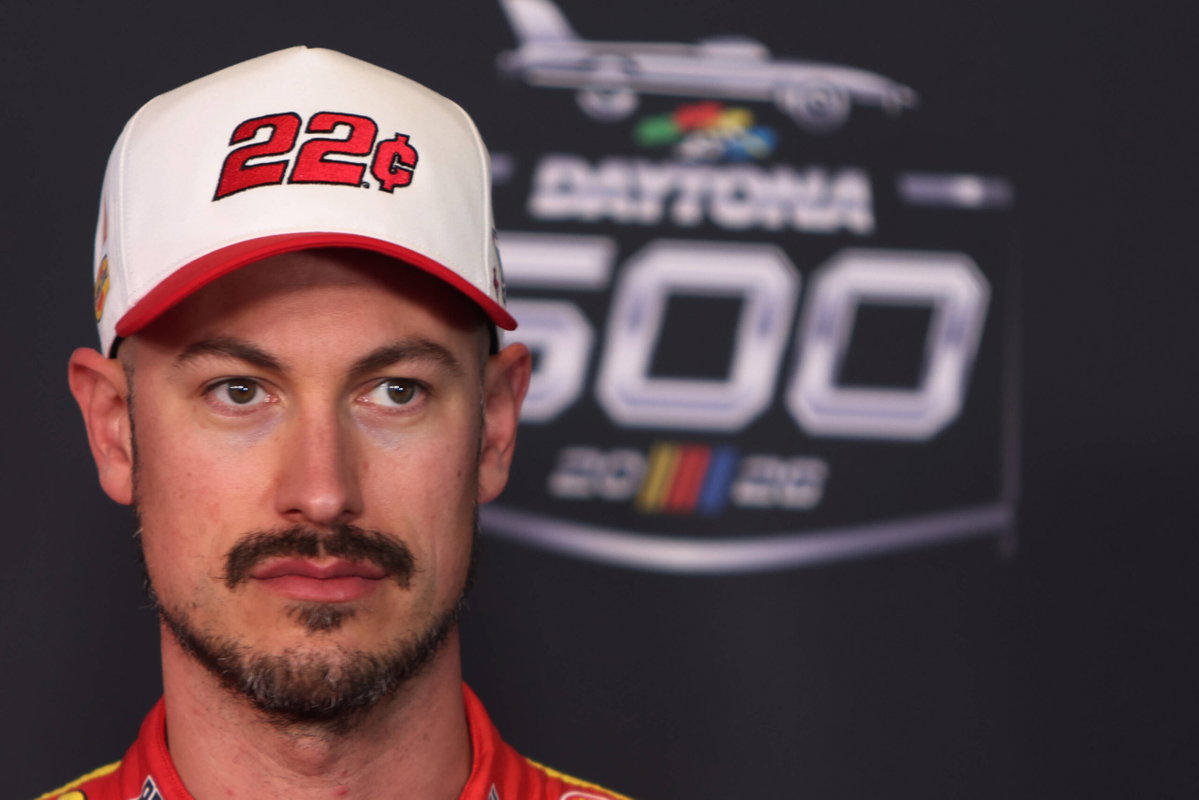
Joey Logano was still fighting for 12th at Kansas when the championship suddenly got a lot more expensive. There were three laps left. Kyle Larson was already on his way to a second Chase win, having led 235 of 267 laps and swept both stages. Logano had started from the pole and was nowhere near the front anymore, but 12th was still enough to limit the damage.
Watch What’s Trending Now!
Then the right-front tire started going down. Logano dropped to 20th by the checkered flag. Larson finished the afternoon with 76 points. Logano got 25. One tire failure had turned an ordinary bad finish into a 51-point swing against the championship leader. That is the part of the 2026 Chase becoming glaringly obvious.
“I think the thing that’s probably stood out the most is the value of wins and stage points together, right? How you can quickly make up, you know, a fair amount of distance with the 70-point day.” In response, Bob Pockrass asked him about the team of engineers and strategists they have at disposal; how come they missed this trend of the chase format? And Logano’s answer was simple yet insightful.
“Maybe we’re not as smart as we think.” Joey Logano told Bob Pockrass on a question about how the math should be clear before.
Joey Logano was talking about something NASCAR’s new scoring system has made impossible to miss. A driver no longer has to wait for the final finishing order to find out how valuable a race was. The points can pile up throughout the afternoon, and if everything goes right, they pile up very quickly.
Larson’s Kansas race showed the extreme version. He won Stage 1. He won Stage 2. He won the race. He also set the fastest lap. That produced the maximum 76 points available under the current system. It was the first time a driver had collected all 76 in a race.
The important detail is what happens when you compare that number with second place. A race win is worth 55 points. Each stage win is worth another 10. The fastest-lap bonus adds one. So a driver dominating the entire afternoon can build a points haul that has very little to do with the simple difference between first and second.
That is why Logano’s Kansas afternoon mattered so much even though he was nowhere near contention for the win. He had already seen the other side of it.
At Bristol, Joey Logano won the race after winning Stage 1 and finishing third in Stage 2. He scored 73 points. It was his third win of the season and moved him to within 16 points of Larson heading into Kansas.
A week later, Larson essentially answered him with an even bigger points day. This is where the Chase starts becoming more interesting than the standings themselves. Larson did not simply win Kansas. He extracted almost everything the race had to offer. Joey Logano did not simply finish 20th. He lost points at the worst possible time, after spending most of the race well clear of that result.
And because this is a cumulative Chase, neither side of that equation gets erased. NASCAR brought back a 10-race Chase this year with 16 drivers, but without the eliminations and resets that defined the playoff format for much of the previous era. Once the Chase reset was made, the drivers were essentially handed a 10-race ledger. Every point earned or lost stays there.
That changes how you look at a bad Sunday. In an elimination format, there is always another round to think about. In this one, the points simply follow you. If Larson gains 51 on Logano at Kansas, Logano has to earn those 51 back somewhere. There is no mathematical reset waiting around the corner.
And Kansas was not an isolated example. Joey Logano had already gone through the kind of swing this format can create at Gateway. He won the first stage from the pole, finished second in Stage 2 and led 96 laps. Yet he finished third after a chaotic race won by Larson. The result gave Logano 54 points. A victory would have taken his total to 74.
Twenty points can sound small when you look at a championship with thousands of points. It is not small when there are only 10 races.
That is the tension NASCAR has created with this format. The season is long, but the Chase is not. The points reset gives the 16 drivers a fresh starting position, then the system lets individual races create large swings inside a relatively small window.
Look at Larson’s position now. After Kansas, he leads Hamlin by 26 points. Joey Logano is fourth, 67 points back. Ten of the 16 Chase drivers are already at least 111 points behind Larson.
Yet the standings can still move violently because the races themselves can. Stage points are part of that. Hamlin’s 18th-place finish at Darlington did not become as damaging as it might have because he banked 16 stage points and finished the day with 35. The final position tells you he had a bad race. The points tell you he had a bad race that he partially rescued before the finish. That distinction matters much more now.
And there is another wrinkle. Larson’s Kansas dominance did not come out of nowhere. He had already finished fifth at Darlington, won Ga,teway and finished second at Bristol. Kansas was his fourth straight top-five finish to open the Chase. The difference was that this time he turned a strong race into a completely optimized one.
That is why the next six races are so difficult to read. Las Vegas comes next, followed by the Charlotte, Phoenix, Talladega, Martinsville and Homestead. A 1.5-mile track, another championship track, a superspeedway and two very different short-track-style tests make for six completely different opportunities to gain or lose points.
Logano knows that better than most. He has already shown that a 73-point race can pull him toward the front of the championship. He has also just watched a tire failure turn a manageable afternoon into a 51-point loss.
Larson, meanwhile, has discovered what happens when a driver combines a winning car with a scoring system that rewards nearly every part of the performance.
So perhaps the real question in this Chase is not whether 76 points is too many for one race. It is whether, over 10 races, NASCAR has created a championship where one extraordinary Sunday can matter almost as much as several merely good ones.
And if that is what this format is designed to do, how many more Kansas-sized swings can the championship absorb before one race starts deciding far more than NASCAR intended?