
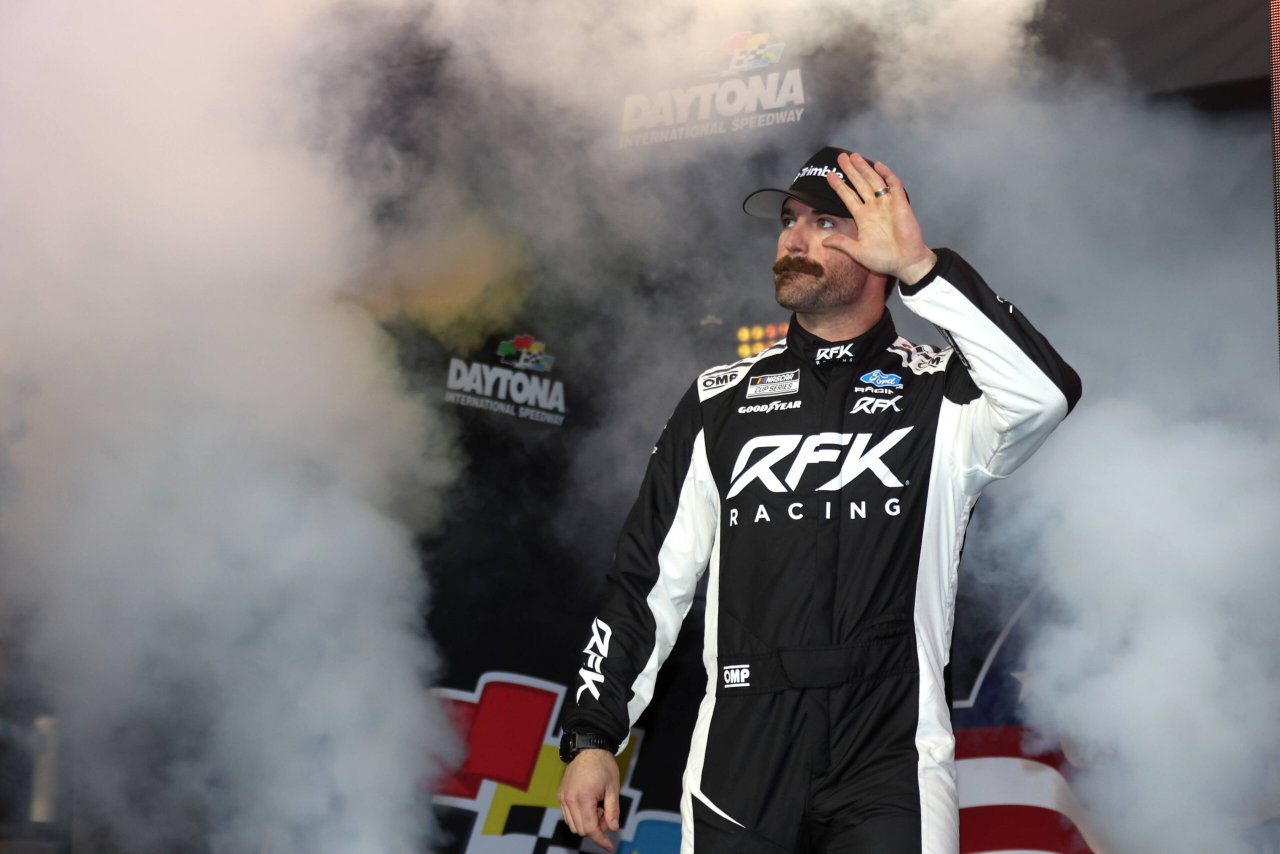
It was some years ago that Corey LaJoie snuck out under cover of darkness at the Charlotte Roval and painted one of the track’s blue curbs to look like a Teenage Mutant Ninja Turtle. Nobody asked him to, and nobody gave him permission. That is the kind of guy he is, and it is a big part of why fans like him. So when LaJoie decided to poke at the sport’s media world on October 10, nobody in the garage should have been shocked that he did it with a lit match and not a polite email. Here is what he posted on X:
Watch What’s Trending Now!
“With all due respect to the men and woman media who cover the sport, I’m genuinely curious why the large media companies have deserted @NASCAR. The @keselowski news is biggest story in recent memory and he’s in the media center surrounded by non affiliated youtube channels.”
Anyone who’s a NASCAR aficionado knows this thing. A big story breaks, the room fills up, and you keep a lookout for the familiar badges from the networks and the national papers. This time, a lot of them weren’t there.
I think here, the underlying question is a good one. But I also think LaJoie packed a second argument inside the first without announcing it, and that second argument is shakier. He turned a question about whether big outlets are paying attention into a question about who belongs in the room.
Those are two very different conversations, and mixing them up says more about how this sport thinks about status than it does about Brad Keselowski.
First, what actually happened at RFK
The temptation with a story like this is to treat it like a headline and move on, so let me slow down and lay it out. RFK Racing announced on September 29 that Keselowski would leave the No. 6 Ford Mustang when the 2026 Cup season ends. He is a 2012 Cup champion with 36 wins at NASCAR’s top level, and he arrived ahead of the 2022 season as both a driver and a co-owner, with a mandate to help rebuild a team that had spent years searching for its old muscle. The team also said the two sides would work through what happens to his ownership interest, and that RFK would chase a third charter so it could stay a three-car operation in 2027.
The release said very little about why. That is normal, because a team statement exists to announce a decision, not to walk fans through the arguments that produced it. But it left a hole, and the hole mattered, because Keselowski was never just a guy in a firesuit whose deal had run out. He had a stake in the company, a voice in how the cars were built and developed, and a big role in where the whole thing was supposed to go.
The explanation came four days later at Las Vegas Motor Speedway, when RFK president Chip Bowers and Keselowski both talked to reporters. And what they described was not a blowup. It was a disagreement about timing. RFK wanted Keselowski to start sliding into a bigger competition leadership job over the next two to three years. Keselowski wanted to keep driving for a lot longer than that. Bowers admitted the sides tried to find common ground and simply landed in different places. Keselowski was blunt about his side of it: “I’m nowhere near ready to be done as a driver.” He also told reporters that his career is not over by any means.
I think that distinction matters, because the internet loves a villain, and this story does not have one. Nobody was shoved out the door for running slow, and nobody leaked a feud. A team looked at the next three years and saw one future, and a driver looked at his own calendar and saw another. Both of those positions are reasonable, which is exactly why the split hurts.
And the fallout stretches far past one car number. RFK has a head of competition job to fill. Keselowski’s ownership stake is still an open item. The man himself needs a place to race in 2027, and as of the Vegas availability nothing had been disclosed. Yes, the rumor mill spit out names like 23XI Racing and a full-time Craftsman Truck Series program, but that was speculation and nothing more. By Charlotte on October 10, the story was almost two weeks old. The first round of answers was out, so the reporters in that room had a different job than the people who were in Vegas on day one.
Taylor Kitchen of Above The Yellow Line was one of the independent journalists in there, as The Daily Downforce reported. The question worth asking is not who was standing next to him. It is what they were all trying to find out.
A famous logo is not the same thing as a good question
Let me be fair to the big outlets, because they matter. They have giant audiences, deep distribution and editors with the muscle to push a story onto a front page. A national report can introduce stock car racing to somebody who has never sat through a full race, and NASCAR should be chasing more of that, not less. Nobody serious disputes it.
But reach and reporting are two separate muscles. Having a famous masthead tells you how far a story can travel. It tells you nothing about whether the person who wrote it asked the right thing. The test of a reporter is stubbornly simple. Did they figure out what happened? Did they push on the answer that sounded too tidy? Did they keep the facts apart from the gossip? Did they come back when the story changed, or did they vanish once the clicks dried up? Those standards apply to a veteran at a national outlet and to a kid with a camera and a channel in exactly the same way.
I do not read LaJoie’s post as an attack on YouTubers. He started by thanking the media members who cover the sport, and his stated worry was about absent big companies. That is a legitimate gripe, and I think he deserves credit for raising it. Where I part ways with him is the framing, the idea that independent folks filling a media center is a sign something has gone wrong. Asking why a big outlet did not send someone is a question about editorial priorities. Sneering at the people who did show up starts to sound like a pecking order of professional worth, and that is a hard thing to defend when those people are doing the job.
If a reporter earns access, asks a smart question and gets the answer down accurately, I do not care whose paycheck they cash. The audience is not better informed because the writer has a bigger payroll behind them. And a report does not become less trustworthy because a fan found it on YouTube and not a news site.
None of that means independence is a guarantee of quality, and I want to be honest about it. A channel with a huge following can still repeat rumors, blow up a throwaway driver quote into a revelation, or spin a thin hint into a bombshell. The big outlets do the same thing on a bad day. Affiliation simply cannot tell you which report to trust. You have to read the work.
Picture two reporters at that Keselowski availability. One wears the most recognizable logo in sports journalism and files a shallow recap of the split. The other works for a tiny independent outlet and explains the disagreement, the timing and the consequences cleanly. If you are a fan, you should care a great deal about the gap between those two stories. You should care almost not at all about the gap between the two logos.
NASCAR already opened that door itself
There is a quiet assumption inside the “deserted” argument that creators sit outside the sport’s real media ecosystem, as if they snuck in through a side gate. That does not match how racing is covered in 2026. Digital outlets, podcasts, video explainers and creator-led channels are part of how people follow this sport now. Some break news as it happens. Others dig into technical rules, retell old stories, sit down with people who rarely get a national platform, or give fans somewhere to argue about racing between Sundays.
Now, being on the same platform does not make everyone a journalist. Commentary, entertainment and reporting are different jobs, and the overlap can get messy. A video reacting to a rumor is not a report that confirms it. A fun podcast conversation is not automatically original reporting. But the fact that some creators blur those lines does not make the whole category unworthy of a seat.
NASCAR’s own credential rules show the boundary is not as rigid as people like to imagine. The official credentials page for the 2026 San Diego event said freelance writers, photographers, content creators and bloggers could all submit requests. Approval, access and how many credentials got handed out stayed at NASCAR’s discretion. So creators could apply, but nothing was guaranteed. I think that is a sensible policy, since a credential is not a trophy for having a big audience. It is access given for a purpose, and the real question is whether the person holding it can add legitimate coverage and follow the rules.
Traditional outlets have to clear the same bar. A pass does not guarantee a scoop any more than a YouTube channel guarantees original reporting. The platform tells you how the work gets delivered. It says nothing about whether the work is any good.
And for a sport this sprawling, a wider media landscape is a feature. A national broadcast might be the first handshake with a casual viewer, but it cannot answer every question that pops up across a 36-race Cup season. A specialist site can spend a week on a crew chief swap, a team’s money problems or the technical fallout of a rules tweak. A creator can explain a messy issue to a younger crowd in a format that feels natural to them. A podcast can give a driver more room than a ninety-second post-race interview ever will. Those jobs are not interchangeable, which is exactly why a sport with this many teams, owners and moving parts needs more than one pipeline.
The danger is getting trapped in a false choice. Either the big media companies show up or NASCAR has been abandoned. Either you work for a traditional employer or you are just a YouTuber. Neither of those is how coverage works on the ground. If the independent reporters at Charlotte were asking questions and chasing the Keselowski story, then their presence was not proof the sport had been deserted. It was proof that people still care enough to cover it.
A bigger media deal brought more partners, not more journalism
Part of the confusion comes from how people talk about media exposure in this sport, so let me untangle it. NASCAR’s seven-year Cup Series rights agreements run from 2025 through 2031 and put FOX Sports, NBC Sports, Amazon’s Prime Video and TNT Sports in the same ecosystem. FOX and NBC each carry 14 Cup events, while Prime Video and TNT each take a five-race midseason package. The partners also split up practice and qualifying coverage. NASCAR announced the structure in November 2023 and did not disclose the financial terms, describing the deal as a way to spread racing across broadcast, cable and streaming.
You will often hear a big number attached to it. BlackBook Motorsport has described the agreements as worth an estimated $7.7 billion over seven years, which works out to roughly $1.1 billion a year. I want to be careful here, because that is an industry estimate and not a figure NASCAR confirmed. The number tells you something about the sport’s commercial value. It tells you nothing about how many reporters any given outlet will send to a Tuesday press conference.
Broadcast rights and newsroom decisions are cousins, not twins. A network pays to show races and build programming around them. A newsroom decides which stories get reporting resources. They overlap when a broadcaster has its own reporters and studio shows, but one does not magically produce the other. A company can pour money into live racing and still skip most press conferences. A news site can cover NASCAR without owning the rights to a single lap. A digital reporter can write a sharp piece about a team’s future without being anywhere near the TV package.
So counting the number of media partners and expecting a matching pile of editorial attention does not hold up. The rights deal widened the list of companies showing Cup races. It never promised that each of them would treat every driver announcement as a national headline.
LaJoie’s question is still worth asking, though: are major outlets giving NASCAR the attention its biggest stories deserve? To answer it honestly, you would have to look well beyond one room on one weekend. Which outlets keep regular NASCAR reporters on staff? How often do they publish original stories away from race day? Do they follow ownership, driver contracts, charter negotiations and the business deals that shape the grid? Do they show up when there is no wreck, no fight and no championship on the line? That is a far better measurement than counting badges at a single availability.
The audience numbers are a mixed bag
There is a real business argument underneath all this noise. NASCAR wants to grow, and no sport grows if the people who might become fans rarely run into its stories. But the numbers do not support a clean conclusion in either direction. The sport is not thriving simply because it has more platforms, and it is not dying because traditional outlets supposedly walked away.
Look at Prime Video. According to Nielsen figures reported by BlackBook Motorsport, Prime’s second season of Cup coverage averaged 2.29 million viewers across its five races in 2026. That is up 6% from 2.16 million in 2025. The Coca-Cola 600 at Charlotte pulled 3.06 million, the biggest Cup audience up to that point. The same report said the median age of Prime’s NASCAR audience was 57.7, up from 56.1 a year earlier. So you get a nice bump in viewers and a not-so-nice reminder that the typical viewer is getting older, not younger.
Those figures do not tell you how many people watched a Keselowski press conference, and they do not prove independent media can stand in for national coverage. What they do show is why the old-versus-new platform fight is the wrong frame. Streaming has become a real part of how the sport reaches people, but changing where a race lives does not by itself fix the problem of finding younger fans or keeping current ones engaged.
Journalism works the same way. A big website does not guarantee readers stick with a story, and a giant subscriber base does not guarantee anyone discovers the sport. A YouTube video might reach a hardcore crowd that already knows the difference between RFK Racing and Team Penske. A national outlet might put the Keselowski news in front of somebody who has not followed NASCAR since his championship year. One keeps the weekly community fed, and the other can pull in people who would never otherwise wander in. NASCAR needs both, and neither is the whole picture.
Then there is the question of what gets explained. A casual fan might recognize Keselowski’s name but have no idea why his exit is a big deal. They may not understand the gap between leaving a driver’s seat and unwinding an ownership stake, or why a team would want a successful driver to move into competition management while he still wants to race. A good report connects those dots and a weak one just repeats the press release. That is where specialist coverage earns its keep, because it gives readers the context to understand why something matters and the follow-up to see what comes next.
LaJoie knows the digital world is not a sideshow
Here is the wrinkle that makes this whole thing more interesting. LaJoie is not some outsider throwing rocks at a media world he does not understand. He hosts the Stacking Pennies podcast and has worked as an analyst on Prime Video’s NASCAR coverage. He lives in the same digital ecosystem he was poking at, and he knows fans consume racing in a dozen ways that never touch a live broadcast.
He also has a personal angle. LaJoie is RFK’s reserve driver, and he was the guy who climbed into the No. 6 at the Cook Out Clash in January when Keselowski was recovering from a broken femur. So this was not a stranger glancing at a story from across the street. He has real skin in the RFK world, which probably explains some of the heat behind that post.
That does not make his concern invalid, and it does not mean he was dismissing independent reporters. What it does mean is that the distinction in his post is more interesting than it first looks. He was not saying digital media should not exist. He was asking why large media companies were not more visible around a major NASCAR story, and there is a legitimate point sitting in that question. National attention changes how sponsors, potential partners and casual fans see a sport. When something big happens and almost nobody outside the racing bubble notices, NASCAR loses a chance to explain itself to people who are not already watching.
But an outlet’s absence from a media center does not tell us why it stayed home. It could be an editorial call, a staffing problem, a crowded news day, the way that outlet covers sports or a judgment about who would read the story. Without knowing the reason, it is hard to say what the absence means. Plenty of outlets also cover a story without anyone physically in the room, working from statements, interviews, other reporters’ work and follow-up calls. Being there is a real advantage, especially when you can ask a question and read the answer on someone’s face, but it is not the only way to do good work.
So I would put the best version of LaJoie’s argument this way. NASCAR deserves steady, serious attention from major news organizations, and the sport should want to know why that attention is uneven. That is a stronger case, and it does not require treating the people who did show up as part of the problem. There is also a difference between wanting the mainstream to care about NASCAR and wanting the mainstream to validate NASCAR. The first is practical: more people meet the sport and learn the characters. The second is about status, and it asks whether the sport feels important only when a national outlet says so.
Independent media deserve scrutiny, not a free pass
I would be dishonest if I only cheered for the creators. The digital space pays for speed, personality and loud reactions, and those things can make racing coverage lively and welcoming. They can also let speculation sprint ahead of verification. A creator who turns every vague comment into a driver-market rumor might get attention this week and burn trust over the next year. A channel that repeats someone else’s reporting without credit is not doing the same job as the person who broke it. And standing up at a press conference does not buy a reporter immunity from criticism.
So judge the work, closely. Does the outlet fix its mistakes? Does it say where its information came from? Does it make clear what is confirmed and what is a maybe? Does it ask hard questions without bending the answer? Does it keep following the story after the excitement fades? Those questions matter a lot with Keselowski, because speculation is guaranteed after a departure this big. Leaving RFK did not mean he signed with another Cup team. Wanting to keep driving did not mean a full-time Truck Series program was lined up. His ownership future was not settled just because the No. 6 would be open. A responsible report keeps those lines sharp even when a dramatic headline would be easier to sell.
Traditional outlets get the same treatment. A familiar name can publish a half-baked report, a respected broadcaster can miss a key detail, and a big newsroom can decide a story is not worth the time it deserves. A good reputation gives you a head start on trust, but it cannot do the reporting for you.
I like a media world where different kinds of outlets are racing each other to get it right. Specialists know the history of a team’s technical choices. Independent creators often sit closer to the questions fans are actually asking. National outlets have the muscle to chase business angles and carry a story to a broader crowd. Every one of them has strengths and blind spots. A YouTube channel is a delivery method, not a verdict on credibility, and a television network is a company, not a guarantee of insight. Fans can handle that distinction just fine. They can watch the broadcast, read the specialist, listen to the podcast and follow the independent reporter without thinking they all do the same job.
What happens after the cameras leave
The lazy way to settle this fight is to count logos in the Charlotte media center and decide whether the number was impressive enough. The better test is what happened to the Keselowski story after the first announcement. Did coverage explain why RFK wanted him to move toward competition leadership? Did it make clear he wanted to keep driving? Did it chase the unanswered questions about his ownership interest and the future of the No. 6 team? Did it separate what is confirmed from what is guesswork about where he races next? Did it come back when there was something new?
That is how you decide whether a story was covered well, and it is a better way for NASCAR to judge its relationship with the press than asking who physically showed up to one availability. The sport can still push for broader attention. It can make information easy to find, give legitimate reporters clear paths to access, and tell stories that make sense to people who do not know every driver and team. It can lean on its media partners to treat the sport as more than a Sunday broadcast. And it can recognize that independent journalists are often how new fans find their way in, not a distraction from the real thing. Those outlets carry duties too. Access is not accuracy, and a big audience is not proof of trust.
A story does not become important because a national outlet finally arrives. It becomes important because of what happened and what it means for the people in it. In this case, a champion wanted to keep racing, a team wanted him to start planning for a different role, the two sides could not agree on a timeline, and now both have a future to figure out. That is plenty of substance without any help from a famous logo.
So here is where I land. LaJoie asked a fair question and asked it with a little too much swagger, which, given the turtle curb, is exactly on brand. The big networks can help NASCAR, the specialist sites can help, and the independent crowd can help too. Nobody has to be anyone’s enemy. When the next huge story breaks, no fan is going to stop mid-click to check whether the reporter’s employer owns a piece of the TV package, and the only real embarrassment would be if nobody had bothered to ask the question at all. At least in that Charlotte media center, somebody did, and honestly, I would rather have a curious kid with a camera in the room than a famous logo with nothing to say.