
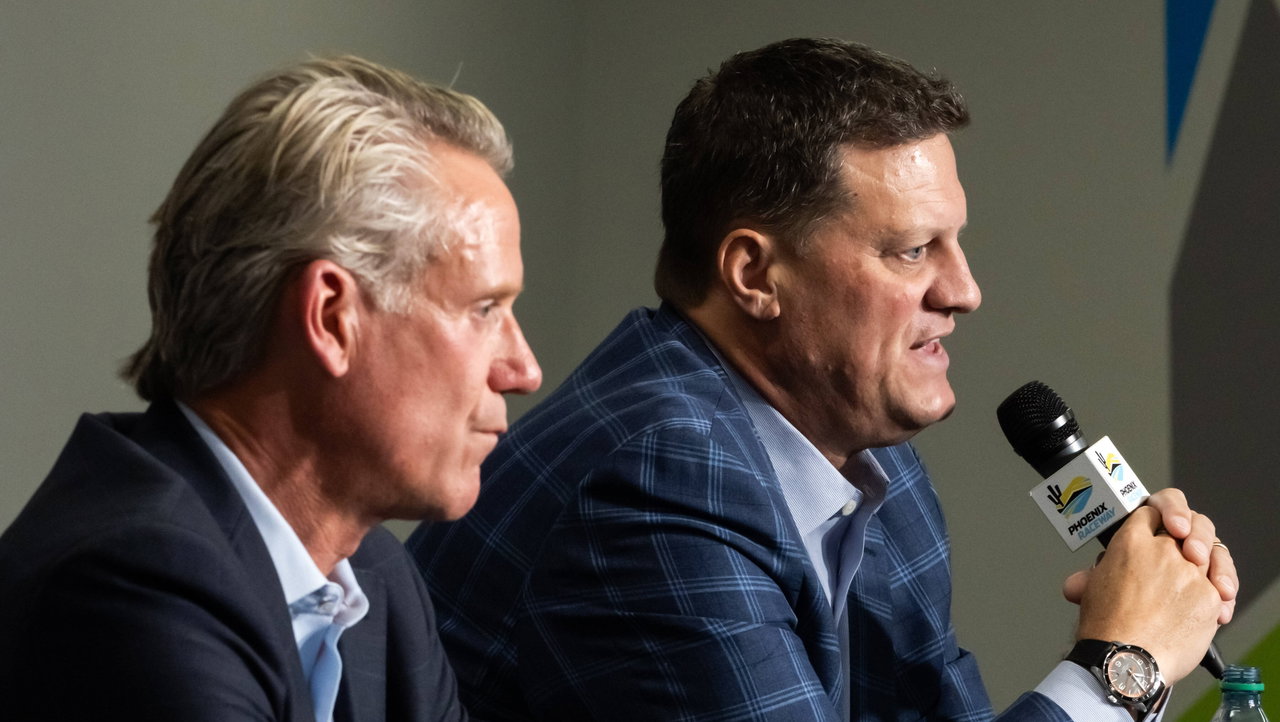
Steve O’Donnell just got started as the new CEO of NASCAR. And since he took the chair, he has been clear about one thing: he wants to bring some fun back to the sport. Which he calls a “badass American sport.” But little did anyone expect that he would start his reign by dropping a serious scoop about the hypocrisy of the very manufacturers that keep the engines running.
Watch What’s Trending Now!
Well, O’Donnell speaking at the Kenny Wallace podcast revealed that their move towards electric tech, which has seen so much backlash from the fans, was not their even their passion project to begin with. In fact, it was their survival tactic which was forced by the car manufacturers on them.
“Let me say five years ago, one of our OEMs said, ‘If you are not hybrid within the next two years, we are out of NASCAR.’ Oh, okay, so we’re going to better start looking at that. Within a year, if you are not electric, we are out of NASCAR,” he said. And so they built the 1,300 horsepower ghost car in 2024 and showed they are capable of adapting to the future. But what happened next was instead was a case of hypocrisy, that maybe even they didn’t expect.
“So then we didn’t say we’re going all electric, but we said we’d put a car together. That same group, when we presented the potential for an electric series, said, “Well, that seems really dumb; that’s not NASCAR, that’s not entertaining.” And we said, We agree,” O’Donnell added.

NASCAR CEO Steve O’Donnell explains the status of electric vehicle racing in the sport From @Kenny_Wallace Wallace Conversations
But O’Donnell was clear that this was always about preparedness, not intent. Meanwhile, John Probst has added another layer to the conversation last week by discussing how the sport might evolve its structure in the long term. He suggested that NASCAR is exploring ways to better differentiate its national series through distinct vehicle identities.
“Long term, you see it as we do have that CUV body that we developed for our electric vehicle. I’m not sitting here saying today we’re breaking news it’s going to be a CUV, but these are the things that are on the roadmap to consider, so you’d have a truck, a CUV, and a cup; those are three very different bodies that are relevant for our OEMs today to create that brand identity for each series,” Probst said.
For fans, NASCAR has always been defined by the sound of the V8 combustion engines. So, the idea of the electric crossover vehicles, even in the O’Reilly Auto Parts Series (formerly Xfinity), has been met with resistance. However, Probst used the example of the Craftsman Truck Series. It was once poorly received, raising doubts around NASCAR racing pickup trucks, but went on to become massively popular—he further said how the executives are simply preparing for commands to come around these ‘what-ifs.’
However, you have to give it to NASCAR, because the silent monster they created was a masterpiece. The ABB NASCAR EV Prototype was unveiled at the 2024 Chicago Street Race, and it featured three STARD motors producing a staggering 1,341 hp, which is nearly double the output of a current Cup car. The body is made of a flax-based composite rather than carbon fiber.
Ford Racing also revealed its newest version of a Mustang. With the Ford racing Mustang Cobra Jet 2200, they aimed to push the limits of all electrical performance. Per reports, it delivered intense acceleration, highlighted by an early 6.87-second pass at more than 221 MPH—a mark that stands well above the previous record of 202.85 MPH.
But will fans ever fully embrace this new-tech idea? Considering that their favorites are not sold at all, the answer remains far from a ‘yes.’ And Dale Jr is one who is against the idea.
Dale Jr. pushes back on EV shift
On X, Dale Earnhardt Jr.’s initial reaction was just three words: “I hope this never happens.” Then, on his Dale Jr. Download podcast, he laid out exactly why.
“The O’Reilly Series has got a lot of good things going right now. Viewership is continuously on the rise and our cars, we can all kind of relate to those cars when we look at them and we see them on the racetrack. I think making a switch to anything unlike what we have would be a massive, massive mistake and it would probably be the end of the rise,” he said. “Any kind of change like that, so dramatic as that would be, would destroy the series as we know it.”
Responding to Kenny Wallace o X, he also questioned whether NASCAR’s reasoning truly lined up with current market trends. According to him, if consumer demand actually drives decisions, then the Cup car should already look very different.
“I don’t buy into this entirely. Or at least I’ve got some questions. The SUV dominates the market at nearly 60% market share, followed by the pickup. Sedans are third and have fallen from 50% to below 20% in the past decade. Why hasn’t the Cup Series then morphed into SUVs?”
He also went a step further on the podcast, offering what he actually wants for the O’Reilly Series instead. “Take that 9-inch rear end out of the car that we’re running and make me a modern version of that. Take all the front suspension off of our car and make me a more modern version of that — not an overengineered hub or rear end like we got in the current Cup car,” he said.
The parts availability issue is real, he stressed, and that’s the conversation NASCAR should be having, not electrification. For context, the series is running 15-year-old components that are increasingly hard to source.
Jr. isn’t alone in that position either. Hall of Famer Mark Martin weighed in on X the same day Probst’s comments surfaced.
“They say hope is not a strategy, but that’s really all I’ve got for now,” Martin wrote.
Reporter Toby Christie was even more blunt: “No. Please, just no. #NASCAR.”
The reaction across the garage was unified in a way that NASCAR brass probably didn’t expect. That concern carries extra weight because the O’Reilly Series has become one of NASCAR’s strongest products, especially with rising viewership on The CW.
Jr. also made clear he would walk away from his own team rather than operate under that model. “I’m certainly not interested in that car or that body or any of that,” he said.