
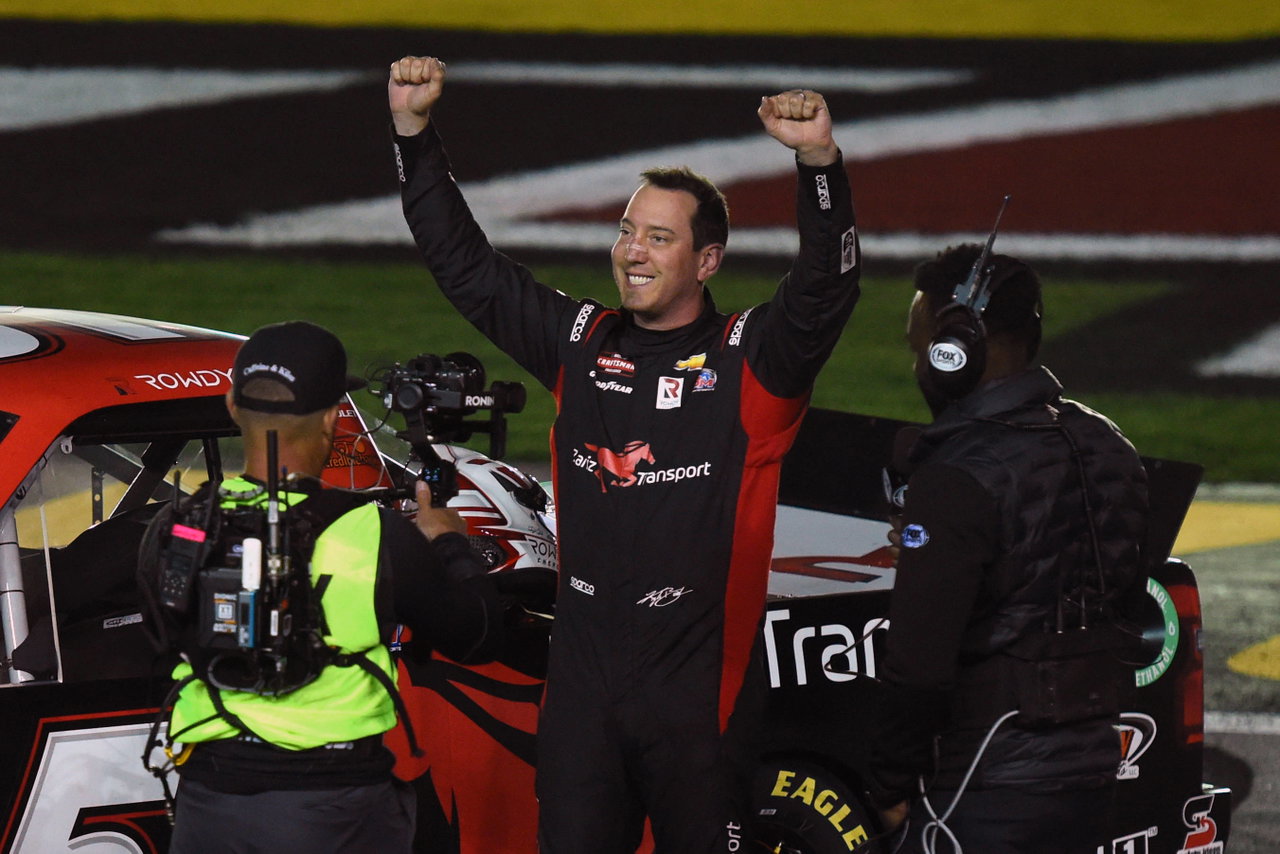
The last time Kyle Busch publicly spoke about the NASCAR Hall of Fame, he was celebrating someone else’s moment. On January 23, 2026, at the Charlotte Convention Center, it was Busch who placed the blue jacket’s ring on his older brother Kurt, the final gesture of the night as Kurt Busch entered the Hall of Fame as part of the Class of 2026. He shared that he looked forward to celebrating that moment with him, but he didn’t turn the conversation toward similar hopes of his own. Unfortunately, he didn’t get a chance to, either.
Watch What’s Trending Now!
But that doesn’t mean NASCAR isn’t going to. Barely two months after Busch’s untimely death, Chief Operating Officer Ben Kennedy made sure to give fans a hopeful update.
“I know we go into- I’ve had the opportunity to be on the panel for some of these. We go into the voting conversations, and there’s always maybe one or two athletes or drivers that come in that are valid for that year’s ballot. We have no conversation about them because we know that they’re gonna be in. Kyle is going to be that way,” Kennedy said during an appearance on the Rubbin Is Racing podcast with host Michael “Large” McCarthy.
Though this update doesn’t come without its own puzzle.
On a normal timeline, Busch wouldn’t even be eligible for nomination until 2028, putting him on track for induction as part of the Class of 2029. NASCAR’s Hall of Fame voting panel had already elected its Class of 2027, Kevin Harvick, Jeff Burton, Larry Phillips and Lesa France Kennedy, just two days before Busch died, with that group set for formal induction in Charlotte in January 2027. So, the next class is already locked, and the vote after that isn’t scheduled until May 2027. There is no clean slot sitting open for Busch, only a choice about which imperfect option to take.
Even on the other side, under NASCAR’s current bylaws, a driver must have competed for at least 10 years and been retired for two years before Hall of Fame nomination, or have turned 55, whichever comes first. Because Busch had raced four days earlier, closing out his final NASCAR Truck Series start at Dover with a win, that two-year clock never had a chance to start.
McCarthy, like several media figures, urged caution before NASCAR waives its own retirement rules. He’d rather see Busch’s legacy celebrated over a longer runway than compressed into a rushed exception. Kennedy has made it fairly clear the sport is leaning the other way.
Brad Keselowski, one of Busch’s fiercest rivals for two decades and a future Hall of Famer himself, was more direct about it. “It’s very clear that Kyle is a first-ballot Hall of Famer, and I don’t know why that needs to wait another year,” Keselowski said, when asked whether the honor should come immediately.
The two men’s rivalry had been public and, at times, personal, Busch had named Keselowski among the drivers he didn’t see eye to eye with as recently as weeks before his death, but Keselowski said their relationship had quietly thawed over the past year or two as their circumstances on the grid shifted.
NASCAR CEO Steve O’Donnell has been asked about waiving the waiting period and, so far, hasn’t committed either way. “I don’t know,” O’Donnell said. “I know that we put that on the list of ideas that we want to look at. … Then we have a little bit more time to think about what we could do as well in the future. Who knows, that could be something we look at.”
NASCAR Hall of Fame executive director Winston Kelley has taken a similar wait-and-see position, though for a different reason.
“First and foremost, we’re concerned about Samantha, Brexton and Lennix and the family,” Kelley said, referring to Busch’s wife and two children. “I don’t think now is the time for that. If and when that is, we’re always open to discussion.”
Kelley added that there’s no fixed criteria written down for how to handle a case like this, only a general sense of what matters: what’s best for the family and what honors Busch appropriately.
However, not everyone who believes Busch belongs in the Hall thinks the calendar should bend for him.
Some in the NASCAR community argue that fast-tracking him would actually shortchange the honor, that a first-ballot election through the normal process says more about what he accomplished than an emergency waiver would. There’s also a more logistical objection: NASCAR caps Modern Era induction at two drivers per year specifically to keep the ballot from getting clogged, and there is no shortage of overdue names competing for those two spots. Greg Biffle, who died in a plane crash in December 2025, has more career wins across NASCAR’s three national series than any other eligible driver still outside the Hall. Slotting Busch in ahead of schedule means someone else. possibly someone who has already waited years, waits longer.
Yet, Kennedy also detailed plans for a tribute event at Bowman Gray Stadium to honor Busch’s career, with legends of the sport, longtime rivals and friends from the garage expected to turn out. Kennedy hinted that Busch’s son, Brexton, could be behind the wheel during the Friday afternoon portion of the event.
As for the Hall of Fame itself, Kennedy insisted there’s no doubt Busch will be inducted, the only open question is when, and a large part of that answer, in his view, comes down to the fans.
“I think a big part of that is going to be the fans, because you had so many folks that were huge Kyle Busch fans throughout the years. And you’ve seen all of them come out to Charlotte Motor Speedway. You’ve seen them go to the race shops ever since,” Kennedy said.
Notably, none of this would be the first time NASCAR has bent its own Hall of Fame rules.
In 2013, the sport overhauled its eligibility criteria, dropping the previous three-year post-retirement wait and making any driver who had competed for at least 10 years and turned 55 immediately eligible, a change written specifically to let Mark Martin, Bill Elliott and Terry Labonte into consideration while some were still active.
NASCAR has also inducted drivers posthumously and ahead of a normal résumé-length review: Alan Kulwicki and Davey Allison, both killed in separate aviation accidents in 1993 without having met the Hall’s usual 10-year service requirement, were still nominated and went in together as part of the Class of 2019, 26 years after their deaths. Busch’s case is different in one important way: those exceptions came decades after the fact. His would be asking NASCAR to improvise in real time, with no framework already built for it.
Other sports have faced versions of this same question, with mixed answers. Major League Baseball waived its five-year waiting period for Roberto Clemente within months of his death in a 1972 plane crash, and did the same for Lou Gehrig after ALS ended his career. The Hockey Hall of Fame waived its three-year wait for Bobby Orr, Mario Lemieux and Wayne Gretzky, then tightened the exception afterward to apply only in “certain humanitarian circumstances.” The Naismith Basketball Hall of Fame waived its own waiting period for Kobe Bryant after his 2020 death, and he went in on the next ballot. NASCAR’s own closest precedent actually cuts the other way.
when Dale Earnhardt died in 2001, the NASCAR Hall of Fame didn’t yet exist, it wouldn’t open until 2010, so it was the separate Motorsports Hall of Fame of America that fielded the public pressure to enshrine him immediately. It declined, and made his induction wait five years.
For Kennedy, the harder question was never whether Busch belongs in the Hall of Fame. It’s making sure however he gets there, it reflects what he actually meant to the sport. Judging by the tribute plans already taking shape, that’s the part NASCAR seems determined to get right, whatever it eventually decides about the calendar.