
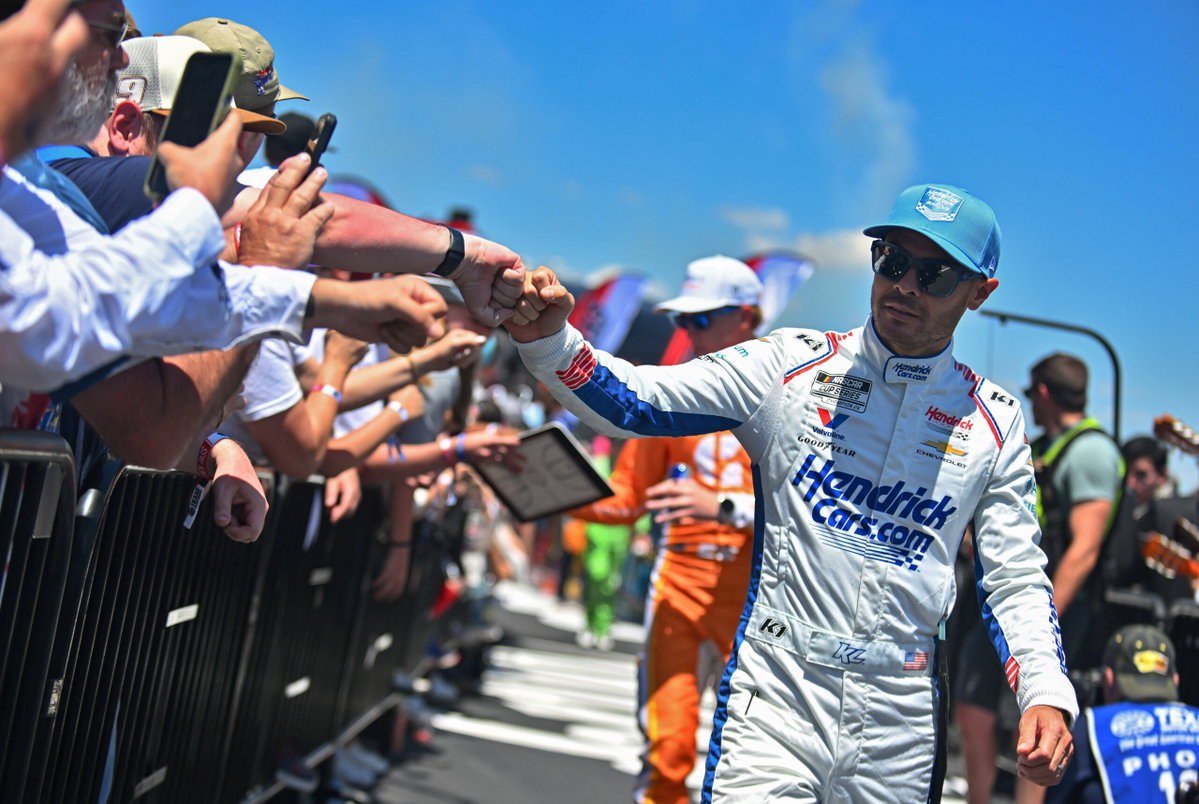
NASCAR has been around for a long time, going right back to 1948. There are fans who have been following it since then. However, that is no problem if you’re more of a recent fan, because if you’ve been around long enough, this will pose a concern to you: the sport is graying.
Watch What’s Trending Now!
This means that the young fans are not coming in and the culture has not crossed over to the youth yet. It’s not a proven fact, but the idea has been so repetitive that it feels that way.
However, now, upon an analytical look, the 2026 numbers suggest something else. In the regular season this year, Cup Series viewership of adults between 18 and 24 increased 8%. For the Craftsman Truck Series, the audience in the same age group has almost doubled.
Going ten years over the age line, the Cup Series’ 18-to-34 demographic has had a significant boost of 46%. Event admissions also went up by 9%, and there were 11 races that sold out during the Cup races this season.
Looking at the sales part of it, merchandise sales went up 26.8%, which is the highest point within a decade. Social impressions, on the other hand, landed at 1.94 billion, which is a 31% boost from 2025. More than 550 million video views were recorded during the regular season.
These stats show you that this claim about young people not watching NASCAR is becoming increasingly difficult to defend. It should be taken with a grain of salt, since the numbers show us that they are watching.
This question, therefore, needs reframing. What should be asked instead is this: what are the young doing after they start watching?
Young fans are here, but retaining them is tough
NASCAR chief executive officer Steve O’Donnell described 2026 as a year of bringing in “younger and first-time fans” alongside the sport’s existing base, and the metrics behind that statement are more compelling than most coverage has acknowledged.
At the Naval Base Coronado race in San Diego, 67% of attendees were attending their first NASCAR event. Amazon Prime Video’s Cup coverage averaged 2.29 million viewers in 2026, up 6%, with a median audience age of 57.7, more than five years younger than the 63.1 median for linear television.
TNT Sports’ practice and qualifying coverage had Adults 18-34 viewership climb 55%. Going by the year-to-date data, which is from the start of the year up until this point, NASCAR World on Roblox has had 180 million visits from more than 37 million unique users, which means new users. Over 60% of these are under the age of 18, and more than 80% are from outside North America.
What those figures paint for you is a sport popularity factor. It’s liked, no doubt, there. What comes once the new gen starts liking it is the more central question. The answer is numerical. The 2026 USC Annenberg and Acceleration Community of Companies study found that 49% of Generation Z sports fans had become interested in a new sport or athlete because of fan-created content or something entirely outside the competition itself.
Viral video, movies, television, athlete relationships, and celebrity involvement all appeared as discovery triggers. Only 26% of Generation Z respondents identified as traditional die-hard fans who watch full games on a regular basis.
A much larger portion sits in the middle, following athletes, highlights, and social content without adopting the viewing habits of older generations. The reach is there. Whether those first encounters are turning into a second one, and a third, and eventually a habit, is where the conversation gets more interesting.
The race nobody outside the sport can actually see
A longtime NASCAR fan watching a three-wide restart with 50 laps to go is running through a mental checklist that a newcomer would not even know is worth a thought.
How much tire is left on the leaders? Who has clean air at the front? Which driver desperately needs stage points for the championship? Which team can afford to pit now without surrendering track position for the next green-flag run?
A person watching for the first time sees three cars going very fast, and they are looking at the exact same broadcast. There is a gap between the new watcher’s perception and what is running on screen. This is due to the information-dense nature of NASCAR in particular.
Look at a Cup race, for example. Many contests are simultaneously running, be it tire management, fuel calculation, the pit road competition, or even the manufacturer’s championship. Along with that, you have the driver’s standpoint, their individual races, and, very specific to this year, the ten-race Chase for the Cup.
An experienced fan has spent years accumulating the vocabulary to process all of that automatically, so naturally that the cause-and-effect feels obvious. For someone watching their second or third race, none of that infrastructure is in place quite yet, and nobody is building it for them in real time.
What makes this particularly difficult for NASCAR is that many of the most consequential things happening in a race are invisible. A car running fifth looks completely normal from the outside, while the driver is intentionally running a slower line through the corner to protect the right-front tire, waiting for the car ahead to reach its pit window, and holding back enough fuel to stretch the run by two extra laps.
The veteran reads all of that from the gap data and the lap times. The newcomer just sees someone running fifth, and without knowing what to look for, there is no reason to wonder why.
Same result, two completely different stories
Look at what happened at Darlington on September 6. Christopher Bell won. Denny Hamlin finished 18th after contact with Michael McDowell. Bell had entered the 2026 Chase 50 points behind Hamlin and left Darlington only 12 behind.
Going by Denny Hamlin’s performance specifically, his 18th-place finish could be called somewhat productive. This is because he got 16 stage points during the race, plus 19 due to his finishing position. So, in totality, he got 35 championship points.
For a fan who has been following the sport for a long time now, it makes complete sense that he did not have the best day, but he didn’t end up having a bad race either.
On the other hand, if contrast it with someone who’s watching for the first time, a driver finishing 18th and still being in a position where he can manage the championship sounds like a big contradiction. It is not, however, completely unreasonable. As per Denny Hamlin’s words, he himself described the race in somewhat similar terms.
“Yeah, it’s frustrating for sure.”
NASCAR’s sought to simplify such complications by bringing back the Chase format. Prior to this, they’d been following the playoff format ever since 2014.
Now, under it, there’s a 10-race shootout in the postseason where 16 drivers race for the championship. It’s strictly based on total cumulative points without a mid-round knockout elimination. However, points are reset before the final 10 races to closely bunch the playoff drivers together, with bonus points that were given during the regular season wins and also stage wins.
Whoever gets the most points on the board in these 10 races wins the Cup Series Championship. Race wins are now worth 55 points, up from 40. O’Donnell explicitly said one goal was a championship that could be explained quickly, including to people who had struggled to keep up with the previous format, and the new one delivers that at the surface level.
“What we recognized through all this is if I can’t explain it to you in an elevator from the first floor to the 20th floor, we’ve got a problem,” O’Donnell put it best in his dialogue with the Athletic.
The problem though, persosts. A simple structure does not equate to NASCAR being easily understood by the newcomers. As discussed, Darlington was a good demonstration of exactly that.
Without the layer of context that we just laid out, the result is confusing. With it, Hamlin’s evening becomes one of the more interesting championship stories of the season. The sport already has the drama. What it needs is for that drama to be followable by someone who is still learning the rules.
The driver has to come before the data
One of the more reliable findings in sports research on fan development is that new followers attach to a person before they attach to a sport. The statistics come later. The standings come later. Even the rules can come later. What tends to come first is someone worth caring about, and NASCAR’s current roster has no shortage of those.
Carson Hocevar is the most useful current example of what that can look like in practice. He drives the No. 77 Chevrolet for Spire Motorsports, which tells a new viewer almost nothing. What tells them considerably more is this: Hocevar is 23 years old and has managed to generate genuine friction with Christopher Bell, Ricky Stenhouse Jr., Ryan Blaney, Austin Dillon, Brad Keselowski, Zane Smith, and Corey Heim, several of them in the same season. At Darlington, he made contact with Keselowski and spun the No. 6 Ford. Keselowski went to the media afterward and said
“Watch out, Carson.”
Hocevar essentially shrugged, said he does things for “TV and entertainment” and “the clicks,” then went out and finished 11th from a 34th starting position. By February 2026, veterans like Kyle Petty and Richard Petty were drawing comparisons between his racing personality and those of Dale Earnhardt and Kyle Busch.
Leigh Diffey’s nickname “Hurricane Hocevar” had stuck. NASCAR itself described him in May as someone who “lives like he drives.”
You do not need a lap chart to find that interesting. Start with one question, not a stat sheet: why is this kid suddenly the center of gravity in the garage? That’s the hook. Curiosity pulls people toward the racing education, not the other way around, and that order is what actually turns a viewer into a fan.
The same trick works everywhere else on the grid. Denny Hamlin is chasing a championship as a driver while also running one of the sport’s most talked-about organizations, 23XI Racing. It has pulled attention from well outside NASCAR’s usual audience, landing sponsors like Hardee’s and Rockstar and drawing interest from athletes like Rams receiver Puka Nacua and retired NFL running back Marshawn Lynch, with coverage even showing up on Nice Kicks, the sneaker-culture account.
Tyler Reddick is the reason that story has teeth right now. He opened 2026 by ending a 38-race winless run with a Daytona 500 win, then became the first driver in Cup history to take each of the season’s first three races. You don’t need to know a thing about the technical alliance with Joe Gibbs Racing underneath that run for the story to land, it’s just a guy who kept winning when nobody expected a fourth, then a fifth.
And Michael Jordan’s name on the ownership group is doing real work here too: he’s been a fixture on pit road since the team’s first season, and that’s the kind of detail that gets someone who’s never watched a lap to at least glance at the standings.
Then there’s Connor Zilisch, who’s rising fast enough that watching him now feels like getting in early on something. He was NASCAR’s Xfinity Rookie of the Year in 2025, set the series record for consecutive top-five finishes, then moved straight into a full Cup ride at nineteen, the kind of trajectory that doesn’t need context to be interesting.
Every one of those is a door. Walk through any of them and the points tables and technical alliances will still be there waiting, they’re just not what gets someone to open the door in the first place.
NASCAR needs a proper transition plan
NASCAR has been more creative about building those doorways than it typically gets credit for, and the 2026 Rolling Stones campaign is one of the best examples of cultural translation done well. The collaboration centers on a hero film featuring NASCAR drivers Jesse Love, Connor Zilisch, and Carson Hocevar, alongside creator and driver Cleetus McFarland, built around a merchandise line, limited vinyl pressings of the band’s new album, and a custom show car turned into a listening lounge that toured Chicago ahead of the Cup Series weekend there.
What makes the film work is the framing. The first Rolling Stones album came out in 1964; Connor Zilisch was born in 2006, and none of that is in frame once the video starts, because the three drivers aren’t presented as athletes at all. The film reimagines them as a touring rock band, drawing a line between life on a music tour and life on the NASCAR schedule.
Someone who shows up because they like the Stones doesn’t need to know what clean air means. The personalities are doing that introduction for them.
Racin’ With The Boys works the same doorway from a completely different angle. Taylor Lewan and Will Compton didn’t pretend to know the sport going in, they picked NASCAR up as a summer project once the NFL offseason left them with time to fill, planning to learn everything they could in the shortest window possible. NASCAR’s chief brand officer Tim Clark put it such: the idea wasn’t to force NASCAR into someone else’s format, but to let two outsiders explore it on their own terms, because that’s how you reach people who might never have given the sport a look otherwise.
There’s a real difference between a host who genuinely doesn’t understand why a team just pitted and says so on camera, versus a broadcast inserting a beginner explainer between segments. One is discovery, while the other is instruction. They don’t land the same way with someone still deciding whether this is a sport for them.
Amazon’s Full Speed: The Daytona 500 leaned on the same instinct. Rather than following an entire playoff run, the film narrowed in on one race and four drivers, Kyle Busch, Connor Zilisch, Brad Keselowski, and Noah Gragson, along with their teams, their families, and what each of them had riding on that single day. The stakes are personal before they’re technical: a champion still chasing the one crown-jewel win that had eluded him, a teenager making his first start in it, a driver fighting his way back from a broken leg. You feel the pressure before you understand what the rulebook dictates.
The physical calendar is doing an identical job. Sixty-seven percent of ticket buyers at NASCAR’s first San Diego weekend had never been to a NASCAR event before, and that wasn’t an outlier, roughly seventy percent of tickets for the inaugural LA Coliseum race went to first-timers, and more than eighty percent did for Chicago’s first street race.
New venues keep producing new audiences, reliably enough that it’s clearly not an accident anymore. Mexico City hosted NASCAR’s first modern-era Cup race outside the U.S. in 2025, and while scheduling around the 2026 World Cup pushed it off next year’s calendar, NASCAR is still working to lock in a return for 2027.
The same challenge just presents itself differently online. NASCAR’s Roblox presence has pulled in 37 million unique users this year alone. Thirty-seven million people that interacted with the brand inside a game. The harder, more interesting question is how many of them ever walk through the door the game opened.
Getting someone to watch once is only the beginning
Here’s the thing nobody talks about: watching a wild Hocevar clip and actually wondering what happens to the guy next weekend look identical from the outside, but they’re not the same thing at all. One’s a scroll. The other’s a hook in you. And that tiny gap between the two is basically the whole game when you’re trying to figure out how a sport actually grows its fanbase instead of just its view count.
There’s data backing this up, and it’s more interesting than you’d think. WSC Sports ran a big generational study and found that 62% of fans discovered a new team, player, or league through a short clip on their phone, not a broadcast. Then there’s L.E.K.’s annual sports survey, which found something almost funny when you think about it: people between 18 and 29 spend only about a quarter of their sports time watching actual live games.
For fans over 60, that number jumps to 60%. You’d think that means young people are checking out of sports. Nope. That same group reported the biggest year-over-year jump in how much sports content they’re consuming, at 39%, higher than every other age bracket.
So what’s really going on is younger fans aren’t losing interest, they’re just walking in through a different door. They meet the personalities first. Then the rivalries. Then the fifteen-second highlight. The full three-hour broadcast, if it happens at all, comes way down the road.
Which means somebody can call themselves a NASCAR fan without having watched a single complete race. Maybe they follow a driver on Instagram, catch a post-race interview clip, peek at the standings once a week, and then actually sit down and watch when their guy has something real on the line. That’s not a watered-down kind of fandom. It’s just an earlier stop on the same road. NASCAR’s job isn’t to drag people straight to the finish line. It’s making sure they can see the next stop from wherever they’re currently standing.
Look at what other leagues have done here, not as a blueprint to copy, but as proof this actually works. The NFL built Next Gen Stats, which takes all that player tracking data and turns it into stuff a casual viewer can use on the fly: completion probability, win probability, that sort of thing. The NBA’s doing something similar now with shot difficulty and defensive numbers.
Neither league dumbed anything down. They just gave people enough to work with so the game made sense while it was happening in front of them, instead of after somebody explains it later.
NASCAR already has everything it needs to pull off the same trick. Tire wear, fuel windows, gap times, stage point math, it’s all getting crunched in real time during every single race already. Somebody just needs to say it out loud in a way that means something. Something like:
“He’s losing spots right now, but his tires are ten laps fresher than the leader’s. If a caution comes out before he falls too far back, this whole race turns upside down.”
That’s not a simplified take. It is rather exactly what a lifelong fan is already thinking. It just needs saying out loud for the guy watching his third race ever.
And to be fair, the top of the funnel is clearly working. NASCAR racked up 1.94 billion social impressions this year, crossed 550 million video views, pulled 58 million visits to its website, and sold out 11 Cup Series races. Nobody can say the sport isn’t putting itself in front of people.
The real question is what happens after that first look. Does it actually add up to something a person can hang onto, or does it evaporate the second the clip ends? A sport that’s great at first impressions but can’t close the second one isn’t really growing. It’s just running in place with better numbers.