
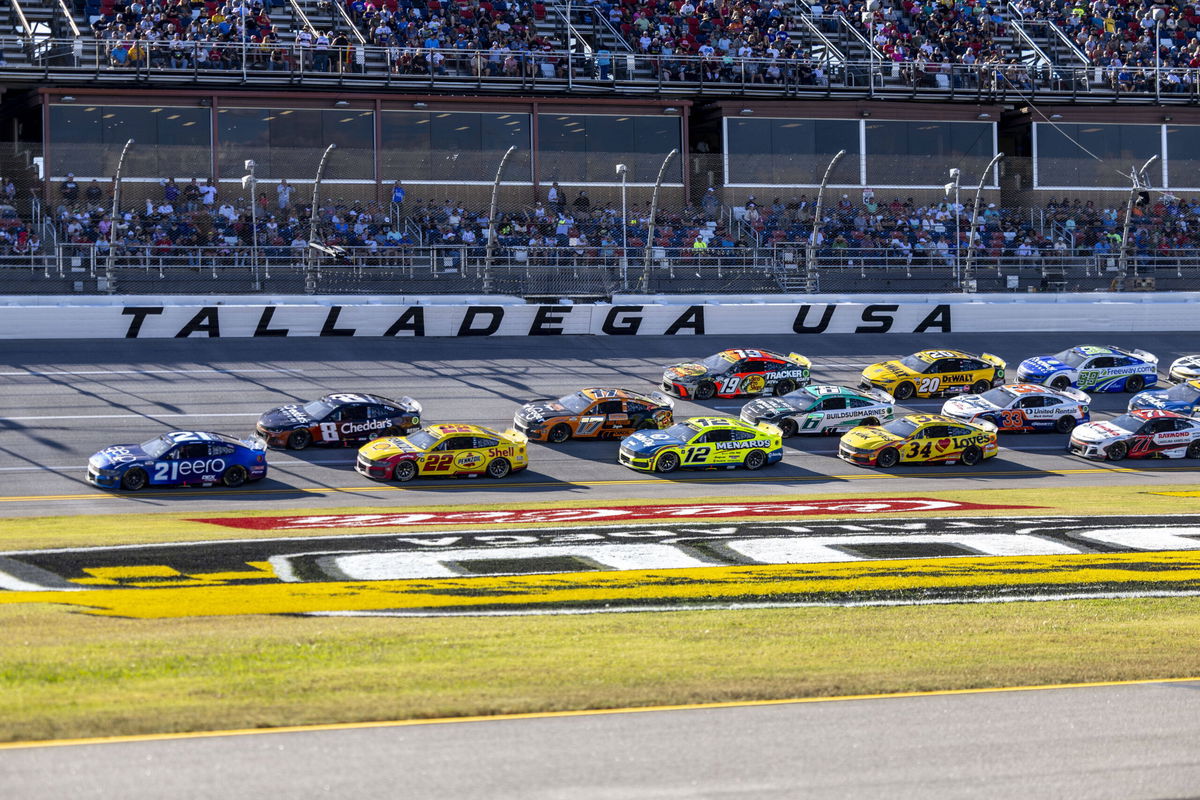
Late-race pit strategy has long been one of NASCAR’s biggest wild cards, especially at superspeedways, where fuel mileage games can decide everything. Instead of flat-out racing to the finish, drivers often save fuel, lifting early and waiting for the right moment to strike. But that might change. With Talladega up in a couple of weeks, NASCAR is rolling out a bold tweak aimed at shifting the focus back to racing and not conserving.
Watch What’s Trending Now!
NASCAR flips the script at Talladega to prioritize racing
“If you look at generally how a lot of our speedways were laid out it was a short stage, a short stage and then a long stage to the end. Going into Talladega, we’re going to flip that and adjust the lengths of the final two stages such that we’re confident that the last two stages are short enough to be made without a fuel stop.”
That’s John Probst laying out a clear shift in philosophy aimed directly at one thing: eliminating fuel-saving races. The Talladega race Stage 1 will end on lap 98; Stage 2 on lap 143; and the final stage on lap 188. From NASCAR’s perspective, this change injects urgency back into the closing laps. If drivers no longer have to worry about stretching fuel to the finish, they’re free to race flat-out.
That means pushing harder in the draft, making aggressive moves, and avoiding those long stretches where the field gets strung out with everyone lifting early to save gas. In theory, it brings back the kind of edge-of-your-seat chaos that makes superspeedways like Talladega Superspeedway famous.

NASCAR has announced new stage lengths for the Cup race at @TALLADEGA in two weeks: The updated stages will be as follows: Stage 1 will end on lap 98; Stage 2 on lap 143; Final Stage on lap 188. Explanation below from NASCAR’s John Probst, Executive Vice President and Chief Show more

And honestly, that’s been a long time coming. Although this tweak addresses fuel mileage games, it doesn’t completely solve another long-standing debate: stages themselves. NASCAR introduced stage racing in 2017 to break up long green-flag runs, reward consistency, and create more restarts.
But many argue that stages interrupt the natural flow of the race, manufacture cautions, and eliminate the organic strategy that once defined NASCAR. So while NASCAR isn’t scrapping stages altogether, this Talladega experiment feels like a middle ground. It’s not a complete overhaul. However, it’s a clear acknowledgment that sometimes, less strategy and more racing is exactly what fans want to see.