Imago
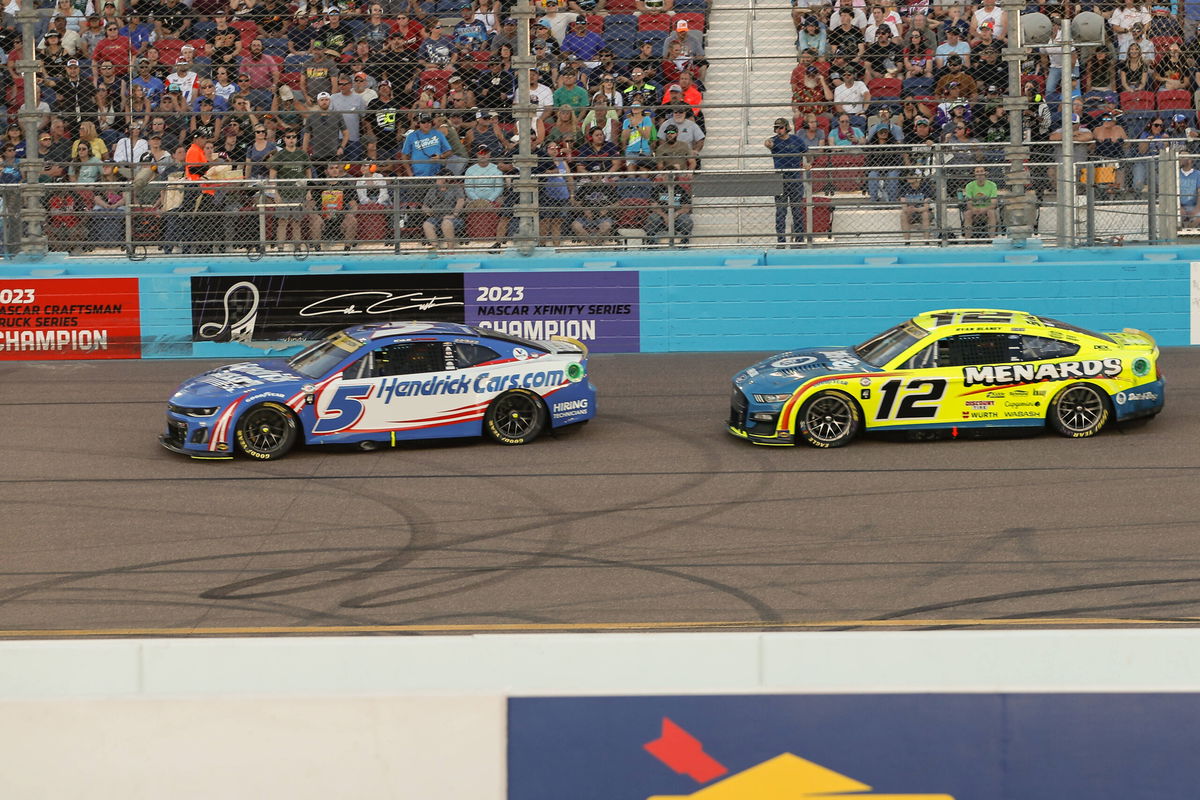
AVONDALE, AZ – NOVEMBER 05: Kyle Larson 5 HendrickCars.com Chevrolet Hendrick Motorsports races in front of Ryan Blaney 12 Menards/Dutch Boy Ford Team Penske during the NASCAR, Motorsport, USA Cup Series Championship Race on November 5, 2023 at Phoenix Raceway in Avondale, Arizona. Photo by Kevin Abele/Icon Sportswire AUTO: NOV 05 NASCAR Cup Series Championship EDITORIAL USE ONLY Icon231105070
Imago
AVONDALE, AZ – NOVEMBER 05: Kyle Larson 5 HendrickCars.com Chevrolet Hendrick Motorsports races in front of Ryan Blaney 12 Menards/Dutch Boy Ford Team Penske during the NASCAR, Motorsport, USA Cup Series Championship Race on November 5, 2023 at Phoenix Raceway in Avondale, Arizona. Photo by Kevin Abele/Icon Sportswire AUTO: NOV 05 NASCAR Cup Series Championship EDITORIAL USE ONLY Icon231105070
“The recommended tire pressures weren’t guesses,” Goodyear posted ahead of the NASCAR Cup Series race at Phoenix, sharing a detailed chart of the exact setups teams were expected to follow. However, once the race weekend actually unfolded, tire issues quickly became one of the biggest talking points. Now, longtime NASCAR insider Tommy Baldwin Jr. has shed light on what may have really happened. And he suggests that some teams knowingly pushed the limits of those recommendations in search of speed.
Watch What’s Trending Now!
NASCAR teams push tire limits
“You can’t change the cambers. You can’t change anything after inspection. So the only thing they had to change is air pressure, right? Well, they were probably way too low, right?”
Recently, on the Door Bumper Clear podcast, Tommy Baldwin Jr. explained what may have triggered the wave of tire problems during the NASCAR Cup Series race at Phoenix. According to Baldwin, once cars pass inspection, teams are extremely limited in what they can adjust. That leaves air pressure as one of the few remaining variables, and sometimes the temptation to chase speed leads teams to push that limit.
Goodyear’s recommended tire pressures were very clear. Teams were advised to run 14 psi in the left front, 30 psi in the right front, 14 psi in the left rear, and 26 psi in the right rear. These numbers are carefully calculated to balance performance with durability across a full race distance. However, in NASCAR, there has always been a delicate gamble involved.

Imago
NASCAR, Motorsport, USA Bass Pro Shops Night Race Sep 13, 2025 Bristol, Tennessee, USA Goodyear tires after a run at Bristol Motor Speedway. Bristol Bristol Motor Speedway Tennessee USA, EDITORIAL USE ONLY PUBLICATIONxINxGERxSUIxAUTxONLY Copyright: xRandyxSartinx 20250913_kdn_bs1_037
Teams often lower tire pressures (especially on the right-side tires) to squeeze out extra grip and speed. The trade-off, of course, is risk. Running pressures too low increases heat buildup and structural stress, which can quickly lead to blowouts or sudden tire failures. And Phoenix turned into a perfect example of that gamble backfiring.
The race featured 12 cautions, many of which were linked to tire-related incidents. At one point, several cars even pitted during the same caution period due to sudden tire concerns. Notably, Chase Briscoe suffered a right-front failure while running third on Lap 132, slamming into the wall and ultimately finishing 37th. Kyle Busch endured a miserable afternoon with three separate flat tires, while Austin Dillon experienced a right-rear failure with 25 laps remaining, sending him hard into the wall.
For teams chasing every fraction of speed, the pressure gamble is nothing new. But as Phoenix showed once again, sometimes pushing those limits can come at a heavy cost once the green flag drops.
Insiders call for rethink on tire limits
While tire pressure strategies dominated the conversation after Phoenix, several NASCAR insiders believe the bigger issue might be how teams are forced to manage their limited tire allotment throughout the race weekend. Currently, NASCAR allows 10 sets of tires per event.
Typically, one set is used during practice, another during qualifying, and the remaining sets are saved for the race itself. But according to former crew chief and NBC analyst Steve Letarte, that system may no longer fit the way teams are pushing performance today.
“It is a direct alignment to speed. I think NASCAR and Goodyear and the teams have to just be okay with this because this is what this is, part of the racing,” Letarte explained. He pointed out that teams constantly chase speed through tire pressure adjustments, particularly on the right-side tires, where slightly lower pressure can significantly improve grip, balance, and overall pace.
Lower air pressure helps the tire conform better to the track surface, improving mechanical grip and aerodynamic balance. Naturally, that makes it tempting for teams to run the lowest possible pressure within the risk zone. Even drivers acknowledge that reality. Denny Hamlin admitted teams knowingly push the limits.
“It’s the teams. We’re just pushing it. We certainly know that the lower the air pressure, the faster you’re going to be in the long run. These teams just keep pushing it. So what they do is they get somewhat comfortable in practice,” Hamlin said.
Others believe the solution might be simpler. Remove the limits altogether! Former driver Kyle Petty argued for a return to NASCAR’s older system.
“I’m a firm believer in unlimited. Like it used to be. When somebody falls out, you rush down to their pit, and you buy their tires from them because you need extra tires. That’s the way it is. That’s the way it always was,” Petty said.
NASCAR introduced tire limits largely to control costs for teams. But critics say the restriction may be unintentionally encouraging riskier strategies. As Phoenix proved, when speed and survival are separated by just a few pounds of air pressure, the debate around NASCAR’s tire rules is far from over.