
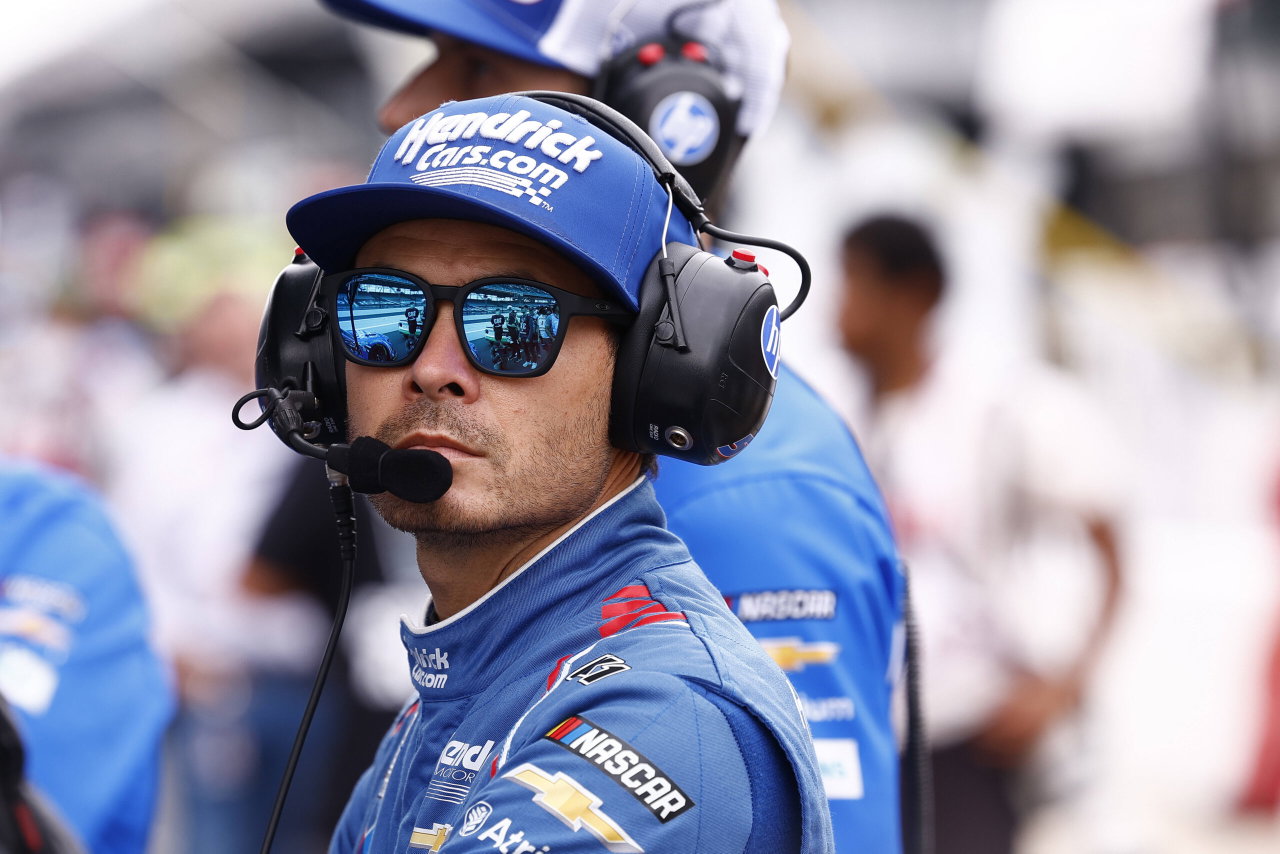
Kyle Larson took the win at Talladega Superspeedway by just 0.041 seconds over Hendrick Motorsports teammate William Byron, though his late push to the front drew heavy controversy. Doubts emerged about whether Larson used the area beneath the double yellow line to get around Todd Gilliland, and critics urged NASCAR to disqualify him from the win. When officials upheld the result, accusations that NASCAR was protecting its championship favorite quickly followed.
Watch What’s Trending Now!
Jeff Gluck and Jordan Bianchi, journalists for The Athletic and co-hosts of The Teardown podcast, challenged the logic behind those claims, questioning why NASCAR would want the title fight to become one-sided with two races remaining.
“If you are into conspiracy theories, it’s not that NASCAR was rigging this for Hendrick or Larson,” Bianchi said on The Teardown podcast. “If there were a conspiracy, it would be them throwing it out because they’re trying to manipulate to keep it closer. There is no incentive whatsoever for not keeping this close, because in addition to keeping it close, you would have all three manufacturers still very much in this championship.”
Bianchi questioned the alleged motive behind NASCAR’s decision. With Martinsville next and Homestead hosting the finale, Larson’s growing advantage raises a question about why the sanctioning body would allow the fight to become so lopsided.
“Why would NASCAR, who created a format and has a championship weekend, want the season to be decided possibly next week, early?” Gluck asked.
Larson entered Talladega with a five-point lead after a difficult weekend at Phoenix. His 71-point haul, combined with trouble for several contenders, extended his advantage to 73 points over Denny Hamlin. Christopher Bell trailed by 74 points, with Chase Briscoe 79 points back. Larson can clinch the title at Martinsville.
The controversy centered on Larson’s final-lap recovery. He fell to 11th before charging through the field, receiving a drafting push from Ross Chastain and edging Byron at the finish. His move on Gilliland drew attention to the double-yellow-line rule and how officials apply it.
Under Section 8.3.2 of the NASCAR Cup Series rulebook, a driver may not move up by using the area beneath the double yellow lines. A violation can result in a black flag. NASCAR checked the pass and insisted Larson had not used the area below the line to improve his position.
According to officials, Larson’s left-side tires touched the yellow line but never went under it. NASCAR also made clear that a single tire below the line is enough to count as a violation. The ruling did not convince every fan, but disagreement over the available footage does not establish that NASCAR manipulated the outcome.
The potential points impact was significant. Gluck explained how the standings would have changed had NASCAR ruled against Larson and relegated him to the last car on the lead lap.
“The difference in points had they said, ‘Okay, he is out of bounds, and we’re dropping him back to the last car on the lead lap.’ There were 14 cars that finished this race on the lead lap,” Gluck said. “So, they would have dropped him back to 14. That is worth 23 points versus the 55 that you get for winning the race. And now he would have had 16 stage points as well. So, he would have had 39 points instead of the 71-point day he had.”
The alternative ruling would have cut Larson’s haul by 32 points, reducing his lead over Hamlin from 73 to 41, assuming other results remained unchanged. With 76 points available at Martinsville, Hamlin would have had a stronger chance to close the gap. A big run by the No. 11 Toyota and a poor Larson finish could have sent the fight to Homestead.
The allegations also extended to claims that Chevrolet drivers deliberately helped Larson. Gluck said NASCAR checked the SMT numbers for Ricky Stenhouse Jr., Byron, and Cole Custer and saw that each driver kept his foot down from Turn 3 to the end. That finding challenged claims that they deliberately lifted to help Larson, although it did not settle every dispute over the final-lap moves.
Larson remains the favorite, not yet the champion. His 73-point lead puts him in position to clinch at Martinsville. Bianchi’s argument is that protecting Larson would make little sense, since a competitive finish involving all three manufacturers benefits NASCAR. The allegations remain unproven, and the ruling alone does not establish manipulation.