
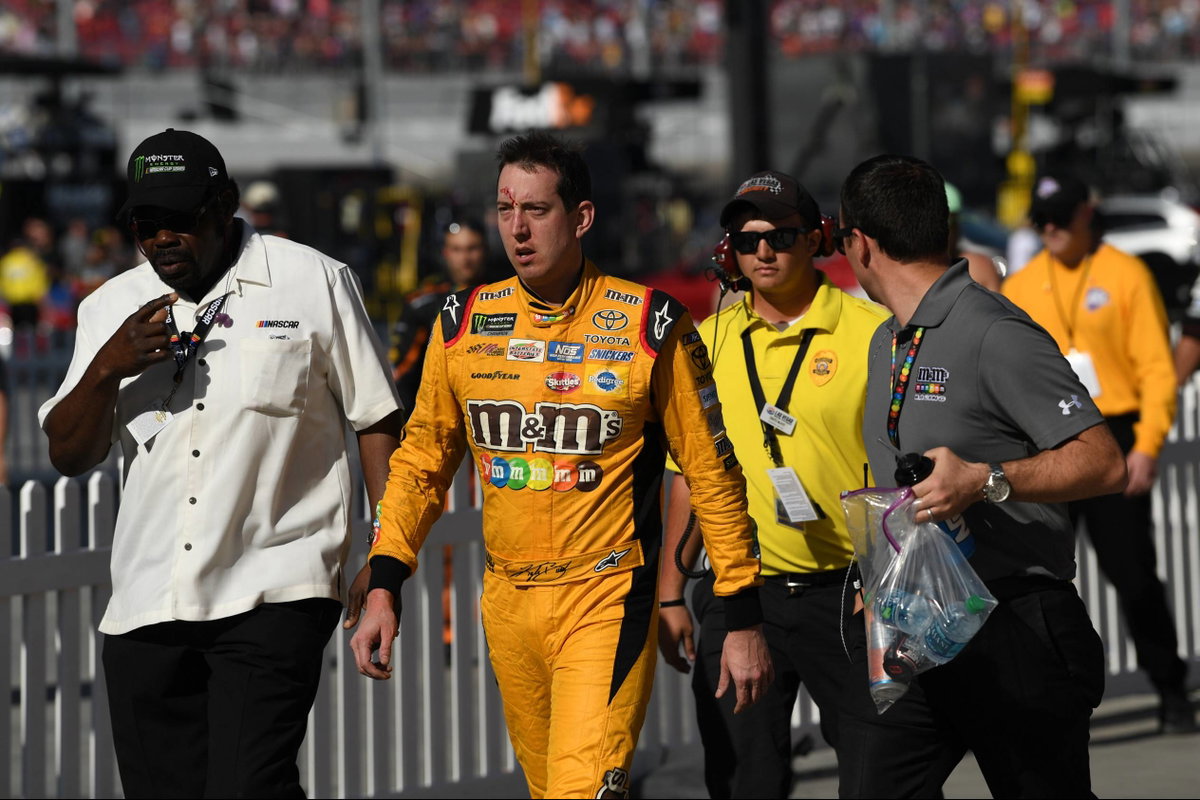
Corey Day was still talking with his team on pit road at Darlington when William Sawalich walked up in street clothes. The two drivers stepped away and spoke for nearly two minutes after the September 5 Chase opener, and Sawalich’s night had ended on lap 68, when Day made contact with the back of his No. 18 Toyota and Sawalich went back into the wall. According to Day, the conversation ended with Sawalich telling him they would see how the rest of his Chase went.
Watch What’s Trending Now!
Day took the words at face value. He told reporters he expected to be wrecked in a race that meant a great deal to him and nothing to Sawalich, who had barely missed the Chase field himself. Day also said he was tired of the treatment and planned to race people the way they raced him. Sawalich finished 30th at Darlington and Day finished second, so the exchange on pit road felt less like an ending than the opening of a longer argument.
The argument resumed seven days later at Gateway with 47 laps to go. Day was racing underneath Sawalich in Turn 1 when Justin Allgaier gave him a push from behind, and Day’s Chevrolet washed up into Sawalich’s left-side door. The cars separated, but the moment wasn’t finished. Sawalich moved left into Day’s right-side door; the No. 17 spun, and it slammed into the inside SAFER barrier. Day finished 33rd.
That was the feud, and it was over for the night. Its consequences kept traveling. Allgaier, who had led the series standings since the Circuit of The Americas race on February 28, took right-front damage, finished 13th and dropped to second, three points behind new leader Sheldon Creed. Day, who arrived fifth in the Chase, left eighth and 69 points behind Creed with seven races to go. Two drivers with unfinished business had rearranged the championship picture for a man who never heard a word of what was said at Darlington.
NASCAR reviewed the incident, decided against penalizing Sawalich and ordered a sit-down at Bristol instead. It took place Friday morning, lasted about twenty minutes, and left Day saying the two were in a much better place while conceding they are still on different mental pages. A hauler meeting can’t answer the larger question Gateway raised. NASCAR has sound reasons to protect the old culture of drivers policing one another, but that culture now plays out at racing speed on a track shared by a full field, and the people who get hurt are not always the people in the feud.
NASCAR changed the question instead of writing a ticket
It would be easy to summarize the Gateway decision as NASCAR watching a payback wreck and shrugging. That isn’t what happened. Officials examined the incident, and senior managing director Brad Moran explained that they saw door-to-door contact building over roughly a lap, not a clear case of intentional wrecking. There was no fine, no points penalty and no suspension. In their place came a meeting, with series director Eric Peterson and Elton Sawyer scheduled to sit down with both drivers and leadership from both teams.
Mike Forde, NASCAR’s vice president of racing communications, laid out the reasoning on the Hauler Talk podcast, and he didn’t dodge the hard part. NASCAR believes Sawalich tried to slam Day’s door on purpose. The slam came on a straightaway and answered what Day had done in the previous corner, so officials treated it as a driver settling a score instead of a wrecking attempt. Forde also pointed to the overhead camera, which showed Allgaier’s No. 7 sitting on Day’s left rear and led him to say Day probably doesn’t wreck without it. A left or right rear hook, especially in a corner, could have earned a different ruling.
Read that carefully, and you’ll see NASCAR acknowledging intent and declining to penalize anyway, because the intent it saw fell inside what the sport tolerates. Moran described the underlying difficulty himself, saying there is no “black and white line” for judging driver contact and there never will be. He’s right, and every other argument in this piece hangs on it. A driver can be racing hard, racing hard and making a mistake, making contact that looks intentional, or making contact that truly is. NASCAR can suspect the last one far more often than it can prove it.
What a confession looks like
Texas offers the clearest contrast. Ryan Preece and Ty Gibbs had already tangled during the May 3 race when Preece told his team under caution that he was done with Gibbs once he got to the No. 54. Later, entering Turn 3, Preece made contact and Gibbs hit the SAFER barrier, finishing 36th. NASCAR reviewed the radio, video and driver data, then fined Preece $50,000 and docked him 25 points under its member conduct and wrecking rules. The National Motorsports Appeals Panel upheld the penalty on May 27, and its statement said NASCAR and RFK Racing had offered competing readings of the same data without either clearly winning, but that Preece’s own comments showed he had decided to give Gibbs no breaks.
Radio isn’t a requirement, and NASCAR can penalize a driver who never keys the mic. Still, Forde called the radio the key difference between Preece and the driver NASCAR didn’t punish that day, since Preece said what he said and then did it. That other driver was Kyle Busch. He and John Hunter Nemechek collided on the second-to-last lap at Texas, and NASCAR chose not to penalize him. Busch’s car was already damaged, his steering inputs suggested he was working just to keep it straight, and nothing on the radio pointed to a plan, so the data left the question of intent inconclusive. It is hard to revisit that review now without noting that Busch died on May 21 at age 41, less than three weeks after the race.
Chicagoland in July, in the Cup Series, followed the same logic. Shane van Gisbergen’s No. 97 Chevrolet hit Austin Hill’s No. 33 on lap 48; Hill’s car took terminal damage, and Hill sideswiped van Gisbergen under caution before heading to the garage. NASCAR reviewed every lap the two had run together and found nothing definitive enough to penalize either driver, but it wanted them to talk so the dispute wouldn’t boil over.
Line up Texas and Chicagoland and a routine appears. Officials review the incident, judge whether the evidence clears the penalty threshold, and punish if it does. If it doesn’t but a rivalry is obviously heating up, they step in personally. Sawalich and Day got exactly that treatment, which tells you formal punishment and conflict resolution have become two separate tools.
The code predates the cameras
None of this is new. The garage has always held that a driver remembers who moved him and who raced him clean, and that anyone who keeps pushing past what his peers consider acceptable will eventually lose the benefit of the doubt. No rulebook needs to say so, because everybody involved understands the consequences.
Historically, the physical version of that code came after the race. A driver got wrecked, the race ended, he climbed out and hunted down the other man, and words turned into shoves or punches. The 1979 Daytona 500, when Cale Yarborough and the Allison brothers brawled after their last-lap collision, remains the most famous example, and nobody would call that safe. What matters is where it happened: the cars had stopped. A punch on pit road is still a punch, but delivering the same message at speed with a stock car that weighs well over 3,000 pounds is a different proposition altogether.
Modern NASCAR added a complication the old sport rarely faced, which is that these fights don’t always stay between drivers. After the 2014 Texas confrontation between Jeff Gordon and Brad Keselowski, crew members waded in, and NASCAR penalized two Hendrick crew chiefs and four crew members rather than the drivers. In 2024, Ricky Stenhouse Jr. waited until the All-Star Race ended to confront Busch, whose contact had ended Stenhouse’s night two laps in at North Wilkesboro. The confrontation turned physical; crew members and Stenhouse’s father joined in, and NASCAR fined Stenhouse $75,000, suspended two JTG Daugherty crew members, and indefinitely suspended his father under the Member Code of Conduct.
Sonoma in 2025 showed how little it takes. Gibbs drove through Keselowski’s pit box on entry and came close to tire carrier Telvin McClurkin, a move NASCAR later judged to be within Gibbs’s rights. After the stop, McClurkin approached the Joe Gibbs Racing crew, and a brief scrum broke out between two RFK Racing crew members and three JGR crew members before officials stepped in. Nobody planned a five-person fight. One man reacted, another answered, a third joined, and that is the flaw in telling drivers to settle things themselves: a dispute between two people can grow into one between two organizations.
Why NASCAR keeps the door open
Before blaming the sanctioning body, consider the alternative it’s avoiding. The sport runs on personalities, and rivalries drive attention. Drivers are expected to race aggressively, and fans want to know who respects whom. If every door slam or disputed restart went to an administrative hearing, officials would spend their weeks asking whether a car ran out of room, whether a driver was holding his line, whether the machine was already damaged or whether the other guy was simply too far alongside. Those questions never end, and drivers would start racing cautiously just to stay out of them.
NASCAR also builds events around close-quarters emotion. It returned the Cook Out Clash to Bowman Gray Stadium for a second straight year, a quarter-mile oval inside a football stadium that NASCAR markets as “The Madhouse,” and the race awards no points. The All-Star Race, also pointless, moved to Dover after three seasons at North Wilkesboro and paid $1 million, which Denny Hamlin collected. It showed how quickly aggression produces consequences. A nine-car crash started when Alex Bowman tagged Riley Herbst, and it collected Chase Elliott, John Hunter Nemechek, Zane Smith, Christopher Bell, Chris Buescher, Kyle Busch and Noah Gragson, in what became Busch’s final NASCAR event.
None of that suggests anyone in those wrecks was settling a score, and NASCAR hasn’t declared revenge acceptable at Bowman Gray or Dover. It does mean the sport deliberately engineers occasions where drivers race hard and put on a show. That leaves a question it can’t avoid: where does entertainment end and vengeance begin?
Ask the harder “why?”
Whether two cars touched tells you very little, since stock car racing can’t exist without contact. Cars run inches apart, drivers use the bumper, and now and then two of them simply run out of room. What matters is the reason. Was the driver making a real attempt to gain or defend a position? Did his steering and throttle fit the corner? Was another realistic move available, and could he have expected the other car to be there? Was it the finale of an earlier dispute, and had he said anything on the radio about intent?
I’d add one more test and weigh it above the rest: did the move endanger people who had nothing to do with the original quarrel? By my own sorting, contact falls into four bins. There is ordinary racing, aggressive but explainable contact, retaliation, and a car used mainly to punish. That framework is mine, not NASCAR’s official rulebook, though it mirrors what officials appear to be working through when they review the tape.
Officials no longer judge from a tower. They can pull multiple camera angles, team radio, steering, throttle and braking inputs, vehicle trajectory and the laps leading into an incident. Nashville shows what that can settle. Keselowski’s camp believed Austin Dillon had wrecked him on purpose, but NASCAR’s data showed Dillon was already out of the throttle, and senior director of racing communications Amanda Ellis said officials viewed it as a racing incident. Keselowski later said that after studying the data and talking with Dillon, the moment made more sense to him, and the two reached an understanding.
Data has limits, though. It can show that a driver braked, lifted or turned the wheel strangely, and it can show that a move had a plausible racing explanation, but it can’t display a box labeled “intentional.” That leap still requires human judgment, and that is where the disagreements begin.
It also creates an uncomfortable incentive, one I want to handle carefully. Nothing suggests drivers are studying the rulebook to plan untraceable payback, and claiming otherwise would be unfair. But if NASCAR needs evidence of intent, a driver who announces his plan on the radio and carries it out hands officials the proof, while a driver who stays silent and makes contact with a plausible racing explanation hands them a much harder case. That doesn’t make the quiet driver innocent, only harder to convict. Preece and Busch showed it, Hill and van Gisbergen showed it again, and Sawalich and Day pushed it further, because NASCAR had documented history between the two and still found no penalty.
Allgaier never signed up
Every driver in a feud faces three questions, whether he says them aloud or not. How hard can I race him? How much contact can I make before NASCAR calls it intentional? And if I take revenge, who else ends up in the way? The first is competition and the second is the ambiguity just described. The third is a safety question, and Gateway answered it in a single lap.
Two drivers can decide they will accept the risk of a feud, but they can’t make that decision for anyone else. Allgaier didn’t build the situation. He was behind Day when the contact developed, yet his Chevrolet took right-front damage, and his points lead slipped away. Bystanders on a racetrack come in every form: a lapped car, a teammate, a rookie with no idea the feud exists, a crew member on pit road, a title contender trying to survive the same race. None of them consented, and none of them can leave.
Pit road is no refuge either, and the same Gateway race proved it. At the Stage 1 break, a chain reaction at pit entry swept up eleven drivers, among them Rajah Caruth, Brandon Jones, Nick Sanchez, Harrison Burton and Jeremy Clements, and Caruth ended up turned across the entrance, blocking it. Three crew members from the No. 19 Joe Gibbs Racing team were struck and escaped serious injury. NASCAR officials will visit Gateway within the week to explore changes to pit road, which is 25 feet wide, the second narrowest on the Cup schedule behind Indianapolis at 24 feet, according to a competition executive who spoke to reporters at Bristol on Friday.
None of this argues that a post-race scrap is safe. The distinction is narrower: a fight after the checkered flag stays contained in a way that revenge delivered among a circulating field does not. The old version could turn two drivers into five people, while the new one can drag half the field into a wreck.
Payback has no brakes
If NASCAR judged every confrontation, it would end up inside every racing dispute. Drivers might soften their aggression, every bumper tap would demand a review, and the informal code would fade because nobody would need to manage relationships anymore. If it leaves everything to the drivers, the opposite danger appears, because revenge becomes the enforcement tool for the code and nothing guarantees it stops. Driver A gets wrecked and retaliates. Driver B calls that excessive and answers. Driver A calls the answer excessive, and by then the original incident hardly matters. This is why sports install referees: someone outside the dispute has to be able to say enough, and in NASCAR that verdict may have to be delivered to a machine moving at speed.
Championship stakes sharpen all of it. Standings update instantly, playoff positions need protecting and teams build entire seasons around title runs, so a wreck that costs someone 20 or 30 points can redirect a year. Gateway showed the mechanism at work: Sawalich and Day held the grievance, Day lost ground in the Chase and Allgaier surrendered the lead to Creed. The farther a consequence travels from its origin, the harder it becomes to argue that the drivers involved should be the ones deciding how the matter ends.
Bristol supplied a live example only hours after the hauler meeting, and it had nothing to do with revenge. In the Food City 300, Jesse Love got into Allgaier while they dueled for the lead with roughly 15 laps to go and forced him into the outside wall. Allgaier finished fourth, walked to Love’s car to voice his anger, and left trailing Creed, who won in overtime, by 11 points. Love said he got caught up in the moment and owed Allgaier an apology. That sums up the lesson: one driver’s emotion can reshape another driver’s title race without any feud at all. Sawalich finished second and Day fifth, and the race report shows no contact between them, though Day still sits 92 points behind Creed with six Chase races left.
NASCAR’s real playbook
Stitch the recent cases together and NASCAR’s approach looks more sophisticated than “let them handle it.” An incident gets reviewed, the evidence gets weighed for intent, a penalty follows if intent can be established, and if worry about escalation remains, officials intervene directly. Hill and van Gisbergen followed that path, and so did Sawalich and Day. NASCAR punished no one in either case, yet in both it wanted to talk to the drivers, which says the sanctioning body is managing relationships as well as individual incidents.
That is an old instinct running on modern information. The sport keeps its informal code, but when the code breaks down, officials now have a mountain of data to consult. They don’t need to punish every hard move to stay in control, because they can reserve penalties for conduct they believe they can establish and use conversation to keep unresolved rivalries from spreading. Whether that backstop is strong enough is the real test, and Bristol offers a first data point. Day says he and Sawalich agreed on what needed agreeing, and the two finished second and fifth without a reported incident. One quiet night doesn’t prove a rivalry is over.
Every unresolved rivalry eventually produces another moment. If Sawalich and Day collide again, does Friday’s meeting become part of the context for the review, or must the new incident stand alone on its evidence? Does NASCAR eventually move from conversation to a penalty? Those questions won’t stay hypothetical for long.
So where should the line sit? Not at every aggressive move, because that would kill the racing culture NASCAR wants to preserve. It should sit where drivers can predict it. Prior history should count, along with timing, steering, throttle and braking, radio, video, the driver’s own explanation, whether the two were genuinely fighting for position and whether he had a realistic chance to avoid contact. The danger a move creates for uninvolved competitors deserves particular weight. That isn’t an existing NASCAR rule, and an innocent driver doesn’t automatically make revenge punishable, but it is a sound safety principle for spotting where the informal code stops working.
The old code says a driver has to protect his reputation and prove he won’t be pushed around. Today’s safety reality says he can’t do that without thinking about everyone else on the track. Moving the conflict into the cars didn’t shrink it; it widened the circle of people who can get hit, and Gateway proved that in a single Saturday night, when Sawalich and Day supplied the history, and Allgaier absorbed the damage. So the real question isn’t whether drivers should police themselves. It’s how far that policing can go before NASCAR has to police the people doing the policing.