
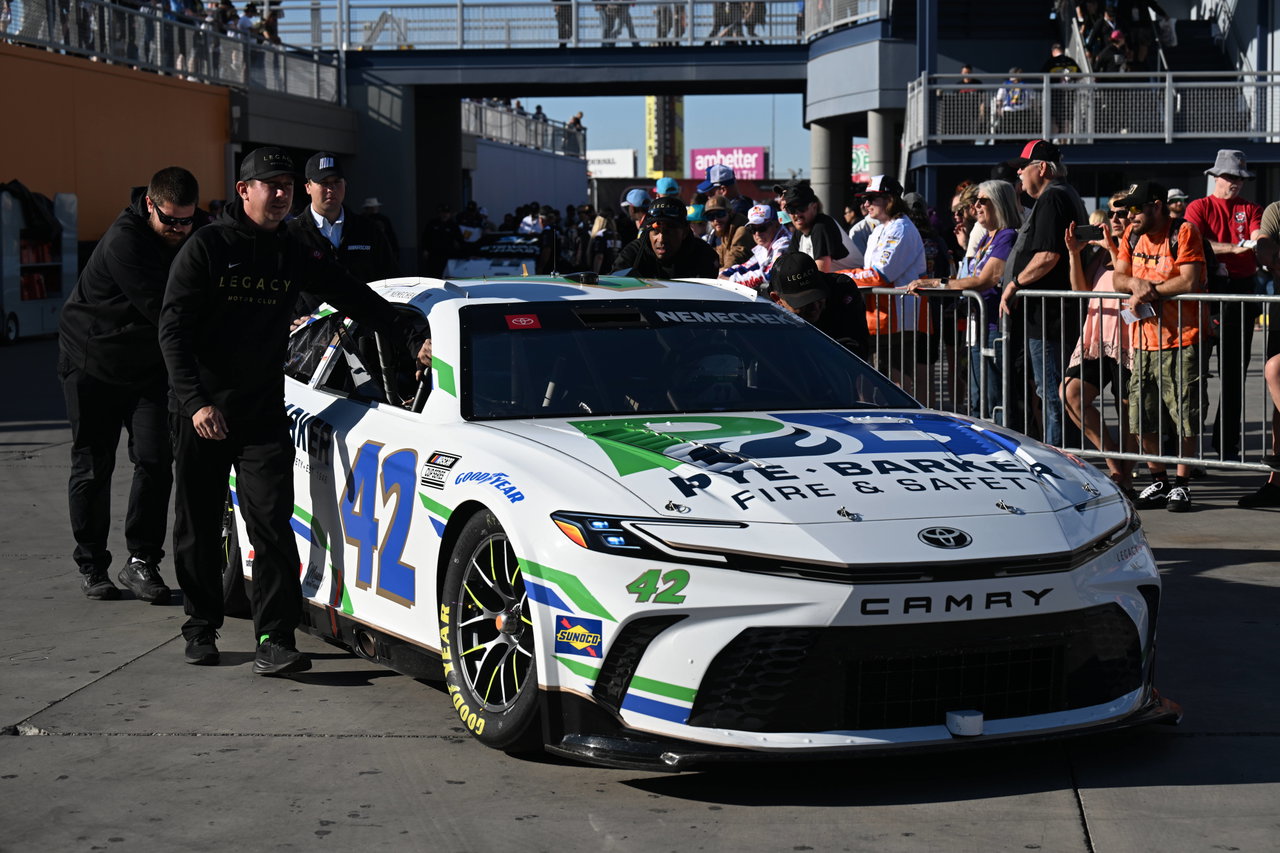
Going back to 2025, John Hunter Nemechek had the best Cup season of his career. He had two top-fives, eight top-10s, and a 20.3 average finish. So much so that NASCAR’s preseason coverage called his pairing with his crew chief, Travis Mack, a step forward for Legacy Motor Club. But the next season, those results went in the other direction.
Watch What’s Trending Now!
On September 2, Legacy confirmed that Nemechek would not return for the 2027 season. This news came despite the team announcing in May that Nemechek would continue the following season. Alas, slip-ups throughout the year ultimately cost him his spot.
In some regard, Legacy’s call can be called defensible. The 2026 numbers were poor, and teams cannot keep seats open indefinitely. But this specific instance of Nemechek leads us to something that the sport has been reluctant to confront.
It is this: when a driver underperforms, how confident can a team actually be that they are supporting someone who has hit his ceiling rather than someone who has just never had the right conditions to find it? While NASCAR management, on-grid players, and fans might think of it as an easy question, it is hardly that simple.
Nemechek’s career already answered that once
Let’s take Nemechek’s case study into focus here. He had his first Cup stint with Front Row Motorsports in 2020, which ultimately stalled. The easy reading on that situation at the time was simply that he was not a Cup-caliber driver.
So he went back to the basics. Nemechek went back to the Truck Series and won five races there in 2021, then two more in 2022. After that, in 2023, he joined Joe Gibbs Racing’s O’Reilly Auto Parts Series program, where he won seven races and finished fourth in the championship.
By then, his resume resembled something that you would look for in a Cup Series driver, and so he returned to NASCAR’s top competing series with Legacy Motor Club in 2024, this time under Toyota’s development pipeline.
The Cup Series results were not immediate. Nemechek’s first season with Legacy in 2024 was full of struggles. He finished 34th in points, but then things looked up in 2025. He was clearly making progress, and it was also the best Cup season of his career.
But after that, in 2026, the numbers started to drop again. That entire sequence paints a story for you because it goes on to demonstrate how dangerous it can be to make permanent conclusions from a temporary set of results.
His results have been full of fluctuations, from the 24 combined Truck and O’Reilly Auto Parts Series wins that got him back into the Cup Series, to a difficult year at Legacy, followed by his career best, and now another low turn in his career.
Therefore, Legacy has been driven to reach a conclusion about where his future lies, and it’s clearly not with them.
His 2026 season is also not an isolated story for Legacy Motor Club. Erik Jones is ahead of him in the standings, but he has also struggled throughout the season, with just two top-five and five top-10 finishes. Jones was 21st in the standings after the regular season.
If you look at it critically, it may be easy to point to one of them as the problem as a convenient way out. But that might not necessarily be the right conclusion.
Talking about the team itself, Legacy is only in its third season as a Toyota team. It’s still getting into that operation of running to win. So making a change, such as replacing Nemechek, does alter the entry list for them. Whether it fixes what is consistently producing such results is a different question.
Presumably, if two drivers at an organization aren’t performing, there might be more surrounding factors rather than just how the man drives.
Berry and Burton complicate the narrative further
Then there’s another driver on a different team. It was confirmed in June that Josh Berry would be leaving Wood Brothers Racing. His story was somewhat similar to Nemechek’s. In 2025, he won at Las Vegas Motor Speedway in March and made the postseason, where he finished 16th in the points standings.
But in 2026, his season completely fell apart. At the time of the announcement, Berry was 30th in the points standings, having run 15 races with four DNFs and 11 finishes of 26th or worse. If you look at why Wood Brothers Racing made that call, the statistics certainly support it. However, it would again be wrong to reduce Berry’s situation to a mere stat line.
Let’s look at his trajectory. He spent years grinding through late model racing before breaking through into the NASCAR O’Reilly Auto Parts Series, where he picked up five wins. He did not get a chance to run the Cup Series full-time until 2024 with Stewart-Haas Racing, when he was already 33 years old.
That is relatively late compared to when other Cup drivers joined the series. But it was presumed he could win when he was given competitive equipment. However, his two seasons at Wood Brothers, a team that works closely with Team Penske, had two radically different results.
While his 2025 season was a strong one, his 2026 campaign fell apart. The struggles became so severe that, midway through the season, the team was forced to make a final call on his future.
And that raises the bigger question: have we really seen enough to decide what his ceiling in the Cup Series is? More importantly, is the team willing to have that uncomfortable conversation, or does this decision risk sending a message that they are not prepared to stand by their drivers when things get tough?
This is not an unsubstantiated opinion. To understand why, look at Harrison Burton. After finishing 27th and 31st in his first two seasons with Wood Brothers, he bounced back in 2024. He won the Coke Zero Sugar 400 at Daytona, made the playoffs, and finished 16th in the standings. Even after all that, he still lost his seat. He then moved to AM Racing in the O’Reilly Auto Parts Series for 2025 and took that team to its first postseason. Now, with Sam Hunt Racing in 2026, he is in 19th position.
Looking at that, you get to see a driver whose position looked wobbly in the Cup Series, but as soon as the environment and the organization around him changed, the results started becoming better. There is also acknowledgment of the fact that it’s a different series. However, both perspectives can be critically examined.
The car is always part of the result, and the sport knows it
When asking that question, it would be foolish to ignore the car. NASCAR’s Next Gen chassis gives every team the same technical foundation, but that does not mean every car performs the same. The difference comes down to the manufacturer, engineering, crew chief support, simulator access, alliances, and, of course, funding. All of those factors can have a major impact when a driver takes the green flag on Sunday.
The finishing position of any driver is not the answer to how that team is performing. There are multiple layers of information built into it.
Going back to Nemechek, his own career is the most efficient proof of this. Front Row Motorsports got very limited results from him. Three years later, JGR’s O’Reilly Auto Parts Series program got exceptional results, which were seven wins in a single season. Although he had experience by then, the organizational change also played a factor, which is very hard to ignore.
Going by that, when a team looks at two or three seasons outside the top 25 and concludes that the driver is the primary problem, they are making an assumption that the equipment and organization are not a part of that result. Sometimes that assumption may be correct. But going by the change in results and the track record of most of these drivers, that judgment may sometimes be wrong.
Also, looking at the consequence part of it, while the team can recover from a bad personnel decision, the driver who loses a Cup seat may never get another chance comparable to the one he lost.
What real patience actually produces
Looking at a case study that is almost the opposite of the ones we discussed earlier, there’s Shane van Gisbergen. When he joined Trackhouse Racing in 2023, his performance seemed to tell two different stories depending on the type of track.
It is no secret that he is considered one of the best road-course drivers in the sport. From 2023 to 2025, he made 12 starts on road courses, winning six of them while recording a 7.6 average finish and a 121.9 driver rating. On all other tracks, however, his numbers were very different. Across 38 races, his average finish dropped to 25.0, while his driver rating fell to 50.0.
Going by that pattern, any organization could have concluded that he was only suited for road-course duty. Trackhouse chose not to do that, and it is worth asking why more teams are not taking the same approach.
In July 2026, NASCAR gave its own analysis on van Gisbergen. It was that he had gone from being a below-average driver on non-road tracks to being essentially average. This was based on him recording seven finishes of 11th or better in 17 starts. His average finish was 19.3, while his Adjusted Points+ index was 97 and his Driver Rating was 67.4, just below the Cup average.
So, on short tracks and drafting tracks, to be specific, he was already posting results that were above the Cup average.
By this point, his 2026 season had produced two wins, four top-fives, and five top-10s. His weakness was not permanent, which means a shorter evaluation period could easily have led to a different conclusion about his Cup Series future before Trackhouse had even given him enough time to improve on other tracks.
Corey Heim is another example of this. Between 2022 and 2026, Heim won 26 NASCAR Truck Series races. In his 2025 championship season, he broke the all-time single-season record by winning 12 times.
Full-time Cup opportunities were readily available to him, but he and Toyota Racing Development chose to show patience instead. He ran four Cup races in 2025 and then a limited schedule again in 2026. In his 15 total Cup starts, he won two races, at Naval Base Coronado in California and the Brickyard 400 in Indianapolis.
Toyota Racing Development President Tyler Gibbs explained the reasoning behind it. He laid out a step-by-step path for Heim, starting with ARCA, then moving to a full Truck schedule, and finally gradually expanding his Cup presence. It was a deliberate approach designed to help him achieve good results.
23XI Racing Competition Director Dave Rogers also pointed out that Heim had specifically turned down a full-time Cup ride to remain within that game plan.
Two wins in 15 races is not a bad result at all. It is a combination of the organization backing him and the talent he has shown. More importantly, it clearly shows that when an organization is willing to be patient with its drivers, the results can follow.
Who gets developed and who just has to produce right now
Connor Zilisch is 20 years old and finished the 2026 regular season 34th in the Cup standings, recording nine DNFs across 26 starts. In August, Hendrick Motorsports signed him to a multiyear deal beginning in 2028, when he takes over the No. 48 Chevrolet after Alex Bowman steps back from full-time racing.
Hendrick did not make that commitment because of what he saw in 2026. He made it because Zilisch won 10 O’Reilly Auto Parts Series races in 2025 and finished second in the championship at 19 years old. Trackhouse’s Justin Marks said in July that the team needed to give him better cars and specifically called 2027 a critical development year once Zilisch had a full Cup season behind him.
So Zilisch finished the regular season 34th in points with nine DNFs and still has a Hendrick seat secured for 2028. Nemechek, meanwhile, came off the best Cup season of his career and is now looking for a team for 2027.
Those two facts, sitting side by side in the same season, are about as clear an illustration as you will find of how differently NASCAR currently treats its drivers depending on which category they fall into.
And make no mistake, the difference is not credentials. Nemechek has 11 O’Reilly Auto Parts Series wins and 13 Truck victories. Berry has five O’Reilly Auto Parts Series wins and a Cup race win. Neither of them showed up in Cup without a meaningful record behind them.
The difference is that Heim, van Gisbergen, and Zilisch each entered Cup inside organizations that had already decided, before a single result came in, what they believed those drivers could eventually become.
That prior organizational belief changed the entire terms of the evaluation. It meant their rough stretches were interpreted as part of a process rather than evidence of a ceiling, and that distinction is everything.
Not everyone leaving is being discarded, but the system still has a problem
Noah Gragson’s 2026 season at Front Row Motorsports looks similar to Nemechek’s on paper. He sits 31st, with two top-10 finishes through the regular season. Front Row extended him for 2027 anyway, publicly citing its belief in his talent despite what the current results were showing.
That is an organization actively choosing to look past a difficult stretch rather than judge a driver solely by it, and it shows that the impatience running through parts of this sport is not universal. It is selective, which is actually the more troubling version of the problem.
Jesse Love moving into Wood Brothers’ No. 21 for 2027 also reframes what happened to Berry. Love won the 2025 O’Reilly Auto Parts Series championship, captured two ARCA Menards Series West titles, and had already made seven Cup starts when Wood Brothers announced him as its 2027 driver.
Wood Brothers did not simply replace Berry with another available veteran. The team chose a 21-year-old reigning O’Reilly Auto Parts Series champion whose lower-series record made him a long-term investment with significant upside. Those are different decisions, even if the outcome for Berry looks the same from the outside.
Riley Herbst is the final piece. He was replaced at 23XI Racing by Heim for 2027 despite improving his average Cup finish from 26.4 in 2025 to 22.2 in 2026 and recording three top-10 finishes. Legacy Motor Club signed Herbst to a multiyear deal for the new No. 84 Toyota, with Monster Energy’s sponsorship transferring with him.
He was not pushed out of the sport. Within months of learning that he would lose his 23XI seat, he had secured another multiyear Cup deal with Legacy Motor Club.
Three outcomes exist for drivers caught in this rotation. Some get retained by organizations willing to absorb a rough stretch. Some get reassigned somewhere more suitable. And some simply run out of road before either option materializes.
The patience exists but is not being distributed fairly
The 2027 Cup grid is mostly decided. Joe Gibbs Racing returns Denny Hamlin, Christopher Bell, Chase Briscoe, and Ty Gibbs. Hendrick Motorsports will return Kyle Larson, Chase Elliott, William Byron, and Alex Bowman in 2027, with Zilisch already lined up to replace Bowman in the No. 48 for 2028. Wood Brothers has Love. RFK Racing keeps Chris Buescher and Ryan Preece. 23XI Racing has Tyler Reddick, Bubba Wallace, and Heim.
Quality seats are genuinely scarce, and an owner does not need to believe his current driver is bad to make a change. He only needs to believe the alternative has more room to grow. That calculus is going to keep pushing established Cup drivers out regardless of whether the evaluation behind it is actually sound.
NASCAR’s own analysis of Corey Heim’s development noted that the usual growth process often takes roughly 100 races before drivers begin winning, even among some of the sport’s brightest young prospects. Heim winning twice in his first 15 Cup starts is an extraordinary outcome, not the developmental benchmark most young drivers can reasonably be expected to meet.
If the realistic development window sits closer to 100 starts, drawing firm conclusions after one or two difficult seasons cuts that short by the sport’s own standards. Charters carry real financial value, sponsors want visible progress, and the pipeline of qualified young talent coming through O’Reilly Auto Parts Series and Trucks is genuinely strong right now.
Holding seats open indefinitely is not realistic, and nobody serious is arguing that it should be. But there is a meaningful difference between a sport that cannot be patient and a sport that chooses not to be, and right now NASCAR is doing more of the latter than it is willing to acknowledge.
What 2026 is really exposing is a two-tier evaluation system operating inside the same sport at the same time. The biggest organizations are becoming more deliberate about development than they have ever been, building real pipelines and protecting drivers they believe in before the results validate that belief.
Meanwhile, established Cup drivers are increasingly being held to an immediate production standard that the sport’s own developmental evidence suggests is unreasonably short. The same organization that locks in a 20-year-old sitting 34th in points will not extend a driver who finished 25th the previous year.
That is not one coherent philosophy. It is two different philosophies being applied to different groups of drivers, and the group with the shorter leash did not choose to be in it.
When a team moves on from a driver, they are making a judgment call about whether they are watching someone who has found his limit or someone who never had the right environment to discover where that limit actually sits.
Given everything the sport knows about how much equipment, organization, and opportunity shape a Cup driver’s results, the real question worth asking is this: how many drivers has NASCAR already moved on from who, given what Heim and van Gisbergen were given, might have told a completely different story?