
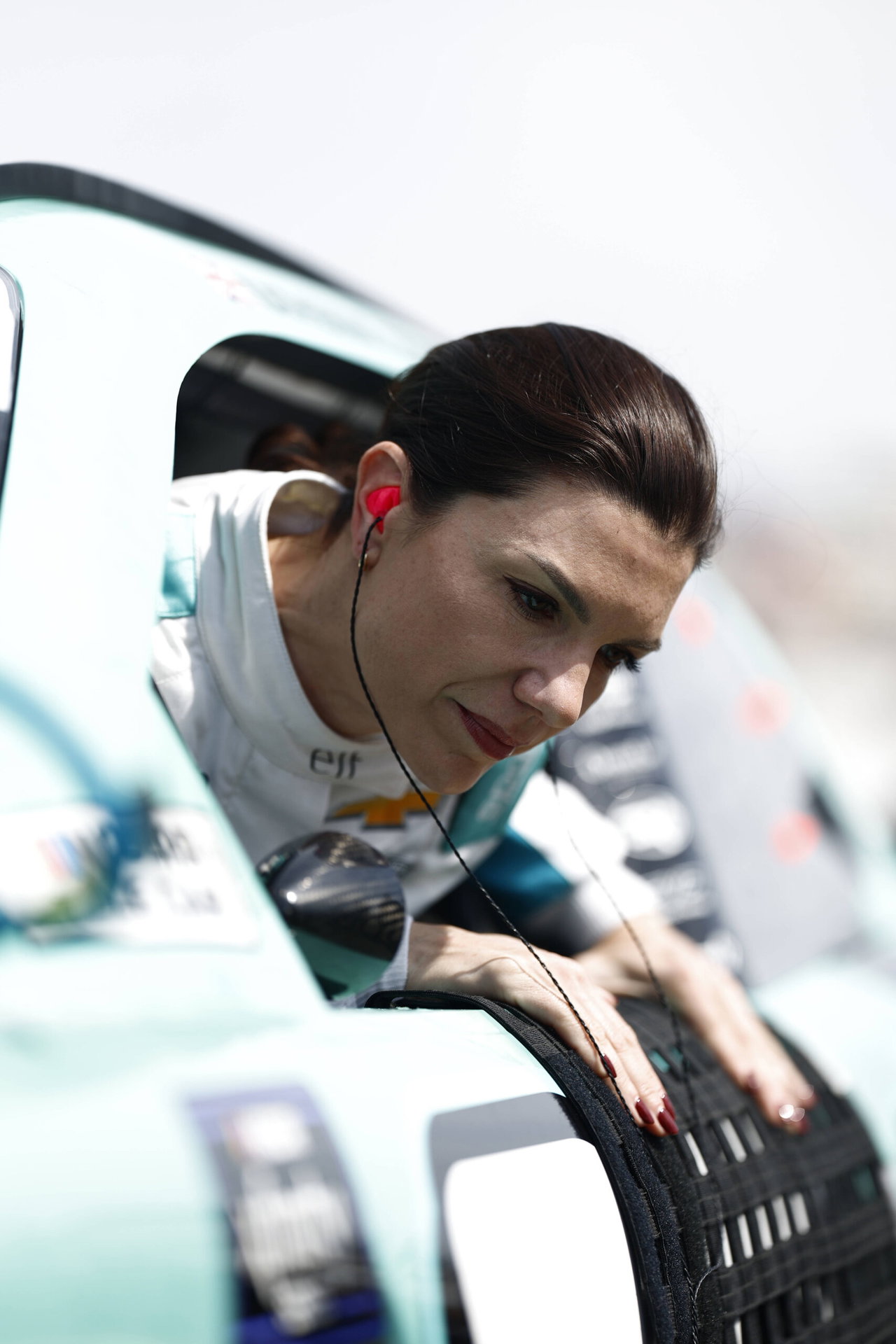
Danica Patrick finished her last NASCAR race in 2018. Eight years later, the sport has not had anyone close to what she was, even off the track. No such consistent presence in a Cup garage, or even a clear heir apparent working her way through the lower series with real manufacturer backing and a genuine shot at the top. There are talented women in the system right now. The question is whether NASCAR has actually built a system at all, or whether it is just hoping one finds her way through.
Watch What’s Trending Now!
“There is absolutely no reason to segregate us, because we can race against the guys,” said Katherine Legge, who has raced in IndyCar, NASCAR Cup, and Formula E. She was making a point about F1 Academy specifically, but the argument is bigger than one series.
The pipeline problem nobody wants to talk about
The standard response to “where are the women in NASCAR?” tends to land on talent. There are not enough of them good enough to compete, goes the thinking. That explanation is too convenient. The real problem starts at nine years old, in a kart, when a girl’s family decides whether racing is something worth investing in. It is in whether a teenage prospect finds a late model team that takes her seriously, whether a sponsor thinks a female driver sells product. And whether a manufacturer development program includes her name on a shortlist.
Isabella Robusto is 21 and racing full-time in the ARCA Menards Series this year with Nitro Motorsports. She has been in the Toyota Racing Development system since 2021. In April 2025, she finished third at Talladega Superspeedway, the best result ever recorded by a female driver there. She graduated high school a year early and is currently studying aeronautical engineering at Arizona State University. She is clearly not there by accident.
But even she acknowledges the road is not entirely level. “You have a handful of people you didn’t grow up with, that grew up in a different way, with a different racing route, and you have to race them on national TV where everything is on camera,” she said. “I think it really depends on how much respect you have for them.”
Toni Breidinger, 27, is a step ahead. She holds the record for most top-10 finishes in the ARCA Menards Series by a female driver and raced full-time in the NASCAR Craftsman Truck Series in 2025 with TRICON Garage. She is the first Arab-American woman to compete in a NASCAR national series. She has sponsorships, media partnerships, and a legitimate profile. She is also still in the Truck Series, trying to find a path into the O’Reilly Auto Parts Series. The gap between where she is and where she needs to be to reach Cup level is not at all a talent problem. It is about money, opportunity, and whether the infrastructure exists to close that gap at all.
Shantel Kalika, who fielded her own car part-time in the NASCAR Canada Series between 2018 and 2022, put it plainly. “You do have to consistently prove yourself in that environment,” she said. “I think sometimes you’re fighting for the same level of respect, and that comes from earning it.”
That is a real answer. It is also one that accepts a barrier most of her male competitors never had to think about.
What happened when someone tried to fix it
W Series launched in 2019 with $1.5 million in prize money and a mission to create a pathway for women who struggled to find seats in the traditional junior ladder. A Formula 1 partnership came later, with W Series joining the F1 support bill in 2021. For three seasons, it got some good attention. Jamie Chadwick dominated every year she competed. But the series entered administration in 2023 after a funding deal collapsed mid-season, leaving drivers without prize money they had already earned. It became the clearest possible illustration of what happens when a women’s racing series is built on optimism and sponsorship promises rather than a durable financial foundation.
F1 Academy launched the same year W Series folded, and it has been more careful about sustainability. It is backed by Formula 1 itself and now has full teams from McLaren, Mercedes, Ferrari, and others. The 2026 Rookie Training Camp at Loughborough University is a serious piece of infrastructure, putting 18 prospective drivers through physiological profiling, cognitive testing, and engineering workshops before an on-track test at Circuito de Navarra in September. Seven drivers from last year’s inaugural rookie test graduated to full-time grid seats this season.
And yet the graduates tell a complicated story. Doriane Pin won the 2025 championship and became a Mercedes development driver and the first woman to test a Mercedes Formula 1 car. Abbi Pulling, the 2024 champion, moved to the GB3 Championship and earned a simulator role with the Nissan Formula E team. These are real opportunities, and yet, none of them are on the single-seater ladder toward Formula 1.
Legge sees that pattern clearly. “They get stuck in this cycle,” she said. “It’s almost like, if you’re gonna make a women’s series, then make it for everybody, not just the young ones coming in, and suck them out.”
The participation numbers make her point harder to dismiss. F1 Academy’s support for Champions of the Future Academy has pushed female karting participation from 5 percent of the grid in 2023 to 30 percent by 2025. That is a real achievement. But karting participation and Cup seats are separated by a decade of development, hundreds of thousands of dollars. Also a series of decisions made by team owners, sponsors, and manufacturers who may or may not choose to invest in a female prospect along the way.
The commercial argument NASCAR is ignoring
The 2026 Daytona 500 averaged 7.5 million viewers, which was up from the rain-delayed 2025 race but still well below the 8.17 million that watched in 2023. The broader trend is a steady decline from numbers that once regularly cleared 10 million. The 2025 Cup Series season finished down 14 percent in overall viewership. NASCAR’s own president expected it, which made it no less uncomfortable.
This is the conversation nobody is having directly alongside the women’s pipeline discussion. NASCAR has a growth problem, and it has been trying to solve it with competition formats, television deals, and weekend structures. None of those things bring in an entirely new audience. A genuinely competitive, well-marketed women’s championship could.
Think about who does not watch NASCAR right now. Young women who follow the WNBA, National Women’s Soccer League, and college athletics. Families who would respond to a sport that looks more like the world outside the grandstands. Sponsors in lifestyle, beauty, technology, and consumer goods who look at NASCAR’s current demographic profile and take their budgets elsewhere. Motorsport is structurally unique in that it already allows men and women to compete directly against each other. NASCAR has never properly marketed that fact, and it has never created the conditions to make it a regular, visible story.
Arianna Casoli has raced in the NASCAR Euro Series five times as Lady Trophy champion, competing as a 50-year-old architect who became a role model to young girls in the paddock simply by showing up. “Motorsports is the only sport where there are no adjustments for women,” she said. “Mentally, in a certain way, we are also different, and this is really powerful to make them understand they can do it.” That line should be on a billboard. It has not been.
So what should NASCAR actually build?
A standalone women’s series, built outside the existing NASCAR structure and relying on its own commercial model, carries the W Series risk. Novelty fades. Sponsorship dries up. Drivers end up without prize money. The lesson from 2023 is not that the concept is wrong but that the funding model has to be embedded in something more stable than enthusiasm.
NASCAR already has a Driver Development Program, which has produced Robusto and others. It exists. It has produced talent. What it has not done is create a consistent, structured path from ARCA to the Truck Series to the O’Reilly Series for female drivers specifically, with real manufacturer commitment attached to performance rather than optics.
The more practical approach is a subsidized women’s developmental championship running as part of existing NASCAR weekends. Not a separate touring series trying to find its own television deal and sponsor base. Put it on Fridays alongside the Craftsman Truck Series at Cup weekends, in front of the crowds already there, with full NASCAR officiating, identical cars, and national broadcast coverage. Then attach a real ladder to it. Race winner gets a Truck Series test. Top three in the championship earn O’Reilly Series manufacturer development contracts. The title holder gets a guaranteed O’Reilly Series start the following season.
Alongside that, NASCAR’s three major manufacturers, Toyota, Ford, and Chevrolet, should each carry at least one female driver through a structured development program every year. Not a guaranteed race seat, but a guaranteed runway: simulator time, testing sessions, data access, coaching, and sponsor introductions. Performance determines what happens after. The driver earns the ride. The program exists to make sure she has a legitimate shot at getting there.
The philosophical question underneath all of this is whether NASCAR wants its next female Cup star to emerge naturally from the existing system, or whether it wants to build something that makes her emergence significantly more likely. The existing system has had eight years since Danica Patrick left and has not produced a clear successor. That is the answer to the first question.
Lyn St. James, co-founder of Women in Motorsports North America and one of the most accomplished drivers this sport has ever produced, framed what is actually being lost every year this conversation stays theoretical. “We need all forms of motorsports to help tell the stories of the successful women racers because it will put them on the radar,” she said. The stories are there. Robusto at Talladega. Breidinger in the Truck Series. Kalika owning her own car in Canada for four years. The infrastructure to turn those stories into a pipeline is not.
A women’s series is not automatically the answer. But doing nothing has already given NASCAR its answer, and it has been the same one for eight years running.