
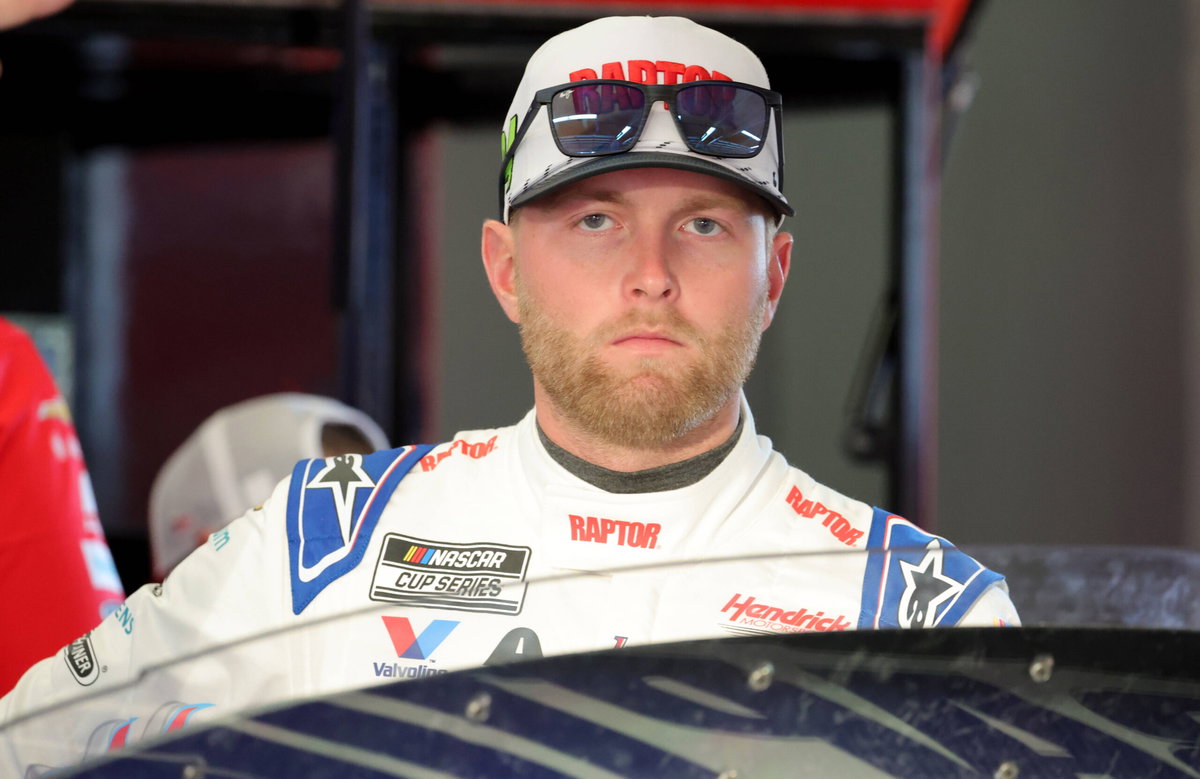
In just under an hour, NASCAR will make history as the Cup Series races for the first time at an active military base at Naval Base Coronado. But after watching chaos unfold in both the Truck and especially the O’Reilly race with wrecks, wall damage, and lengthy stoppages, William Byron isn’t worried about speed. Instead, the Hendrick Motorsports driver believes the biggest threat may be the NASCAR Next Gen car itself.
Watch What’s Trending Now!
William Byron’s biggest concern at the San Diego race
William Byron expressed his concern to veteran reporter Bob Pockrass before the Cup Series race, which comes directly from how the NASCAR Next Gen car is built and how it poses a significant challenge at the technical circuit.
“If you’re hitting the wall with this thing, the car is done. So I think there is a lot of awareness for that for just the Cup Series guys because the risk of that is, it’s a day end with the way the toe links and the rear suspension is on these cars. So hopefully we don’t have issues with it. Like the safety side, I mean, I’m not super concerned. It just would take time to put it back. So I think that’s the problem. It would take time to throw the caution, put the wall back in place,” Byron said.
One of the most fragile parts of the platform is the toe link. This is a small but critical rod in the independent rear suspension that keeps the rear tires pointed correctly. NASCAR intentionally designed it to fail upon impact. The logic is simple: sacrifice a relatively inexpensive component instead of transmitting force into much costlier drivetrain pieces like the transaxle.

William Byron with the prescient comment yesterday morning about whether he had any concern about the walls coming apart as they did in the truck race -- he said his biggest concern was the time it would take to repair. @NASCARONFOX
While the logic is absolutely correct, it also comes with a downside. Once the toe link bends or breaks, the car’s alignment collapses, and the race is usually over. The independent rear suspension itself is another major change. Older Cup cars used a solid rear axle that could absorb punishment and stay functional. The Next Gen replaced that setup with independent suspension. While this move improved handling precision, it also increased the likelihood that wall contact could result in significant suspension damage.
And if you’ve been following NASCAR for the last couple of days, San Diego already showed exactly why William Byron is worried.
During the NASCAR O’Reilly Auto Parts Series race, Sam Mayer misjudged corner entry and clipped the inside wall. That launched his car into Anthony Alfredo before both slammed into the outside barrier. Because the crash happened immediately after a restart, the field had nowhere to go. The narrow street layout became completely blocked, collecting over twenty cars in a massive pileup. NASCAR was forced into a 43-minute red flag just to rebuild damaged safety barriers.
Mayer’s car (and a few others) never recovered. That’s exactly the scenario William Byron wants to avoid today.
Not the first time Byron expressed his concern about the Next-Gen car
William Byron’s concerns didn’t begin in San Diego. Just days earlier, he publicly pointed to the Next Gen platform after Christopher Bell suffered one of the hardest crashes of the era at Michigan, leaving with wrist and ankle injuries. Byron argued that the car itself contributes to incidents becoming more violent.
“So you’re seeing that crash because of the nature of the tire and the aero and everything with these cars, so it’s a violent impact…I think that wreck was caused because of the nature of this car”
His argument centers on how dramatically the car changed. The Next Gen introduced symmetrical bodywork, shifted downforce underneath the chassis using a rear diffuser and stepped splitter, added wider 18-inch wheels with lower-profile tires, and replaced the solid axle with independent suspension.
Those changes modernized NASCAR, but they also changed recovery behavior. Drivers now describe the cars as harder to catch once they rotate. Underbody aero becomes unstable at extreme angles, the tires grip until they suddenly don’t, and dirty air only makes things worse.
At San Diego, where walls are everywhere, and margins are tiny, Byron believes that combination could turn routine mistakes into race-ending disasters.