
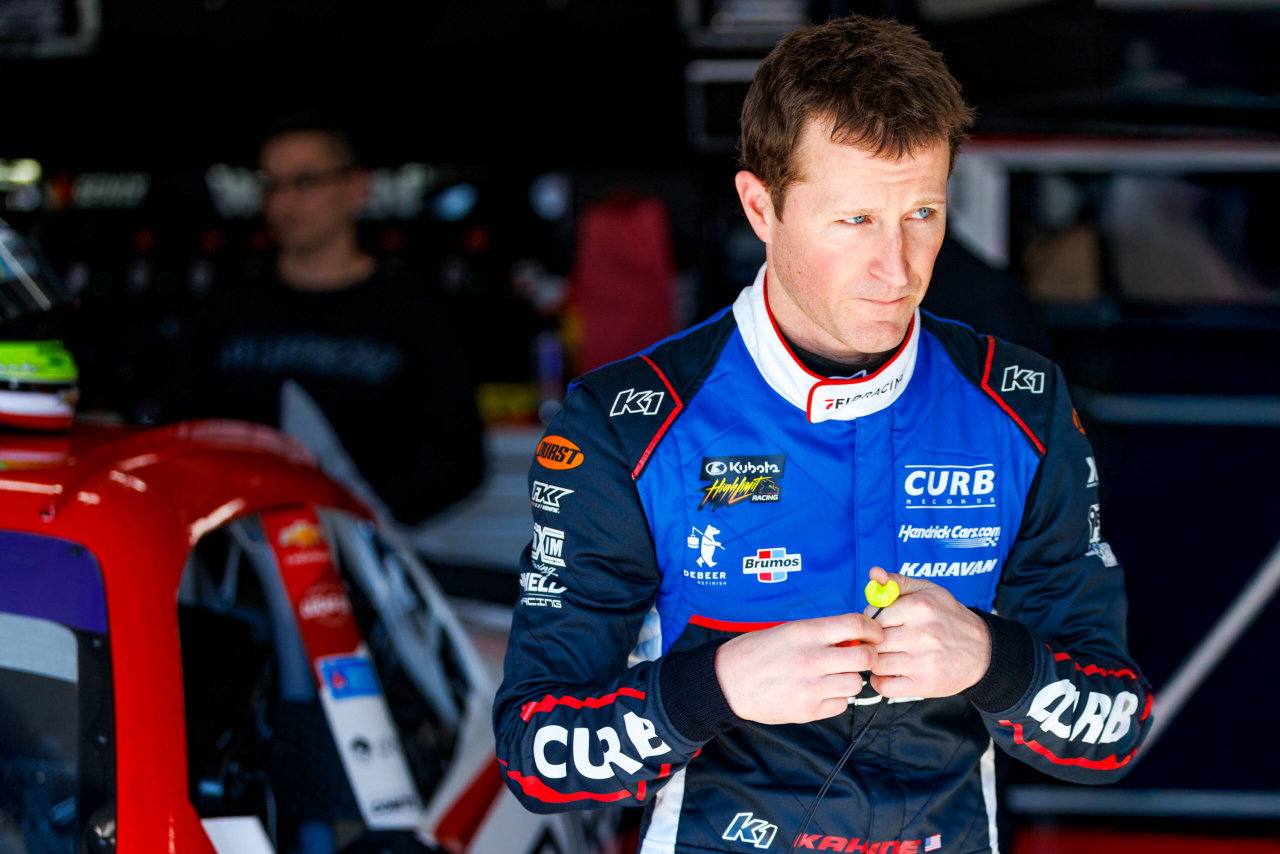
Kasey Kahne’s return to NASCAR is the kind of announcement that brings back memories of a different era of the sport. The 18-time Cup Series winner is set to compete full-time again in 2027, joining Spire Motorsports for a Truck Series campaign after stepping away from NASCAR in 2018 because of health issues. He will take the wheel of the No. 77 Chevrolet, bringing plenty of experience to a series he has won in five of his six career starts. But a NASCAR veteran has a different perspective on the challenge waiting for him.
Watch What’s Trending Now!
“The trucks are a little different, they’re a little under horsepower than when I drove them. They got to roll a lot more through the corners. They got to use a little less brake,” Ron Hornaday said in a press conference recently.
Hornaday has watched the NASCAR Truck Series evolve considerably since his own days behind the wheel. The four-time champion believes today’s trucks demand a different driving approach, with competitors having to carry more speed through corners instead of relying on the horsepower he remembers from his era.
That shift has changed how drivers manage their equipment and approach battles on the track. But Hornaday’s concerns go beyond the technical differences. He believes something has changed in the way some young competitors think about the risks of racing.
In Hornaday’s time, drivers had considerably more engine power to work with. They could use that power to accelerate out of corners, whereas today’s competitors have to be more deliberate about maintaining momentum. Carrying speed through the center of a turn and avoiding unnecessary braking become important parts of extracting performance from the truck.
Reduced horsepower also changes how drivers create passing opportunities. With less power available to recover after losing momentum, competitors have to be more deliberate about setting up moves and carrying speed into corners. That can encourage closer racing, where drivers rely on positioning and bumper contact to gain an advantage. A mistimed move, however, can quickly turn a battle for position into a multi-truck incident.
However, Hornaday’s criticism is not that the younger generation lacks talent. His concern is how some drivers approach contact and whether they fully appreciate what happens when an aggressive move goes wrong. He illustrated that point with an unexpected story about his grandson.
“The only thing I don’t like nowadays with the kids is my grandson said it the best,” Hornaday explained.
He recalled being at a fair when his grandson challenged him to a race on a simulator. Hornaday declined, telling him he had already done enough driving. His grandson responded that there was no reason to worry because nobody could get hurt in the simulator.
“I think some of these kids are thinking that,” Hornaday added.
The exchange made Hornaday think about the difference between racing on a screen and competing in a real truck. A simulator allows drivers to hit walls, make mistakes, and restart without dealing with physical consequences.
On a race track, one poorly judged move can damage several trucks, put competitors in danger, and leave an entire team with hours of additional work. Hornaday worries that some young drivers do not always appreciate that distinction when they make contact.
The 2026 Truck Series season has offered some frightening reminders of how quickly things can go wrong. At Bristol Motor Speedway on April 10, Christian Eckes and Corey Heim made contact while battling for the lead. After Heim used his bumper to move Eckes out of the way, Eckes attempted to return the favor on the following lap.
The contact sent Heim’s No. 1 Toyota into the wall and triggered a multi-truck crash involving Kaden Honeycutt, Layne Riggs, and Chase Briscoe. Eckes later accepted responsibility for the incident.
Another incident came at Charlotte Motor Speedway in May. Corey Day and Gio Ruggiero made contact on Lap 47, sending Day’s truck sideways and then airborne before it slammed into the inside wall. The truck landed upright, but the violent sequence illustrated how quickly a battle for position can turn into a dangerous accident. Day was evaluated at the infield care center and released.
Interestingly, Kasey Kahne’s own career offers an example of how experienced drivers can also make mistakes with serious consequences. During the 2016 Auto Club 400, Kahne’s No. 5 Chevrolet made contact with Danica Patrick’s car, sending her into a heavy, nose-first crash against the frontstretch wall.
Kahne apologized over the radio and after the race, while NASCAR required him and crew chief Keith Rodden to meet with officials for a post-race consultation. The incident is a reminder that experience does not eliminate mistakes, but accountability matters when they happen.
That sense of responsibility is something Hornaday believes needs to extend beyond the driver’s seat. Recalling his early years racing for Dale Earnhardt, he explained that if he caused an accident through his own mistake, he would show up at the shop on Monday morning and help cut the damaged truck apart. Earnhardt never had to order him to do it. Hornaday understood that his actions created additional work for the people preparing his equipment.
He has tried to pass the same lesson on to his grandson Landon. Drivers need to work alongside their crews, understand the consequences of their decisions, and build relationships that extend beyond race day. For Hornaday, that is an essential part of winning. Speed matters, but so does having the entire team working together.
His message to the younger generation is simple: race hard, but take responsibility for what happens when things go wrong.