
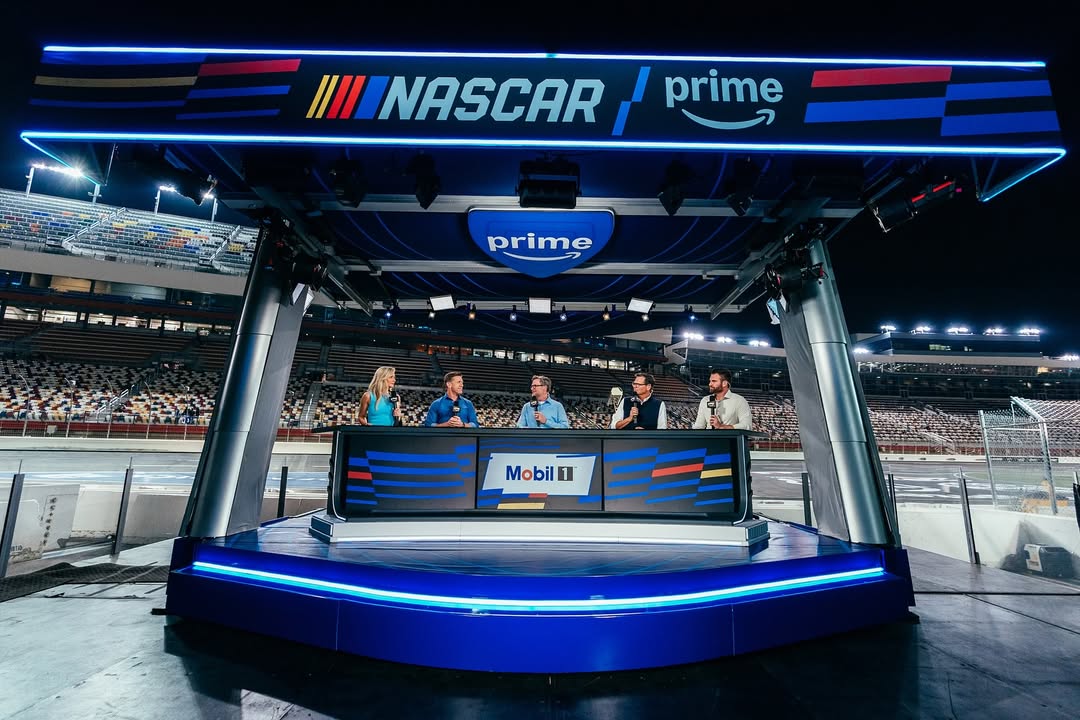
NASCAR fans are fractured across four broadcast services. Kenny Wallace says they’re complaining about the wrong thing. Not only does the divided schedule increase the complexity of watching races for the older audience, but it also annoys the fans to the point that they question, “Why should we pay for yet another streaming/broadcast service?” It seems like Wallace has an answer for those disgruntled fans.
Watch What’s Trending Now!
With multiple media outlets covering the NASCAR schedule of 36 races, fans often end up wondering about the feasibility of paying for them all. But Wallace, who was once a FOX broadcaster himself, thinks that fans should undoubtedly try to pay for this one service.
“Prime is just a streaming network, and they have a lot of leeway. They can do kind of sometimes, whatever they want… So they were able to move up the race two hours. Because of what they are… Once again, you have to give credit where credit is due, everybody. NASCAR is on a roll.
“I know a lot of you don’t like paying for it, but like I said, if you have Amazon Prime, then you got it on your TV… and they partner up with Prime. It’s official: everybody likes Prime now, just because it’s fresh and new. A little different look. It’s not that they are way better than FOX. It’s like being the third brother…”

“Coffee with Kenny” @SportsonPrime did something NO ONE can do in @NASCAR and @dennyhamlin is on a heater 🏁
While using the analogy of his racing career and learning from his brothers to describe the way Prime operates, Wallace ends up addressing the pricing issues directly. As he mentions, people hate to pay for it because of the additional strain on their wallets, but they do not realize that the subscription comes as part of a package.
Prime isn’t a standalone NASCAR service; it’s a perk bundled with retail, music, and shipping. That changes the math for fans. So, as a package, being a Prime member and buying its subscription makes more sense than considering it solely as a NASCAR broadcast payment.
Prime has been delivering consistently on its promises so far. When it comes to the quality of the broadcast, fans prefer it over the other three media outlets.
Their latest move to conduct the race from 1 PM was seen as a welcome addition, which fans appreciated. It helped the fans facilitate their daily lives better and allowed them to avoid any unnecessary delays. There were significant gains in the younger audience for Charlotte in particular. Motorsports.com reported the following: viewership among adults ages 18-34 is increasing 14% year-over-year, with adults 18-49 up 26%, and adults 25-54 up 25%.
There was another aspect to their broadcast that greatly touched the fans’ hearts. After Kyle Busch’s untimely demise, Prime was in an impossible situation with the sensitivity of the matter.
Yet they handled it elegantly and dedicated an entire hour of the pre-race broadcast to Kyle Busch and allowed others to narrate their stories and tributes about him, giving the fans some closure and much-needed solace. The audience loved this thought and couldn’t help but thank Prime for the same.
It is safe to say that the data supports Amazon Prime and its viewership on a much more concrete level, if not for the raw sentiments of the fans. Two out of NASCAR’s four best broadcasts from this season were handled by Amazon Prime this year.
The Cup Series broadcast in Michigan and Charlotte ended up attracting 12 and 17 percent more viewers compared to last year. The data was collected using Nielsen’s Big Data + panel figures. Since NASCAR stopped using Big Data, its official statistics may differ from these figures. However, the increase in viewership is going to translate to any set of data.
The Charlotte race in particular had a peak viewership of 3.37 million with an average viewership of about 3.06 million on Sunday, as per Motorsports.com’s reports. It is proof that the experiments that Prime is trying are undoubtedly bringing in results. Charlotte and Michigan will set a precedent for other broadcasters and ultimately reshape NASCAR’s broadcast strategy.