
If you had to illustrate the phrase calm before the storm, in terms of NASCAR, it would be this move by Ryan Blaney. Before he marched toward Carson Hocevar at Bristol Motor Speedway, he handed his phone to crew chief Jonathan Hassler and left his team behind. He later told Denny Hamlin’s podcast that he did not want to show up with what he called the “cavalry.”
Watch What’s Trending Now!
He was certainly level-headed for a driver who knew he was about to fight minutes later. It did, however, make one thing clear: Blaney understood something crucial in a pit-road scrum. A fight between two drivers stays a fight between two drivers only as long as everyone else keeps out of it.
Bristol tested that idea on September 19, and a regional NASCAR race in Virginia tested it again seven days later. The results, though? Drastically different. We’ll see just how much.
The wreck, the walk and the ruling
The fuse was lit on the track. With 43 laps left in the Bass Pro Shops Night Race, Hocevar made a crossover move while racing Blaney. Blaney tried to block, the two touched, and Blaney slammed into the outside wall. His No. 12 Team Penske Ford was finished, and he ended up 33rd after leading a race-high 202 laps.
So here’s how it presumably felt for Ryan. You’re having a good night, you lose it in one bad second, and all that anger has to go somewhere. Blaney took his to Hocevar’s No. 77 after the race. He grabbed and pushed Hocevar first, and Hocevar answered with the first punches. Blaney threw one of his own before officials and crew members pulled them apart.
Then NASCAR, surprisingly, penalized neither driver. NASCAR CEO Steve O’Donnell said the sport was not encouraging fighting, but that it wanted to keep “passion.”
Being the devil’s advocate here, Blaney did walk over alone about a wreck that had just happened between the two of them, and nobody else had a stake in it.
The more interesting part was what NASCAR said next. It announced that it would review the crew members who joined the scrum, and it would do that separately from the drivers. Read that again. The sanctioning body was telling us it sees two categories of people in a fight. Drivers get room, and everybody else gets scrutiny.
So how did NASCAR get comfortable enough to let a fight like this slide?
How NASCAR got here
Bristol was not a sudden change of heart. In March 2026, Mike Forde, NASCAR’s vice president of racing communications, explained that drivers had been asking for more room to show emotion. They wanted to know whether a heated moment would automatically cost them a fine. Forde called the approach case by case. He also made clear that NASCAR still wanted drivers safe and did not want things to get out of hand.
The idea itself goes back to 2010, when NASCAR adopted its informal “Boys, Have at It” philosophy. Drivers were told to race hard and settle some of their own business. Even then, the sport never handed out a blank check. In 2015, then-chairman Brian France said contact and emotion are part of NASCAR, but,
“there’s always limits to that.”
There is a contradiction, though. NASCAR has never written a rule that says drivers may fight. It has chosen to punish less often and judge each case on its facts. That might signal a green light, but officially it is only a shrug with conditions attached.
Perhaps the sport has this mostly right. Fans love a grudge, and a driver who just lost a race in a wreck is in a different place from one who wrecks a rival at 180 mph on purpose. If NASCAR fined every shove, the sport would start to look scripted. The catch is that a policy around drivers only works while drivers are the only ones involved. Which brings us to the people who run in after them.
Where is the line?
Three days after the race, on Sept. 22, Forde explained what officials had seen. They reviewed the footage and decided the crew members at Bristol were trying to break up the fight, not join it. That is why nobody got penalized. Forde added that NASCAR does not want crew members getting violent with drivers. Put simply, pulling people apart is okay and swinging is not.
That sounds simple enough, until you picture the scene. A pit-road scrum lasts a few seconds, and a lot can happen in that window. A crew member can pull his own driver away, hold the other driver, or shove someone aside. He can also throw a punch or tackle a person. From a wide camera angle, several of those look almost the same.
The middle ground is the tricky one. At Portland International Raceway in 2023, a Kaulig Racing crew member put Jeb Burton in a headlock during an NASCAR Xfinity Series race. Burton had gone after Chandler Smith following a late incident. Was that restraint or aggression? I have not found an official penalty for it, so I will not guess. It does show how blurry the word “restraint” gets when an arm ends up around someone’s neck.
Bristol also showed how far a fight can spread past the people who started it. Ty Gibbs of Joe Gibbs Racing threw a water bottle during the scrum. It hit a media member and knocked a phone out of that person’s hand. NASCAR did not fine Gibbs, but it called him in for a talk. Forde said the bottle could have caused a serious injury, and he pointed to the risk of the cap hitting someone in the eye.
Gibbs admitted it afterward. “Definitely shouldn’t’ve done that,” he said.
The media member had nothing to do with Blaney and Hocevar. He was just standing close, and that was enough. Once a crowd forms, everyone nearby becomes part of the risk, whether they signed up for it or not. Forde also said something at Bristol that changes how you should picture these crew members.
These are not the NASCAR pit crews of the 1980s
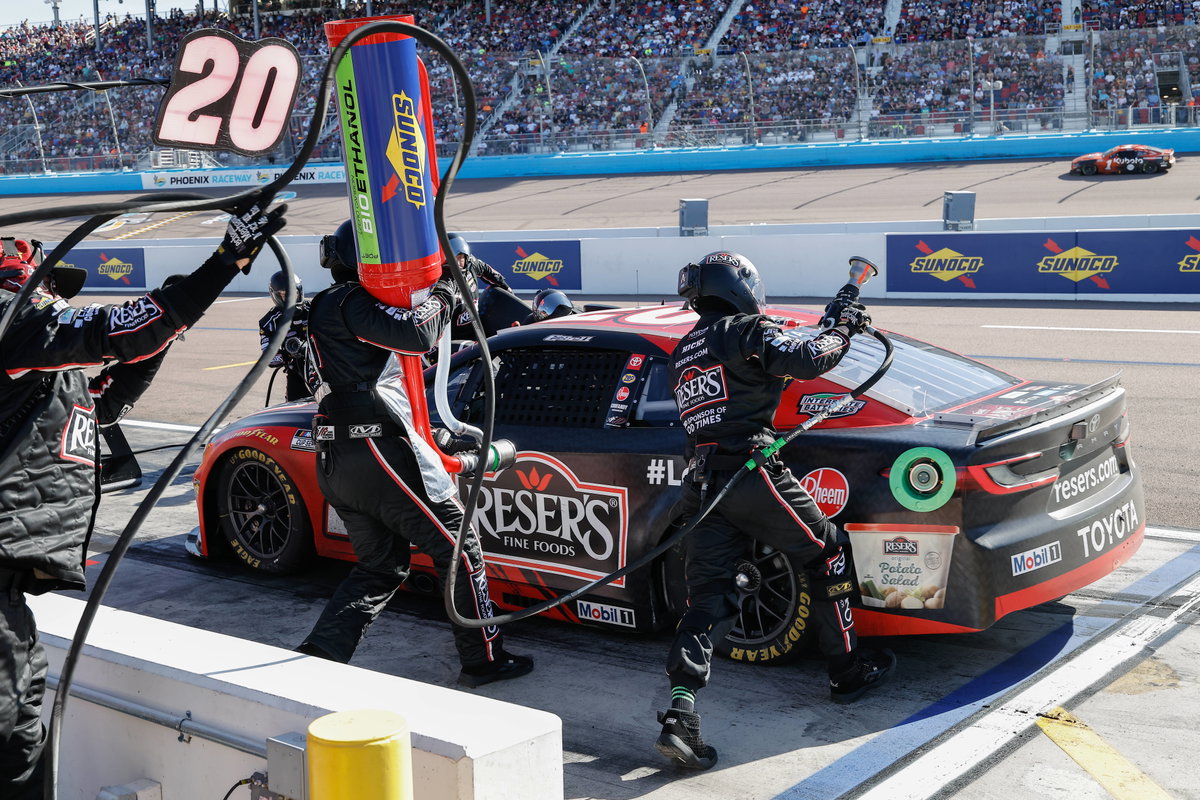
Say “crew member” to a new fan, and they picture a mechanic in a team shirt. In NASCAR that phrase covers very different jobs. The road crew includes the crew chief, the car chief, engineers, mechanics and tuners. The pit crew is its own group of five who go over the wall. Those five are the front tire changer, rear tire changer, tire carrier, jackman and fueler. NASCAR’s roster rules treat the crew chief as separate from them.
Those five are now recruited like college athletes. Rick Hendrick has described how the over-the-wall crew in 1984, when he started his organization, were ordinary shop employees. Today Hendrick Motorsports runs a 35,000-square-foot Atrium Health Motorsports Athletic Center built for performance and crew development. In June, 52 prospects came to a one-day combine. Only a few got offers after more testing and a minicamp, and Hendrick keeps a database of more than 200 potential athletes.
Most recruits played football, though some come from wrestling, baseball, soccer, basketball and swimming. Hendrick has documented former college football players working as jackmen and fuelers. That is why Forde’s remark at Bristol are worth a second look. He said many crew members are Division I athletes, and some were playing football as recently as last year. He was describing the hiring pipeline as it exists, with no exaggeration.
This does not make them dangerous people. The same training that builds strength also builds discipline and teamwork. The point is narrower. Teams select these athletes for explosive movement, so a decision to get physical from one of them means more than it did when pit crews were guys from the shop.
There is another angle to it. Hendrick’s head pit coach, Jacob Claborn, runs a department that supplies crews for more than Hendrick’s four Cup cars, including Spire Motorsports entries. Each week, Claborn and a car’s crew chief set that car’s lineup together.
Team Penske works differently. After eight races, Blaney’s No. 12 had lost 88 positions on pit road, 31 more than any other team. Blaney and Hassler took it to Travis Geisler, Penske’s vice president of competition, and the lineup changed.
So when a crew member crosses a line, the question of who answers for him has no single answer. It could be the pit coach, the crew chief, or someone in competition. NASCAR has faced that puzzle before, and how it handled it says a lot.
NASCAR has done this before
If you think Bristol was NASCAR inventing rules as it went, look at Texas Motor Speedway in November 2014. Jeff Gordon confronted Brad Keselowski after contact on the track, and Kevin Harvick shoved Keselowski into the mix. Crew members piled in, and it became a full pit-road brawl. NASCAR did not punish Gordon, Harvick or Keselowski. It went after the crews.
Jeremy Fuller, Dwayne Doucette and Jason Ingle each got a $25,000 fine and a six-race suspension. Dean Mozingo received $10,000 and a three-race suspension. The crew chiefs paid as well. Alan Gustafson and Kenny Francis were each fined $50,000 and put on six-race probation. NASCAR cited its rule that the “Crew chief assumes responsibility for the actions of his team members.” Robin Pemberton said the crew members crossed the line by punching people, which put others in harm’s way.
Three years later, NASCAR filled in the other half of the picture. After Kyle Busch and Joey Logano fought at Las Vegas Motor Speedway in 2017, O’Donnell said NASCAR wanted to leave it to the drivers. He also said a crew member should not start a fight with a driver. But if a driver walks into another team’s pit area and attacks someone, the crew has a fair reason to step in.
That same season produced a strange case at Indianapolis Motor Speedway. Martin Truex Jr. and Busch crashed while racing for the lead. Two of Truex’s tire changers, Chris Taylor and Lee Cunningham, got into a heated confrontation with Busch’s crew chief, Adam Stevens. Joe Gibbs Racing suspended both for three races.
The odd part is who employed them. Truex drove for Furniture Row Racing, but those pit crew members worked for Joe Gibbs Racing under a technical alliance. On Aug. 16, 2017, Joe Gibbs Racing announced it was moving management of the No. 77 and No. 78 pit crews to Furniture Row Racing. Truex was unhappy, because the two were among his best pit-road performers. A driver who did nothing wrong had to race with substitutes.
In 2019 at Martinsville Speedway, Logano put a hand on Hamlin after a late-race incident. A Team Penske tire technician, Dave Nichols Jr., grabbed Hamlin by the back of his firesuit and pulled him to the ground. NASCAR suspended Nichols for one race. O’Donnell said the move went beyond breaking up a fight and became an aggressive act. That is almost the same question Bristol asked seven years later.
The most recent Cup example came at the 2024 All-Star Race at North Wilkesboro Speedway. Ricky Stenhouse Jr. punched Busch after a wreck, and the fight spread to both teams. NASCAR fined Stenhouse $75,000. It also suspended No. 47 mechanic Clint Myrick for eight Cup Series races and tuner Keith Matthews for four. Stenhouse’s father, Richard Stenhouse, was suspended indefinitely under the Member Code of Conduct. Elton Sawyer, NASCAR’s senior vice president of competition, said the sport reacts when crew members or family members put hands on drivers. Busch and his team were not penalized.
The same thinking reaches the lower levels. After a Late Model Stock Car qualifying race at Martinsville in September 2023, NASCAR fined Magnum Tate and Connor Hall $500 each and suspended both until they paid. Zachary Bruenger, a crew member for Hall, was fined $1,000. He was suspended until he finished NASCAR-approved anger-management training and then placed on one-year probation. NASCAR labeled it a member-to-member confrontation involving physical violence.
Crews also do not need a driver to start things. At Sonoma Raceway in July 2025, Ty Gibbs’ No. 54 Toyota nearly clipped the tire carrier on Keselowski’s No. 6 Ford during a green-flag stop. Two RFK Racing crew members and three Joe Gibbs Racing crew members ended up shoving each other before officials broke it up. No driver feud was involved at all.
Trouble can follow people off the track as well. After a Nationwide Series race at Richmond Raceway in 2013, two Richard Childress Racing crew members got into a physical encounter with Nelson Piquet Jr. and a friend in the motorcoach lot. Both were arrested and charged with misdemeanor assault. NASCAR suspended each for four races and fined them $15,000, though an appeals panel later reduced those penalties.
The criminal case and the racing penalties ran on separate tracks. With that history in mind, what happened one week after Bristol makes a lot more sense.
Martinsville, seven days later
The ValleyStar Credit Union 300 at Martinsville Speedway on Sept. 26 was a regional NASCAR series race. It still produced the best evidence in this whole story. Corey Heim and Treyten Lapcevich fought for second late in the race. Caden Kvapil won, and Heim beat Lapcevich for second by 0.072 seconds. That should have been the end of it.
It was not. On the cooldown lap, the two touched again in Turn 1. Heim’s No. 22 went over the front of Lapcevich’s No. 77, and both cars were badly damaged. Lapcevich climbed out and headed toward Heim, and his team owner, Chad Bryant, stopped him. For a moment, the team did what NASCAR would want. It acted as the brake.
That restraint did not last. Later, Heim was walking back to his hauler near the Martinsville hot dog stand when multiple members of the Chad Bryant Racing group confronted him. Video showed it turning physical. A dispute between two drivers had become a group of people from one team going after a driver from another.
NASCAR announced its penalties on Sept. 29. Bryant received a $2,000 fine and an indefinite suspension. He is also suspended from the 2027 ValleyStar Credit Union 300, on probation for a year, and required to complete NASCAR-approved anger-management training. Steven Civitarese was fined $1,000 and suspended indefinitely, and he is out of the 2027 race and on probation for a year too. Ryden Lapcevich was fined $500 and placed on probation through Dec. 31, 2027. All three were cited under Sections 12-6.1C and 12-6.1C2, which cover member conduct and physical violence between members.
Look at who got punished. A team owner and two other members of the organization took the hit, and the pattern from Texas in 2014 held up in Virginia in 2026. The Heim case also exposes the limits of the “just protecting my guy” argument. Once the drivers were apart, nobody needed protecting. The confrontation had moved away from the cars to a food stand with fans and vendors nearby.
The same weekend brought a second fight. After the second heat race, Brad Housewright and Chase Burrow clashed after contact on the track. Crews got involved first, and then the drivers traded punches. NASCAR penalized four people under the same physical-violence provisions. Dylan Jenks and Ryan Burrow each received $500 and probation through Dec. 31, 2027. Housewright and Chase Burrow each received $250 and the same probation.
Put Bristol and Martinsville side by side and the contrast is clear. At Bristol, NASCAR judged the crew members as separating. At Martinsville, it judged the team members as fighting. That difference matters even more once you consider where these things happen.
Pit road was never a safe place to begin with
A fight on pit road does not happen in an empty parking lot. Cars enter and leave stalls while crew members move around them with tires, jacks and fuel equipment. Officials, photographers, TV crews and security stand close by. NASCAR’s rules define a safety violation as an action or omission that creates an unsafe environment or threatens the safety of competitors or others. Those rules also limit who can cross the wall and how tires and equipment are handled.
A brawl wrecks that order in seconds. The whole system depends on people knowing where to stand and when to move. The injuries in a normal race are already real. A peer-reviewed study covering 2003 to 2014 looked at 226 NASCAR team members treated for upper-extremity injuries at one medical institution. Among race and practice injuries, pit changers made up the largest share. The equipment weights in that study come from that era, so they should not be read as current numbers.
Recent incidents make the point better than any study. In 2020 at Indianapolis, Team Penske tire changer Zach Price was squeezed between cars and taken to a hospital. He was later released. At the 2022 Coca-Cola 600, Hamlin’s car clipped Penske tire changer Tanner Andrews, who finished the stop with a sprained MCL. Hamlin later watched the video and admitted he cut into the box too far.
That episode had a twist. Logano argued that crews sometimes swing wider than needed to make it harder for a rival to enter a stall. Hamlin acknowledged that it happens. So drivers and crews both create risk for each other. At Phoenix Raceway in 2022, RFK Racing tire carrier Justin Edgell was hit during a stop and went to a hospital before being released. In 2023 at World Wide Technology Raceway, Legacy Motor Club front tire changer Thomas Hatcher tangled with another crew member and fell. He was taken to the hospital, released that night and entered the concussion protocol.
The closest example came this month. On Sept. 12 at Gateway, a pit-road pileup in the O’Reilly Auto Parts Series race sent a car into an active stall. Joe Gibbs Racing’s Bryan Backus was hit while servicing Brent Crews’ No. 19, and a nearby tire carrier had his tire knocked loose. Backus said that if the car had been about a foot closer to the carrier, the result could have been far worse. That was two weeks before Martinsville.
Crew members are not only the risk, though. In May, a Spire Motorsports pit box reportedly broke loose at Dover Motor Speedway and rolled toward people on pit road. A pit-crew athlete stepped in to protect FOX Sports reporter Amanda Busick. That is why NASCAR cannot simply say crew members should never touch anyone. Sometimes a crew member stepping in is exactly the safe move.
NASCAR also already holds crew members personally accountable when their work creates danger. At Circuit of the Americas in March, Ross Chastain’s No. 1 Trackhouse Racing Chevrolet lost a right-rear wheel. NASCAR suspended jackman Josh Appleby and rear tire changer Kenneth Pozega for two races. At New Hampshire Motor Speedway, a loose wheel contributed to William Byron hitting the wall. His rear changer Orane Ossowski and jackman Allen Holman were suspended for two races, and Hendrick moved jackman Dax Hollifield and rear changer Rod Cox over from Alex Bowman’s crew to fill the gap.
Blaney’s own team went through it in 2022 at Bristol, when the No. 12 lost a wheel. NASCAR suspended crew chief Hassler, rear tire changer Zachary Price and jackman Graham Stoddard for four races. If NASCAR holds a person responsible for a loose wheel, it is not a stretch to hold him responsible for his hands. Punishment from NASCAR is only one of the systems that can come into play.
Courts, contracts and logos
A NASCAR suspension is a sporting penalty, and it does not settle what a team does with an employee. Michael Waltrip Racing showed that in 2013. NASCAR suspended Truex’s front tire changer, Eric Maycroft, indefinitely over a substance-abuse violation. The team then fired him under its zero-tolerance policy. NASCAR and the employer were two separate systems, and each acted on its own.
A third layer arrives if someone gets hurt. Ordinary law can step in, and that means state law, not NASCAR’s rulebook, so the answers vary by place. Employers can be liable for what employees do within the scope of their jobs. Intentional assaults are often treated differently, because they can fall outside that scope.
Other claims focus on the employer’s own choices. Negligent hiring asks whether the employer should have found a dangerous history before hiring someone. Negligent retention asks whether the employer kept a person in the job after learning of dangerous behavior. Negligent supervision asks whether the employer reasonably controlled the worker. Repeated incidents change the picture, because one assault does not prove carelessness, but an employer who knew of earlier fights and did nothing faces a tougher question about foreseeability.
OSHA is where writers tend to overreach, so a caution is in order. Federal OSHA has no specific workplace-violence standard. It can use the General Duty Clause when an employer exposes its own employees to a recognized hazard likely to cause death or serious harm, and a feasible fix exists. A fight between two teams does not automatically create an OSHA violation. This is a question for employment and workplace-safety attorneys, who can explain when foreseeable violence creates exposure and how workers’ compensation rules apply if the injured person is another employee.
Sponsors add one more layer. A driver’s feud can be marketed, but a crew member in a branded uniform hitting someone is a different picture. He may not be famous, but the sponsor’s logo is still in the frame. The contracts are private, so nobody outside can say what they require. Morality and reputation clauses are common in sports sponsorship, and NASCAR has its own history. Fruit of the Loom ended its sponsorship of Robby Gordon under a morals clause after his conduct at the track. That case involved a driver, not a crew member. I have found no public sign that any sponsor has threatened to leave over the 2026 incidents.
Where to hypothetically draw the line
NASCAR does not need to ban fighting or build a new discipline system. Its rules already reach crew members, owners and crew chiefs. What it can do is make the line easier to see before a fight begins. The framework rests on intent and conduct, and it leans on what NASCAR has already said.
Driver-to-driver confrontations should stay case by case, which is already NASCAR’s stated policy. A crew member pulling his own driver away should generally be fine, as at Bristol. A crew member restraining the other driver deserves a closer look at whether it was needed to stop the fight or became aggressive. A crew member who strikes someone should trigger an automatic review, though not an automatic penalty. Context still matters, including whether he was defending someone, whether he started it, and whether he kept going after officials stepped in.
Starting a confrontation deserves extra scrutiny, because that crew member was not reacting to an immediate threat. Several crew members surrounding one person is more serious still, since it changes both the power balance and the safety risk. Martinsville is the current example. Anything involving a bystander, official or media member is its own safety issue, and the Gibbs bottle shows why.
Officials have the tools to make these calls, since dozens of cameras cover pit road. The hard part is reading the footage. When six people move toward two drivers in three seconds, someone has to sort out who arrived first and who touched whom. Someone also has to decide whether the contact was defensive. Reviews can answer that afterward, but crews need to understand the standard beforehand.
Perhaps it would be safe to factor in NASCAR’s flexibility on team punishments. The recent penalties target individuals, and no rule punishes a whole team automatically when one crew member fights. NASCAR has penalized crew members, owners, crew chiefs and drivers separately, depending on the rule and the facts. That freedom lets officials match the penalty to what actually happened.
The next scrum
NASCAR did not have to invent a boundary after Bristol, because it has been building one since at least 2014. Crew members can pull people apart, they cannot join the fight, and owners and crew chiefs can answer for what their people do. The Bristol decision and the Martinsville penalties do not contradict each other. Officials looked at different conduct and reached different answers.
The real gap is speed. A fight moves faster than any review, and a crew member has a few seconds to decide whether he is protecting a teammate or joining a brawl. NASCAR can let drivers be angry, let rivalries breathe and tolerate the occasional post-race confrontation. But when a group of employees enters the scene, they bring a job, a team and a sponsor’s logo with them.
Bristol showed NASCAR separating those two situations, and Martinsville showed what happens when the separation fails. So here is what I keep coming back to. The next time a fight breaks out on pit road and five athletes sprint toward it, will each of them know in that split second whether he is ending the fight or starting one?