
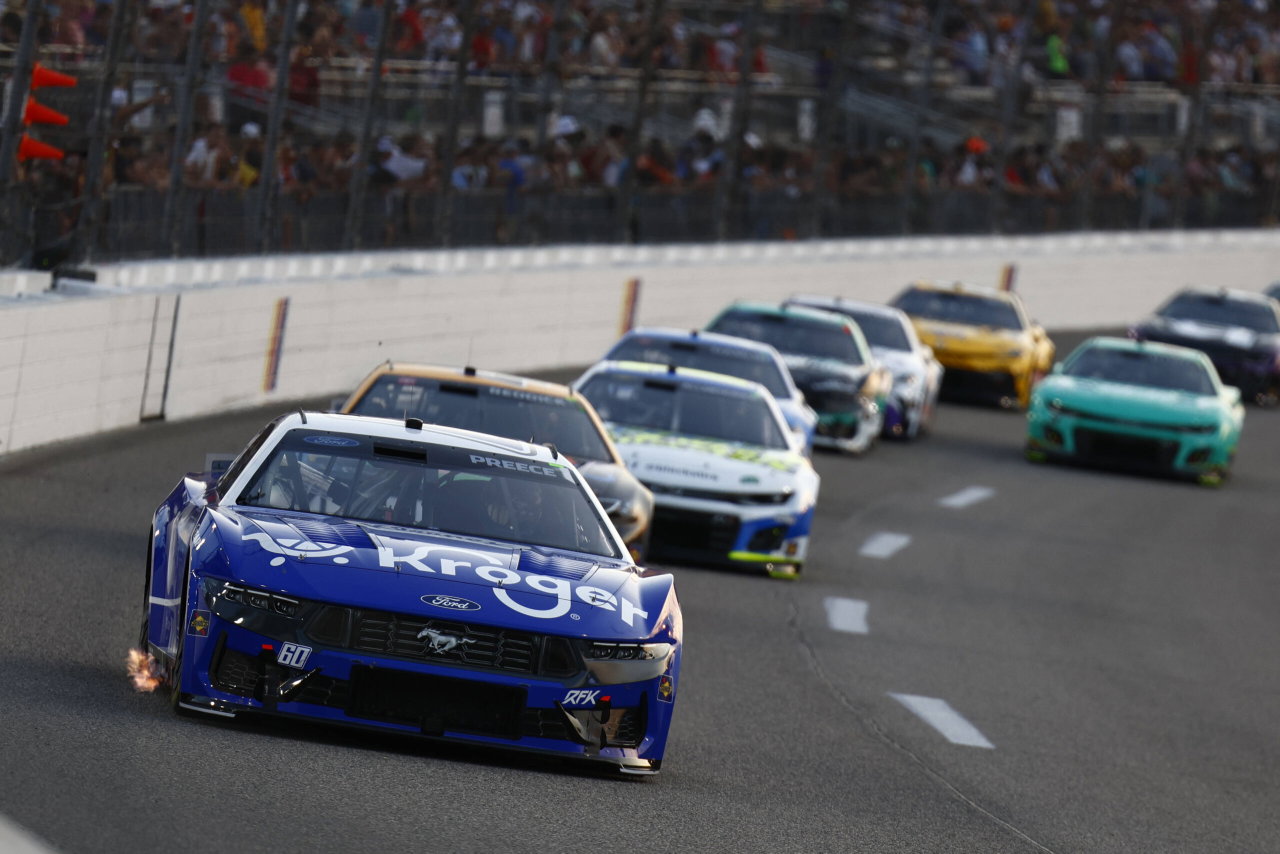
The Martinsville incidents exposed a weakness in NASCAR’s ability to police on-track retaliation in real time. NASCAR Senior Vice President of Competition Elton Sawyer now wants the sanctioning body to improve that process. For years, NASCAR has operated with a ‘Boys, have at it’ philosophy, but with drivers now domesticating and weaponizing the idea, turning it from having no bounds into knowing no bounds, NASCAR has recognized the gap in its officiating process. However, knowing the problem does not solve it, as Sawyer expands on the notions of intent, accuracy of judgment, and speed of intervention.
Watch What’s Trending Now!
During his appearance on the SiriusXM NASCAR Radio Interviews’ November 3 episode, Sawyer explained the difference between Carson Hocevar’s and Josh Berry’s penalties coming out of the Martinsville race weekend, expanded on the softer bumper package NASCAR introduced this year for short-track races, and weighed in on NASCAR’s independent decision versus Spire’s suspension.
Talking about the officiating process and how NASCAR needs to do a better job at intervening during races, Sawyer explained, “The world that we live in today with the amount of data we can pull off the cars and go back and review that, you know, we can make better decisions. The one thing that I would add something that we’re looking at is how we can do a better job, we as NASCAR do a better job and officiate this within the race.”
“Would love to not be talking about this today. Would love to be talking about going to Homestead Miami, to crown, you know, three very deserving champions, whoever they may be, Friday night, Saturday, or Sunday. But unfortunately, we’re talking about this today.”
“But what we really strive is to get it right. And sometimes you have to wait just a little bit to get all the data and get all the information to be able to do that. But I will give our team credit that the NASCAR production facility, Scott Miller and his team, and how we’re starting to be able to process data, and be able to have this information live so we could have made a decision in race. But that’s something for the future, but we’ll work on our side on that.”
Sawyer’s comments came two days after the Hocevar–Cindric and Berry–Blaney brake-checking incidents. Hocevar and Berry were fined $100,000 and $50,000, respectively, and each lost 25 championship points for behavioral violations under Section 4.4a of the NASCAR rulebook. Fans and members of the racing fraternity were disappointed by how long it took NASCAR to act.
Before NASCAR announced its penalties, Spire Motorsports suspended its No. 77 driver for the season finale at Homestead-Miami. Hocevar initially downplayed the incident, saying “we were just having fun,” but later apologized for letting his team and Spire down and vowed to do better. The fraternity appreciated the strict action the team took, but many still questioned what took NASCAR so long.
That’s where Sawyer’s explanation comes in. The NASCAR official revealed how the sanctioning body reviewed every little detail, including data, in-car information, and radio communications. While NASCAR’s goal is to take disciplinary action as quickly as possible, it cannot do so without verifying the driver’s intent and having evidence to back it.
In Hocevar’s case, the data showed four hard-braking instances on the straightaways in front of Team Penske’s Austin Cindric, while his spotter, Tyler Green, could be heard repeatedly telling him to stop over the radio, establishing that the driver indeed brake-checked Cindric on purpose, which eventually earned him the penalty.
Meanwhile, Josh Berry pulled a similar brake-checking move on title contender Ryan Blaney, which ended the Team Penske driver’s title run at Martinsville. The damage to Blaney’s front bumper sent him to the garage to patch up his No. 12 car, and he returned more than 50 laps down to finish 35th, while Berry took the checkered flag in fourth position.
Although Sawyer could justify the delay with verified evidence of intent, he has admitted NASCAR needs faster officiating, with incidents reviewed during the race using evidence that is readily available, instead of extracting tons of data afterward. NASCAR must also stay accurate in its judgment to avoid penalizing an innocent driver over something they were not responsible for.
While NASCAR has faced similar issues in the past, such as Bubba Wallace vs. Kyle Larson at Las Vegas in 2022, where Wallace deliberately turned Larson into the outside wall after contact, and Austin Dillon vs. Joey Logano and Denny Hamlin at Richmond in 2024, where Dillon intentionally took out the other two drivers to win on the final lap, the Xfinity 500 outing in Martinsville 2026 made an important case for why NASCAR needs to draw a line on drivers taking matters into their own hands by ruining their rival’s race.
Martinsville has a reputation for stack-ups and bump-and-run racing, where drivers intentionally move rivals out of the way to make a pass. According to Sawyer, drivers themselves asked for softer bumpers. Some wanted to lessen the impact felt in the cars, and others wanted to discourage divebombing in favor of cleaner passes. NASCAR concluded that Hocevar and Berry used the softer front structure as a weapon, slowing sharply in front of the drivers behind them and damaging their cars.
While drivers often find loopholes to bring out the best strategies on track, twisting new upgrades to intentionally wreak havoc on the field takes it too far. The question is, where does NASCAR draw the line between innovative strategies and dangerous weaponizing of its own new developments against other drivers?
While the disciplinary action has arrived well in time for the next race in Homestead-Miami, the fraternity expects better intervention from NASCAR to avoid promoting recklessness among drivers. And while NASCAR has a fair share of improvements on its to-do list, from working on improving stage one racing, revamping the new softened bumper, and now ensuring penalties and fines are handed out during the race, not after them when the damage is done, the 2027 season will answer just how much NASCAR can fix heading into the new season.