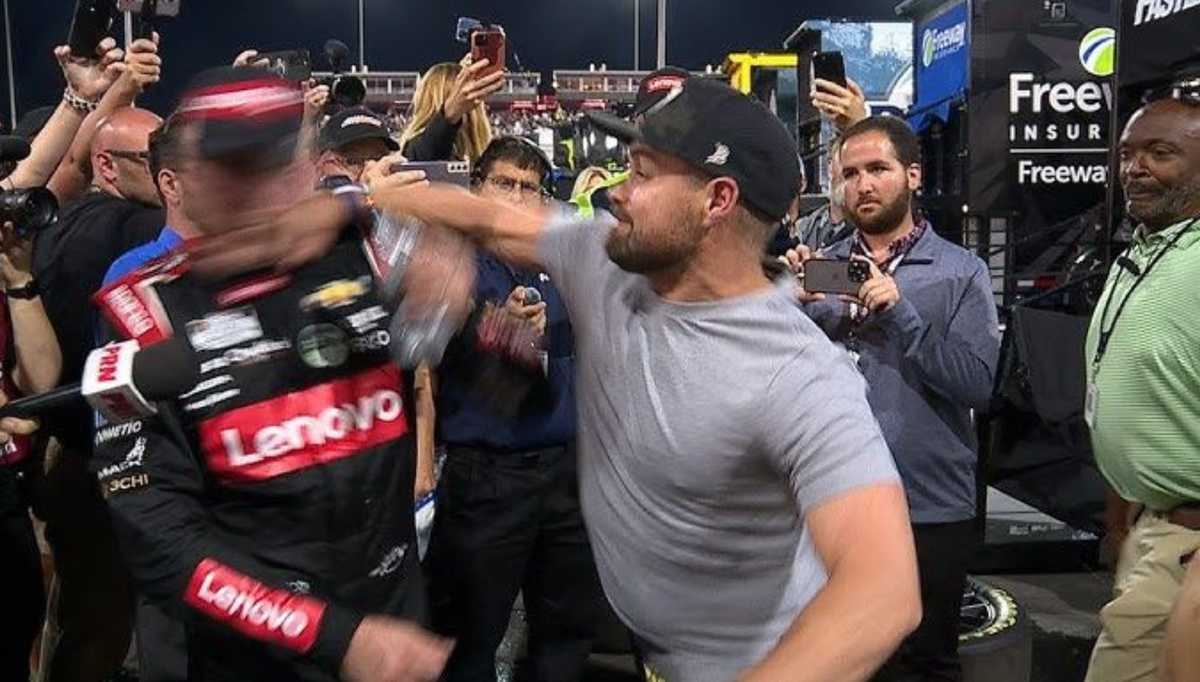
“To punch him and put him on the ground, it was going to cost me $50,000,” was one of the reasons Daniel Suárez gave as to why he avoided a brawl with Ross Chastain at Las Vegas Motor Speedway. “It’s 75k just for the record,” Ricky Stenhouse Jr. chimed in on X, referencing his own fine after a clash with Kyle Busch. And now, Stenhouse is taking things a step further. He is publicly calling out NASCAR’s so-called “protection” narrative as something far less convincing than it sounds.


Ricky Stenhouse Jr. calls out NASCAR’s “Protection” narrative
Watch What’s Trending Now!
“I don’t think it’s protection, in my opinion. I think we all can handle ourselves out there. I mean, we drive race cars at 200 miles an hour. Getting in an altercation after the race is definitely not a concern of mine.”
That blunt take from Ricky Stenhouse Jr. hits at the core of NASCAR’s ongoing balancing act. This was in response to NASCAR executive Brad Moran’s recent statement on the Las Vegas incident involving Chastain and Suárez, “I kid when I say played a lot of hockey, and certain things were allowed, but mainly in hockey games, the boys that are fighting, want to fight, and you have to be cautious of that. These are professional athletes, and we protect our drivers.”
But, how much of NASCAR’s decision is safety, and how much is optics?
To be fair, Stenhouse isn’t completely wrong. NASCAR drivers routinely face far greater risks on track than anything that happens after the checkered flag. At speeds pushing 200 mph, they deal with high-impact crashes, mechanical failures, and split-second decisions that can make or break careers, or worse. Compared to that, a post-race shove or even a brief scuffle might seem minor in the grand scheme of things. But that’s only one side of the story.

Imago
March 13, 2017 – Las Vegas, Nevada, United States of America – March 12, 2017 – Las Vegas, Nevada, USA: Kyle Busch (18) walks away after a confrontation with Joey Logano (22) after the Kobalt 400 at Las Vegas Motor Speedway in Las Vegas, Nevada. NASCAR Motorsport USA 2017: Monster Energy Cup Series Kobalt 400 Mar 12 – ZUMAa161 20170313_zaa_a161_012 Copyright: xWalterxGxArcexSrxAspxIncx
Image Credits: Imago
The other reality is that NASCAR fights can escalate quickly and dangerously. Just look back at the infamous 2017 clash between Kyle Busch and Joey Logano at Las Vegas Motor Speedway. What started as frustration boiled over into a full-blown pit-road brawl, with crew members jumping in and Busch walking away with a bloody forehead. That incident remains a clear example of how quickly things in NASCAR can spiral beyond “just racing emotions.”
And that’s exactly where NASCAR draws its line. As journalist Jeff Gluck pointed out, there’s an unspoken acceptance of pushing and shoving. Yes, there can be heated moments that add drama without crossing into chaos, which can add a layer of entertainment for the fans. But outright fighting? That’s where penalties, fines, and suspensions come into play. And rightly so!
So while Stenhouse may see it as “false protection,” NASCAR sees it as risk management. Both for its drivers and its image.
Daniel Suárez draws the line
While NASCAR continues to debate where to draw the line on physical altercations, Daniel Suárez made it clear that, for him, the real damage from Las Vegas had nothing to do with shoves or post-race tension. In fact, it was personal. Following his run-in with Ross Chastain, Suárez didn’t hold back while speaking on SiriusXM NASCAR Radio.
“The part that, in my opinion, the line that he crossed is the stuff that he said afterwards. That’s low. That’s disrespectful. That’s not okay. Honestly, that’s the part I was the most disappointed. What happened on the racetrack on Monday, on Tuesday, it’s already moved on, and we’re going to the next one. But the stuff that people say, those words, they don’t go away,” he explained.
That distinction matters. For Suárez, racing incidents are part of the job. There’s the occasional contact, frustration, even retaliation. Those moments fade as the schedule rolls on. But words? They linger. Now driving for Spire Motorsports, Suárez emphasized that both he and Chastain have had their fair share of on-track run-ins with others.
That’s just the nature of NASCAR. But what crossed the line for him was the post-race exchange, comments that, in his view, went beyond competition and into disrespect. He even admitted it was “a little bit sad” to see Chastain lose control in that moment, adding that it fundamentally changed how he views him not just as a driver, but as a person.
And that’s the part NASCAR can’t regulate with fines or penalties. You can control the actions to some extent. But the words? Those tend to stick around a lot longer than any $50,000 fine ever could.
