
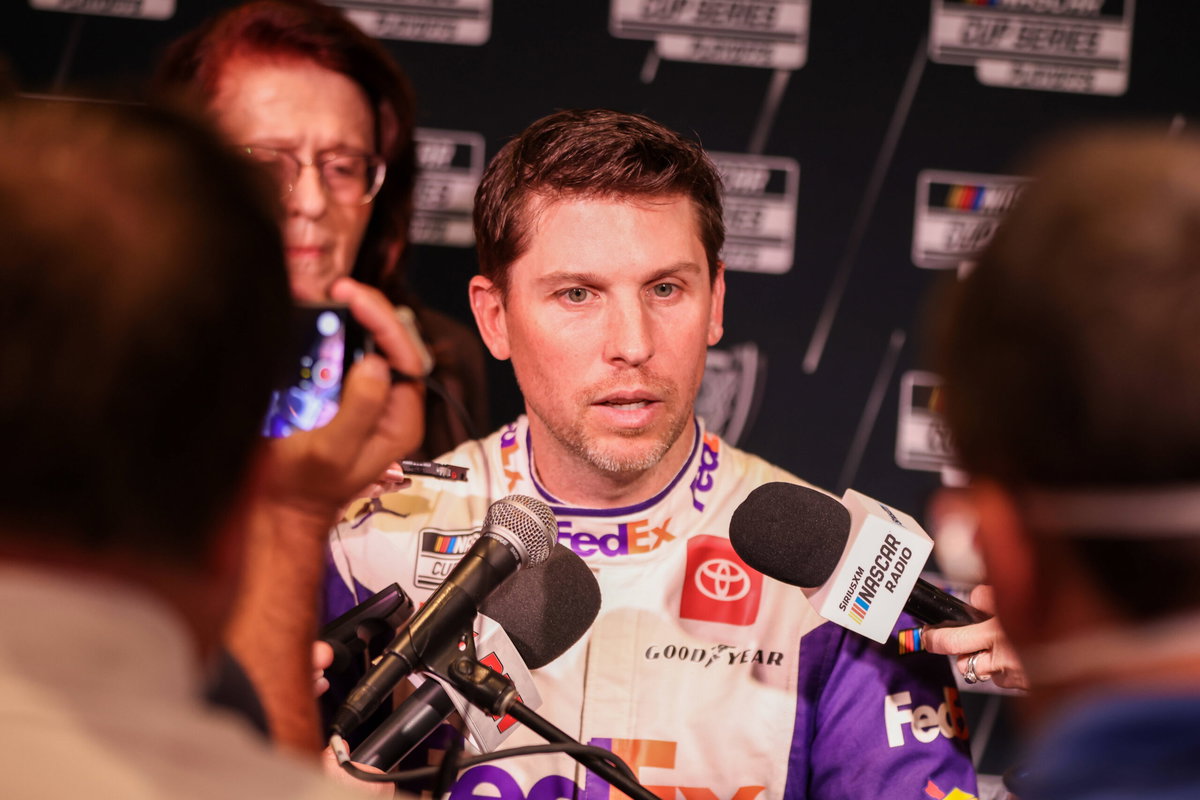
When a veteran like Denny Hamlin sounds the alarm, the garage listens. After a chaotic weekend at World Wide Technology Raceway (Gateway), the championship leader was furious about a glaring track hazard. But his anger wasn’t about the banking, the catch fences, or the race track itself.
Watch What’s Trending Now!
It was about a narrow concrete corridor. Here, unprotected crew members must stand just inches away from the cars going past at over 40 mph. That tiny margin for error vanished this past weekend. At the end of Stage 1 in Saturday’s NASCAR O’Reilly Auto Parts Series race, an 11-car pileup blocked the designated work area. Out-of-control vehicles spun directly toward the mechanics.
Luckily, no one was hurt on Saturday, but the close call put everyone on edge for Sunday’s Cup Series race. Driving through the tight corridor, Hamlin felt he came close to injuring one of his crew members while pitting and said that he would advocate for removing the wall.
“Remove this wall; it’s way too tight. I mean, remember in my opinion is a bad place for them to be pitting. And I just think that even if it’s a temporary wall. I believe they need to knock this pit wall down and move it. Give these pit guys a little bit of room because, I mean, I’m nearly rolling over the ankles of the guy who’s changing tires in front. If we’re too wide, it’s just it’s. This is a dangerous spirit for sure,” the No. 11 driver said to Frontstretch.
While Hamlin came close to hurting a member of his crew as they worked on the right side of the car, he believes there isn’t enough space for pit crews to make stops safely. When changing the right-side tires, pit crew members are almost in the way of cars coming into or out of their pit boxes, making their jobs risky and unsafe to an extent. What happened in the O’Reilly Auto Parts Series race on Saturday was clear proof of that.
The incident saw Rajah Caruth’s car spin sideways, with Nick Sanchez’s car hitting the right rear of Brent Crews’ No. 19 Joe Gibbs Racing Toyota as the crew prepared to change tires. Tire carrier Brad Donaghy saw the fresh tire knocked from his hands in the collision and was lucky to escape without injury. Rear tire changer Bryan Backus and jackman Matt Wilps were also hit by Sanchez’s sliding car but somehow managed to finish the pit stop without getting hurt.
All cars run under the pit-limiter speed, yet when William Sawalich checked up after overshooting his pit box, Caruth had to check up too, and those behind the Junior Motorsports driver didn’t slow down enough. Sanchez’s car came within inches of Brent Crews’ pit crew, and even after watching multiple replays of the incident from every angle, fans will feel like the crew members got lucky.
But luck doesn’t work out every time, which is why Hamlin was calling for the pit wall to be moved ten feet. What that would do is create more than two lines, meaning more room for cars coming in and cars going out of their pit boxes while no crew member is exceedingly close to the pit lane itself.
Also, the issue is somewhat personal for Hamlin. During the 2022 Coca-Cola 600, Hamlin accidentally clipped Joey Logano’s tire changer, Tanner Andrews, while pulling out of his stall. The No. 11 driver later issued an apology to Team Penske and wants to avoid repeating any such mistakes.
NASCAR, in the past, has also suffered because of tight work lanes. In November 1990 at the Atlanta Motor Speedway, a spinning car hit Melling Racing tire changer Mike Rich, tragically killing him.
That incident forced NASCAR to implement a mandatory speed limit in the pit lane to slow the cars down. However, speed is not the thing that can solve the problem. The space is too narrow.
NASCAR can maybe look at Formula 1 when it comes to pit lane safety.
F1 tracks have dedicated fast lanes. Those lanes keep the work area of the pit crew separated from the cars entering the lane. The mechanics in F1 do not jump over a wall to reach the cars. Instead, they wait inside designated boxes in front of the garage. In NASCAR, on tracks like Gateway, crew working with the cars moving past so closely is dangerous.
While the pit wall itself didn’t cause any issues during the Cup Series race, there was another glaring issue at the Gateway: brake rotors burning up and failing.
Zane Smith, Ryan Blaney, Noah Gragson, Chris Buescher, and Chase Elliott were the ones who suffered issues with their brake rotors overheating. While it looks like it was a Ford issue, Elliott’s name — he drives a Chevrolet — in that list makes it clear that it wasn’t just the blue oval that had a problem.
A total of 18 cautions plagued the race at World Wide Technology Raceway, and with several laps spent under caution and under the red flag, Hamlin believes any more cautions would have caused more such failures.
“It was getting hot when they stopped us, and I truthfully think that those red flags would cause more rotors to blow because it’s like a rotor’s heat soak with a car sitting there, no air going through it,” said Hamlin in the same interview. So I was glad they at least got going quick, but stopping didn’t help to break the situation there.”
Hamlin didn’t have a particularly good race, although he finished 9th and picked up 33 points to maintain his position as the Championship leader.
The No. 11 JGR Toyota driver believed that his car wasn’t good, and on pit stops his team was able to help him make the car better for short runs, but those didn’t make any difference during the multiple restarts, and Hamlin believed he got swallowed up and lost positions on every restart.
Hamlin admitted that he felt blessed to still be the Championship leader.
After Larson picked up his first win since Kansas 2025 and 73 points to go with that win, the No. 5 HMS Chevrolet driver is now second in points, just 9 points shy of Denny Hamlin going into Bristol Motor Speedway, a track at which both Larson and Hamlin have enjoyed great success.